Immigrant Healthcare Workers & Canada’s 2025 Recruitment Strategy: What You Need to Know

Canada is in the midst of a profound healthcare crisis, with critical shortages of doctors, nurses, and support staff affecting every province and territory. In response, the federal and provincial governments are launching an unprecedented Health Workforce Recruitment Strategy for 2025—a coordinated plan that will dramatically reshape immigration pathways for international healthcare professionals.

This guide breaks down the key pillars of the 2025 strategy and explains exactly what it means for your plans to immigrate and work in Canada’s healthcare system.

The Crisis Driving the 2025 Strategy: By the Numbers

To understand the strategy, you must first grasp the scale of the need:

  • Over 100,000 nursing vacancies nationwide.
  • 5+ million Canadians without a family doctor.
  • Aging population: By 2030, nearly 25% of Canadians will be over 65, dramatically increasing demand for care.
  • Burnout & Attrition: High stress is driving experienced workers out of the system, worsening shortages.

This isn’t a temporary problem—it’s a structural deficit requiring a massive influx of skilled professionals. This is where you come in.

The 5 Pillars of Canada’s 2025 Health Workforce Recruitment Strategy

The 2025 strategy is not a single program, but a multi-faceted approach. For immigrants, the most impactful pillars are:

Pillar 1: Turbocharged Express Entry for Healthcare Workers

What it is: A significant expansion of Express Entry category-based selection draws specifically for health occupations.

What it means for you:

  • More Frequent Draws: Expect healthcare draws to become the most common category, potentially happening monthly or even bi-weekly.
  • Lower CRS Score Requirements: The CRS cut-off scores for healthcare draws will likely remain low (in the 410-450 range), giving you a massive advantage over candidates in other fields.
  • Broader Occupation List: The list of targeted NOC codes could expand to include more specialized and allied health roles.

Action Item: Ensure your Express Entry profile is active, accurately reflects your healthcare experience, and that you have a valid language test (aim for CLB 9+ to be ultra-competitive).

Pillar 2: Provincial Nominee Program (PNP) “Health-Only” Streams

What it is: Provinces are being funded and encouraged to create or expand dedicated, fast-track PNP streams exclusively for healthcare workers.

What it means for you:

  • Streamlined Applications: Look for new “priority processing” streams for health professionals in provinces like Ontario, British Columbia, and Nova Scotia.
  • Job Offer Focus: Many of these streams will continue to require a provincial job offer, but the process for employers to get a Labour Market Impact Assessment (LMIA) or support your nomination will be simplified.
  • Enhanced Support: Provinces may bundle nomination with settlement services, credentialing loans, and mentorship programs.

Action Item: Research the PNP websites of your target provinces relentlessly. Set up alerts for new healthcare pilot programs.

Pillar 3: The “Licensing First” National Framework

What it is: The biggest historical barrier has been licensing. The 2025 strategy includes a $86 million investment (as part of the Foreign Credential Recognition Program) to streamline licensing for 6 key priority professions, including nursing and physicians.

What it means for you:

  • Faster Credential Recognition: Funding for provincial regulatory bodies to speed up assessment times.
  • Bridging Program Expansion: More government-subsidized “bridging” programs to help you meet Canadian qualification gaps.
  • Supervised Practice Pathways: More opportunities for Internationally Educated Nurses (IENs) and doctors to complete required practice hours under supervision while working and earning.

Action Item: Start your licensing process NOW. Contact the provincial regulatory body (e.g., College of Nurses of Ontario) immediately. This remains the longest step, but new resources are being deployed to accelerate it.

Click Here To Learn More: How to Register With the NMC UK as an International Nurse (Updated 2025)

Pillar 4: Targeted Recruitment in Key Source Countries & Retention

What it is: The government is funding overseas recruitment missions and partnering with organizations like the WHO to directly recruit from select countries.

What it means for you:

  • Pre-Arranged Job Fairs: You may find more opportunities to interview with Canadian health authorities (like Ontario Health or Alberta Health Services) virtually from your home country.
  • Relocation Packages: To attract talent, employers are increasingly offering enhanced packages: signing bonuses, flight reimbursements, temporary housing, and licensing fee coverage.

Action Item: Follow Canadian health authorities and major hospital networks on LinkedIn and their career pages to catch virtual recruitment events.

Pillar 5: Supporting Caregivers & Support Workers

What it is: Recognizing that the healthcare system relies on a full team, the strategy includes support for lower-wage but critical roles like Nurse Aides (NOC 33102) and Licensed Practical Nurses (NOC 32101).

What it means for you:

  • Clearer Pathways for TEER 3 Occupations: Enhanced pathways for these essential workers through both the caregiver pilots and PNPs.
  • Potential for Union Advocacy: Increased recruitment may strengthen the position of unions advocating for better wages and permanent residency pathways for these roles.

What the 2025 Strategy Means for Different Healthcare Professionals

For Internationally Educated Nurses (IENs):

You are the #1 priority. Expect the most aggressive recruitment, the fastest processing, and the most support. The strategy is designed to clear your two main hurdles: licensing (NCLEX and provincial registration) and job placement.

For Physicians:

The pathway remains complex but is being streamlined. The focus is on:

  • Fast-tracking physicians in family medicine and psychiatry.
  • Expanding the Practice Ready Assessment (PRA) pathways for family physicians.
  • Creating more supervised licensure models for specialists.

For Allied Health Professionals (Physiotherapists, Lab Techs, etc.):

Your roles are critical to system capacity. Expect:

  • More of your NOC codes to appear in targeted draws.
  • Increased provincial demand, especially in smaller communities.
  • Pressure on your regulatory colleges to speed up credential recognition.

The Bottom Line: Unprecedented Opportunity with a Caveat

The 2025 strategy represents the most immigrant-friendly healthcare recruitment environment in Canadian history. The government is actively dismantling barriers and creating express lanes for qualified professionals.

However, the core challenge remains: licensing.
The strategy aims to make licensing faster and fairer, but it does not eliminate standards. You must still prove your competency through exams, assessments, and sometimes additional training.

Your 2025 Action Plan: 5 Steps to Seize This Opportunity

  1. Lock in Your Credentials: Immediately begin the process with your provincial regulatory college. This is your bottleneck.
  2. Enter the Express Entry Pool: Create or update your profile today. Even if you’re not fully licensed, being in the pool makes you visible.
  3. Target Provincial Health Authorities: Apply directly to the career pages of Health Authorities (not just individual hospitals). They have the HR departments equipped for international recruitment.
  4. Prepare financially: While costs may be offset, budget for language tests, credential assessments, and exam fees. Explore government loans for licensing support.
  5. Seek Community: Join online forums and associations for internationally educated health professionals in your target province. Peer support is invaluable.

The Canada Health Workforce Recruitment Strategy 2025 is not just policy—it’s a direct invitation. Canada is stating unequivocally that it needs your skills, is willing to reform its systems to welcome you, and is investing significant resources to help you succeed.

For healthcare professionals worldwide, this is your moment. The door is open wider than ever before.

The call is for you. How will you answer?
How to Register With the NMC UK as an International Nurse (Updated 2025)

For internationally trained nurses, registration with the Nursing and Midwifery Council (NMC) is the essential key to practising in the United Kingdom. The process is rigorous but structured, designed to ensure all nurses meet the high standards of care the UK public expects.

This definitive 2025 guide walks you through the updated step-by-step process, including costs, timelines, and tips for a successful application.

An Overview of the NMC Registration Process for International Nurses

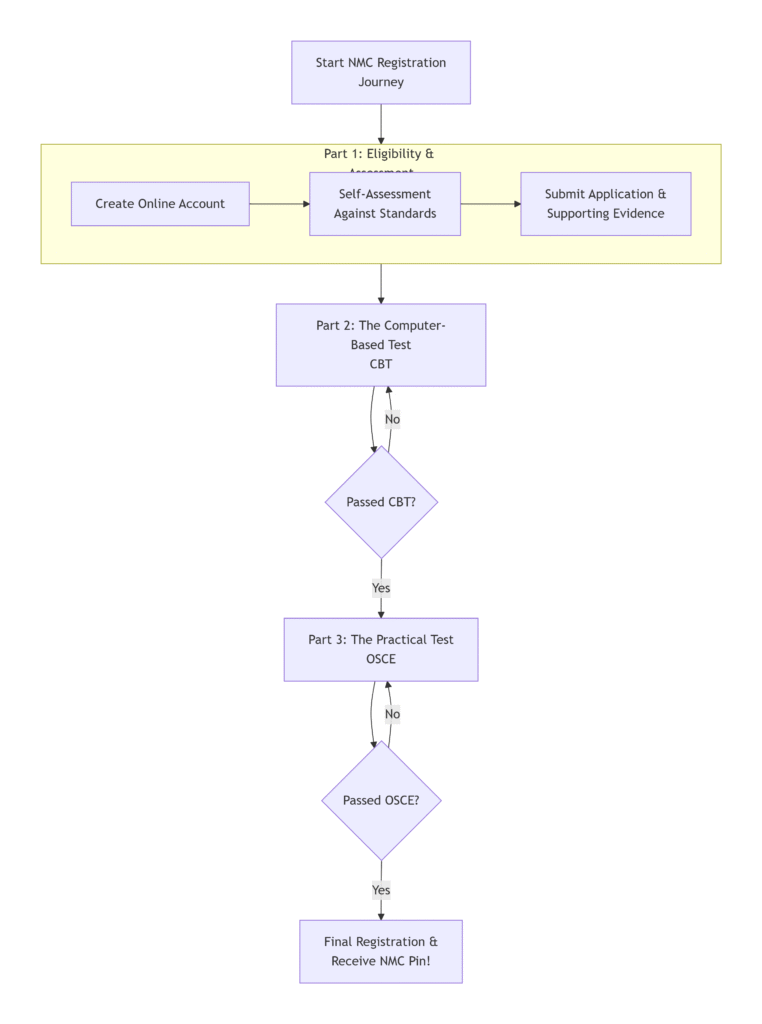
The NMC registration process for nurses trained outside the UK is a multi-stage journey. It can be visualised in three key phases, as shown in the flowchart below:

Part 1: Eligibility and Application (The Paperwork Stage)

Step 1: Check Your Eligibility & Create an NMC Online Account

Before you spend any money, ensure you meet the basic requirements:

  • You must have completed a post-secondary nursing education program of at least 3 years (or 4,600 hours) combining theory and practice.
  • You must be a current, registered nurse in your home country.
  • You must have practised as a nurse for at least 12 months (full-time equivalent) after qualifying.

If you meet these, go to the NMC website and create an NMC Online account. This portal will be your hub for the entire application.

Step 2: Take an English Language Proficiency Test

You must prove your English is safe for practice. You can do this by:

  • IELTS (Academic or OET (Occupational English Test):
    • You need a minimum score of 7.0 in reading, listening, and speaking, and 6.5 in writing for IELTS.
    • For OET, you need at least a Grade B in all four sections.
    • You can combine two test scores if you achieve the required minimum in all four areas across both tests, taken within 6 months.
  • Exemption: You might be exempt if you recently completed a pre-registration nursing or midwifery qualification taught and examined in English in a majority-English speaking country (like the UK, Ireland, Australia, USA).

Step 3: Complete Your Self-Assessment and Submit Application

In your NMC Online account, you will complete a self-assessment of your qualifications and experience against the UK’s standards. You will then formally submit your application and pay the initial assessment fee.

Step 4: Provide Your Supporting Documents via COPA and CAP

This is a crucial administrative step. You must provide:

  • Proof of Identity: A copy of your passport.
  • Proof of Qualification: Your nursing diploma/degree.
  • Registration Verification: Proof of your current registration in your home country.
  • Transcript of Training: A detailed breakdown of your nursing education.

How it works: The NMC uses two portals for this:

  1. COPA (Computer-Based Test of Competence Part A): You enter your personal and training information here.
  2. CAP (Computer-Based Test of Competence Part B): Your nursing education provider (your university/college) must complete this part to verify your training.

Tip: Contact your nursing school early to inform them that they will receive a request from the NMC. Delays here are common.

Part 2: The Computer-Based Test (CBT)

Once your Part 1 application is approved, you can book and take the CBT.

  • What it is: A multiple-choice exam taken at a Pearson VUE test centre in your home country (or another country if more convenient).
  • Content: It tests your theoretical nursing knowledge and your professional judgment. The exam is based on the current UK pre-registration nursing curriculum.
  • Format: 120 multiple-choice questions (90 scored, 30 pilot questions) to be completed in 4 hours.
  • Cost: £83 (as of 2024, check for 2025 updates).

Preparation: Use the official NMC Test of Competence 2021 blueprint to guide your studies. Consider investing in reputable online question banks and preparation courses.

Click Here To Learn More: Best Hospitals in British Columbia Hiring International Healthcare Workers

Part 3: The Objective Structured Clinical Examination (OSCE)

The final hurdle is the OSCE, which you must take in the UK.

  • What it is: A practical exam that simulates real-life clinical scenarios. It tests your clinical skills, decision-making, and patient-centred care.
  • Where: You must take it at an approved UK university test centre.
  • Format: The exam consists of several stations (like a circuit), including:
    • Skill Stations: Demonstrating a clinical skill (e.g., wound dressing, medication administration).
    • Scenario Stations: Managing a patient scenario, testing assessment, planning, and communication.
  • Cost: £794 (as of 2024, check for 2025 updates).

How to Approach it: Most international nurses secure a job with an NHS Trust first. The employer will typically sponsor your visa and pay for your OSCE (often as a salary advance). They will also provide paid OSCE preparation training.

The Complete Cost Breakdown (2025 Estimates)

Fee TypeCost (2024)Estimated 2025 Cost
Initial Application Assessment£140£140 – £150
Computer-Based Test (CBT)£83£83 – £90
Objective Structured Clinical Exam (OSCE)£794£794 – £820
Registration Fee (First Year)£153£153 – £160
Total£1,170~£1,200 – £1,220

Note: These are NMC fees only. Additional costs include English language tests, courier fees for documents, and potential travel/accommodation for exams.

Your 2026 Action Plan: A Step-by-Step Timeline

  1. Months 1-2: Research & Preparation
    • Research the process and costs.
    • Begin studying for your English test (IELTS/OET).
  2. Months 2-4: Application Stage
    • Take and pass your English test.
    • Create your NMC Online account and submit Part 1.
    • Contact your nursing school to prepare them for the CAP request.
  3. Months 4-5: The CBT
    • Upon Part 1 approval, book and pass your CBT.
  4. Months 5-7: Job Search & OSCE
    • Start applying for NHS jobs! With CBT passed, you are highly employable.
    • Secure a job offer and a Certificate of Sponsorship from an NHS Trust.
    • Apply for your UK Health and Care Worker visa.
    • Move to the UK and undergo OSCE training provided by your employer.
    • Take and pass the OSCE.
  5. Final Step: Full NMC Registration
    • After passing the OSCE, the NMC will confirm your registration and issue your PIN (Personal Identification Number).
    • You can now practice without supervision as a Registered Nurse in the UK.

Common Pitfalls to Avoid

  • Underestimating the English Test: The required scores are strict. Prepare thoroughly.
  • Delaying Contact with Your Nursing School: The CAP verification can take time. Alert your school early.
  • Poor OSCE Preparation: The OSCE is challenging. Take full advantage of the training your NHS employer provides.
  • Misunderstanding Costs: Budget for all fees and potential retakes.

Your NMC Registration Checklist

  • Researched the entire NMC process and associated costs.
  • Booked and passed an IELTS or OET exam.
  • Created an NMC Online account and started the application.
  • Contacted my nursing school to inform them of the upcoming CAP request.
  • Prepared for and passed the Computer-Based Test (CBT).
  • Secured a job offer with an NHS Trust.
  • Applied for my UK visa and relocated.
  • Completed OSCE training and passed the OSCE.
  • Received my NMC PIN and started practising!

The path to NMC registration is a marathon, not a sprint. However, with careful planning, dedication, and the support of a future NHS employer, you can successfully navigate this process and embark on an incredibly rewarding nursing career in the United Kingdom.

Your skills are needed in the UK. Start your NMC journey today!

Best Hospitals in British Columbia Hiring International Healthcare Workers

British Columbia’s stunning landscapes and high quality of life make it a top destination for healthcare professionals worldwide. Fortunately, the province’s health authorities are actively recruiting internationally educated nurses, doctors, and allied health staff to meet growing demand.

This guide covers the top hospitals and health authorities in BC hiring international workers, detailing their recruitment programs and how you can apply.

Why Work for a BC Health Authority?

Before we dive into specific employers, it’s important to understand the structure. In BC, most hospital jobs are managed through regional Health Authorities rather than individual hospitals. This means you apply to the health authority and may be placed at any of their facilities.

Benefits include:

  • Comprehensive Sponsorship: Most health authorities provide extensive support with immigration, licensing, and relocation.
  • Structured Onboarding: Dedicated international recruitment teams guide you through the process.
  • Career Mobility: Opportunities to transfer between different hospitals and communities within the same health authority.
  • Competitive Benefits: Government pensions, union representation, and professional development opportunities.

Top Health Authorities & Hospitals Hiring International Workers

1. Vancouver Coastal Health (VCH)

Regions Served: Vancouver, Richmond, North Shore, Sea-to-Sky, Sunshine Coast, Bella Bella, and Bella Coola.

Major Hospitals:

  • Vancouver General Hospital
  • Lions Gate Hospital (North Vancouver)
  • Richmond Hospital
  • UBC Hospital

Why They’re a Top Employer:
VCH manages some of BC’s largest tertiary care and teaching hospitals. They offer:

  • Dedicated International Recruitment Team
  • Comprehensive relocation support (including registration fees, flight, and temporary housing)
  • Structured orientation and mentorship programs
  • Opportunities across urban and coastal communities

How to Apply: Visit the VCH Careers website and search for positions marked “International Hires” or filter by your profession.

2. Fraser Health Authority

Regions Served: From Burnaby to Hope, covering the eastern metro Vancouver area and Fraser Valley.

Major Hospitals:

  • Royal Columbian Hospital (New Westminster)
  • Surrey Memorial Hospital
  • Burnaby Hospital
  • Abbotsford Regional Hospital

Why They’re a Top Employer:
Fraser Health serves BC’s fastest-growing population and has extensive experience with international recruitment:

  • Established International Recruitment Program
  • Financial support for licensing and immigration fees
  • Temporary housing assistance
  • Active in recruiting for both urban and suburban locations

How to Apply: Check the Fraser Health Careers page regularly for international hiring initiatives.

3. Providence Health Care

Focus: Specialized care in Vancouver, particularly in academic and research environments.

Major Hospitals:

  • St. Paul’s Hospital (moving to new state-of-the-art facility in 2025)
  • Mount Saint Joseph Hospital

Why They’re a Top Employer:
Providence offers unique opportunities in specialized care:

  • Academic and research-focused environment
  • Strong partnerships with the University of British Columbia
  • Specialized recruitment for mental health, renal care, and urban health
  • Comprehensive relocation package

How to Apply: Visit the Providence Health Care Careers website.

4. Island Health

Regions Served: All of Vancouver Island, the Gulf Islands, and some mainland communities.

Major Hospitals:

  • Royal Jubilee Hospital (Victoria)
  • Victoria General Hospital
  • Nanaimo Regional General Hospital

Why They’re a Top Employer:
Island Health offers the perfect blend of professional opportunity and island lifestyle:

  • Dedicated International Hiring Program
  • Relocation assistance and settlement support
  • Opportunities in vibrant cities and coastal communities
  • Strong focus on work-life balance

How to Apply: Explore the Island Health Careers portal and look for international recruitment events.

Click Here To Learn More: The PEI PNP Healthcare Pathways: Your 2025 Complete Guide

5. Interior Health

Regions Served: The interior region of BC, including the Okanagan Valley and Kootenays.

Major Hospitals:

  • Kelowna General Hospital
  • Royal Inland Hospital (Kamloops)

Why They’re a Top Employer:
Interior Health combines growing career opportunities with affordable living and four-season recreation:

  • Active international recruitment program
  • Support with BC College of Nurses and Midwives registration
  • Relocation assistance available
  • Growing healthcare infrastructure with new facilities

How to Apply: Visit the Interior Health Careers website.

6. Northern Health

Regions Served: Northern BC, including Prince George and rural/remote communities.

Major Hospitals:

  • University Hospital of Northern BC (Prince George)
  • Mills Memorial Hospital (Terrace – new facility opening 2025)

Why They’re a Top Employer:
Northern Health offers unique incentives for those willing to work in northern communities:

  • Northern and Rural Recruitment and Retention Bonus
  • Comprehensive relocation packages
  • Opportunities for a broader scope of practice
  • Strong community connections and support

How to Apply: Check the Northern Health Careers page for current international openings.

Your 5-Step Action Plan to Get Hired

Step 1: Get Your Credentials in Order

  • Nurses: Start your registration with the BC College of Nurses and Midwives (BCCNM) immediately.
  • Doctors: Begin the process with the College of Physicians and Surgeons of BC (CPSBC).
  • Allied Health: Contact your specific provincial regulatory body.

Step 2: Prepare Your Application Documents

  • Canadian-style resume (2 pages maximum)
  • Cover letter tailored to each health authority
  • Reference letters from previous employers
  • Copies of credentials and certifications

Step 3: Apply Strategically

  • Apply directly to the health authority career portals listed above
  • Use keywords like “international,” “new graduate,” or “sponsorship available.”
  • Create job alerts for your specific profession

Step 4: Prepare for the Interview

  • Research the specific health authority and community
  • Be ready to discuss your commitment to working in BC
  • Prepare examples of your clinical experience
  • Practice virtual interview skills (most initial interviews are online)

Step 5: Understand the Immigration Process

Most health authorities will guide you through:

  • BC Provincial Nominee Program (BC PNP) application
  • Work permit processing
  • Temporary to Permanent Residence transition

Key Benefits Typically Offered

  • Relocation assistance (up to $10,000+ in some cases)
  • Temporary housing (30-90 days)
  • Licensing fee reimbursement
  • Immigration lawyer support
  • Mentorship programs
  • Signing bonuses (in high-need areas)

Pro Tips for Success in 2025

  1. Start Early: The licensing process can take 6-12 months. Begin before you apply for jobs.
  2. Be Flexible: Consider positions in regional or northern locations for faster hiring and additional incentives.
  3. Use Health Match BC: This free provincial service helps internationally educated health professionals with job matching and settlement support.
  4. Network: Connect with current international staff at BC hospitals on LinkedIn to learn about their experiences.

Your BC Hospital Job Search Checklist

  • Initiated my BCCNM/CPSBC registration process
  • Created profiles on all major BC health authority career sites
  • Prepared my Canadian-style resume and cover letter
  • Set up job alerts for my profession
  • Researched BC communities to identify my preferred locations
  • Joined relevant professional groups on social media

The demand for healthcare professionals in British Columbia has never been higher. By targeting these major health authorities and preparing a strong application, you can successfully launch your Canadian healthcare career in one of the world’s most beautiful locations.

Your skills are needed in British Columbia. Start your application today!

The PEI PNP Healthcare Pathways: Your 2025 Complete Guide

Known for its stunning coastline, vibrant communities, and high quality of life, Prince Edward Island (PEI) is actively seeking healthcare professionals to join its team. The Prince Edward Island Provincial Nominee Program (PEI PNP) offers dedicated streams that can fast-track doctors, nurses, and allied health workers to Canadian permanent residence.

This complete 2025 guide breaks down the step-by-step process for securing a job, obtaining a provincial nomination, and achieving your PR goals through PEI’s healthcare pathways.

Why Choose Prince Edward Island for Your Healthcare Career?

While small in size, PEI offers big opportunities for healthcare professionals:

  • High Demand: Significant need for healthcare workers across the island.
  • Streamlined Process: PEI has a reputation for a responsive and straightforward PNP process.
  • Community Focus: Experience a strong sense of community and a better work-life balance.
  • Natural Beauty: Enjoy a stunning coastal lifestyle with outdoor activities year-round.

Understanding PEI PNP Healthcare Pathways

PEI prioritizes healthcare workers through its Express Entry and Critical Worker streams. The pathway you take depends on your qualifications and job offer.

1. Express Entry Linked Stream (For Skilled Healthcare Workers)

This is the primary pathway for skilled professionals like Registered Nurses, Physicians, and Allied Health staff.

  • Eligibility Requirements:
    • Have an active profile in the federal Express Entry system.
    • Have a genuine, full-time job offer from a PEI employer in a skilled occupation (NOC TEER 0, 1, 2, or 3).
    • Meet the minimum qualifications for the job.
    • Possess a valid work permit (or have legal status in Canada) at the time of application.
    • Demonstrate sufficient settlement funds.
    • Demonstrate the intent and ability to settle in PEI.
  • How it Works:
    1. You secure a job offer from a PEI healthcare employer (e.g., Health PEI).
    2. You submit an Expression of Interest (EOI) to the PEI PNP office.
    3. If selected, you receive an invitation to apply for a provincial nomination.
    4. Upon nomination, you receive 600 additional Comprehensive Ranking System (CRS) points, guaranteeing you an Invitation to Apply (ITA) for permanent residence from the federal government.

2. Critical Worker Stream (For Support Healthcare Roles)

This stream is designed for positions at NOC TEER 4 or 5 levels, which can include certain Healthcare Support roles.

  • Eligibility Requirements:
    • Have a full-time, non-seasonal job offer from a PEI employer in a critical sector (including healthcare).
    • Have worked for the PEI employer for at least 6 months on a valid work permit.
    • Possess a valid work permit and legal status in Canada.
    • Have a high school diploma or equivalent.
    • Be between 18 and 59 years old.
    • Demonstrate the intent and ability to settle in PEI.
  • How it Works:
    1. You come to PEI on a temporary work permit for an eligible healthcare support job.
    2. You work for the same employer for a minimum of 6 months.
    3. Your employer supports your application for provincial nomination.
    4. Once nominated, you apply for permanent residence through a non-Express Entry (paper-based) process.

Click Here To Learn More: 2025 Complete Canada Healthcare NOC Codes List for Express Entry & PNPs

Step-by-Step Guide: From Job Search to PR

Step 1: Secure Your Professional Licensing (First & Most Important)

You cannot work in a regulated health profession in PEI without a license from the provincial regulatory body.

  • For Nurses: College of Registered Nurses and Nurses of Prince Edward Island (CRNPPEI) or the College of Licensed Practical Nurses of Prince Edward Island (CLPNPEI).
  • For Physicians: College of Physicians and Surgeons of Prince Edward Island (CPSPEI).
  • Action: Contact the relevant body immediately to start the credential recognition process, as it can take many months.

Step 2: Find a Job with a PEI Healthcare Employer

This is your key to the PEI PNP. The primary employer for clinical roles is Health PEI.

  • Where to Look for Jobs:
    • Health PEI Careers Page: The official site for most clinical and nursing jobs.
    • Prince Edward Island Government Jobs: For public health and administrative roles.
    • Indeed.ca & LinkedIn: Set alerts for “Healthcare” jobs in “Prince Edward Island.”
  • Pro Tip: In your cover letter and interviews, clearly state your intention to settle permanently in PEI and your willingness to go through the PEI PNP process.

Step 3: Obtain a Valid Job Offer

Your job offer must be:

  • Full-time (minimum 30 hours per week).
  • Permanent (no end date).
  • From an employer registered and in good standing with the PEI PNP office.
  • In an eligible NOC TEER category.

Step 4: Submit an Expression of Interest (EOI) to the PEI PNP

Once you have a job offer, create an EOI profile on the PEI PNP portal. You will be ranked based on factors like:

  • Employment in PEI
  • Official language ability
  • Education level
  • Work experience
  • Age

Step 5: Receive an Invitation and Apply for Nomination

PEI holds regular draws from the EOI pool. If you receive an Invitation to Apply, you will have a limited time to submit a complete application with all supporting documents.

Step 6: Receive Nomination and Apply for Permanent Residence

  • If you are in the Express Entry stream: You will accept the nomination in your IRCC account and receive your ITA shortly after.
  • If you are in the Critical Worker stream: You will use your nomination certificate to apply for PR via a paper-based application to IRCC.

Processing Times & Fees

  • PEI PNP Processing: Several weeks to a few months after submitting a complete application.
  • Federal PR Processing (after nomination):
    • Express Entry: ~6 months
    • Paper-based (Critical Worker): ~12-18 months
  • Fees:
    • PEI PNP Application: $300
    • Federal PR Application: $1,365 per principal applicant

Common Pitfalls to Avoid

  1. Skipping the Licensing Step: You cannot be hired for a regulated profession without starting the licensing process. This is the most common delay.
  2. Not Researching the Employer: Ensure your potential employer is familiar with and willing to support the PNP process.
  3. Weak Ties to PEI: In your application, you must convincingly demonstrate your intent to live and work in PEI long-term. Research the island and be prepared to discuss why you want to settle there.
  4. Incomplete Application: The PEI PNP office is strict about documentation. Ensure every required form and supporting letter is included.

Why PEI is a Strategic Choice in 2025

PEI may not have the volume of jobs of larger provinces, but it offers a targeted and supportive environment for healthcare workers. The province has a clear need and a streamlined system to bring in the talent it requires, making it an excellent option for those seeking a community-focused lifestyle.

Your PEI Healthcare Pathway Checklist

  • Researched and contacted my PEI regulatory body to start licensing.
  • Updated my CV and cover letter for the Canadian/PEI job market.
  • Created job alerts on Health PEI and other job boards.
  • Prepared for interviews, emphasizing my commitment to settling in PEI.
  • Created an Express Entry profile (if eligible).
  • Gathered documents for a future PNP application (passports, language tests, ECA, reference letters).

The path to becoming a healthcare professional in Prince Edward Island is clear and achievable. By methodically following these steps—starting with licensing and securing a job—you can successfully navigate the PEI PNP and build a rewarding life in one of Canada’s most beautiful provinces.

Your skills are needed in Prince Edward Island. Start your journey today!

2025 Complete Canada Healthcare NOC Codes List for Express Entry & PNPs

For internationally educated healthcare professionals, understanding Canada’s National Occupational Classification (NOC) system is the first step to a successful immigration journey. Your NOC code is your professional identity in the eyes of Immigration, Refugees and Citizenship Canada (IRCC)—it determines your eligibility for programs like Express Entry and Provincial Nominee Programs (PNPs).

This definitive 2025 guide provides the complete, updated list of healthcare NOC codes, helping you identify your correct occupation and navigate your path to Canadian permanent residence.

Why Your NOC Code is Critical for Canadian Immigration

Your NOC code is more than just a number; it’s a key that unlocks specific immigration pathways:

  • Express Entry Eligibility: You must have skilled work experience (NOC TEER 0, 1, 2, or 3) to qualify for the Federal Skilled Worker Program.
  • Category-Based Draws: IRCC holds targeted draws for healthcare occupations. Using the correct NOC code ensures you are considered.
  • Provincial Nominee Programs (PNPs): Provinces use NOC codes to identify in-demand occupations for their streams.
  • Job Offer Requirements: Your job offer in Canada must match an eligible NOC code.

Understanding the NOC TEER System

Canada’s NOC system categorizes jobs based on the type of education, experience, and responsibilities required. The system uses “TEER” (Training, Education, Experience, and Responsibilities) instead of the old “skill level.” For healthcare immigration, you typically need experience in TEER 0, 1, 2, or 3.

  • TEER 0: Management occupations (e.g., Healthcare Manager)
  • TEER 1: Usually requires a university degree (e.g., Physician, Dentist)
  • TEER 2: Usually requires a college diploma or apprenticeship training (e.g., Registered Nurse, Physiotherapist)
  • TEER 3: Usually requires a college diploma or apprenticeship training (e.g., Licensed Practical Nurse, Medical Sonographer)

Click Here To Learn More: Manitoba MPNP Healthcare Worker Support Pathway: Complete Step-by-Step Guide

Complete List of Healthcare NOC Codes for 2025 Immigration

Here is the comprehensive list of healthcare occupations, organized by field, that are eligible for Canadian economic immigration programs.

🏥 Physicians, Dentists & Veterinarians

  • NOC 31100 – Specialists in clinical and laboratory medicine
    • Includes: Cardiologists, Anesthesiologists, Dermatologists, Psychiatrists, Radiologists
  • NOC 31101 – Specialists in surgery
    • Includes: General Surgeons, Orthopedic Surgeons, Neurosurgeons, Cardiovascular Surgeons
  • NOC 31102 – General practitioners and family physicians
  • NOC 31103 – Veterinarians
  • NOC 31110 – Dentists
  • NOC 31111 – Optometrists
  • NOC 31112 – Audiologists and speech-language pathologists
  • NOC 31120 – Pharmacists
  • NOC 31121 – Dietitians and nutritionists

👨‍⚕️ Nursing & Allied Health Professionals (TEER 1)

  • NOC 31300 – Registered nurses and registered psychiatric nurses
  • NOC 31301 – Nurse practitioners
  • NOC 31302 – Physician assistants, midwives, and allied health professionals
  • NOC 32100 – Opticians
  • NOC 32101 – Licensed practical nurses
  • NOC 32102 – Paramedical occupations
  • NOC 32103 – Respiratory therapists, clinical perfusionists, and cardiopulmonary technologists
  • NOC 32104 – Animal health technologists and veterinary technicians
  • NOC 32109 – Other technical occupations in therapy and assessment
  • NOC 32110 – Denturists
  • NOC 32111 – Dental technicians
  • NOC 32112 – Dental assistants
  • NOC 32120 – Medical laboratory technologists
  • NOC 32121 – Medical radiation technologists
  • NOC 32122 – Medical sonographers
  • NOC 32123 – Cardiology technologists and electrophysiological diagnostic technologists
  • NOC 32124 – Pharmacy technicians
  • NOC 32129 – Other medical technologists and technicians
  • NOC 32200 – Chiropractors
  • NOC 32201 – Physiotherapists
  • NOC 32209 – Other professional occupations in therapy and assessment

🩺 Healthcare Support Occupations (TEER 2 & 3)

  • NOC 33100 – Dental hygienists and dental therapists
  • NOC 33101 – Medical laboratory technologists
  • NOC 33102 – Nurse aides, orderlies, and patient service associates
  • NOC 33103 – Pharmacy technical assistants and pharmacy assistants
  • NOC 33109 – Other assisting occupations in support of health services
  • NOC 43200 – Sheriffs and bailiffs

🏠 Home Health & Senior Care Support

  • NOC 44100 – Home child care providers
  • NOC 44101 – Home support workers, caregivers, and related occupations

*Note: While NOC 44100 and 44101 are eligible for specific caregiver pilots, they are not typically targeted in general healthcare category-based draws.*

How to Find and Confirm Your NOC Code

Finding your correct NOC code is a straightforward process:

  1. Visit the Official NOC Website: Go to the ESDC NOC website.
  2. Search by Job Title: Use the search bar to enter your job title (e.g., “Registered Nurse”).
  3. Verify the Lead Statement & Duties: Click on the suggested NOC code and read the “lead statement” and “main duties.” Your experience must match a significant number of these duties.
  4. Note the TEER Category & Code: Ensure you have the correct 5-digit code (e.g., 31300) and TEER category (e.g., TEER 1).

Using Your NOC Code for Immigration: Key 2025 Programs

1. Express Entry Category-Based Selection

Healthcare is a top-priority category for Express Entry draws. If you have work experience in one of the NOC codes listed above, you could receive an Invitation to Apply (ITA) with a significantly lower Comprehensive Ranking System (CRS) score.

Top-targeted NOC codes for category-based draws often include:

  • NOC 31300 – Registered nurses
  • NOC 31301 – Nurse practitioners
  • NOC 31102 – General practitioners
  • NOC 32101 – Licensed practical nurses
  • NOC 33102 – Nurse aides & orderlies

2. Provincial Nominee Program (PNP) Healthcare Streams

Almost every province has a PNP stream targeting healthcare workers. You must ensure your NOC code matches the province’s in-demand occupation list.

  • Ontario: Frequently invites NOC 31300, 33102, and others.
  • British Columbia: Holds weekly healthcare draws for a wide range of NOC codes.
  • Saskatchewan: Targets NOCs like 31300, 32101, and 33101 through its International Health Worker EOI pool.

Common Pitfalls to Avoid

  1. Choosing the Wrong NOC Code: Do not select a code based solely on the job title. Please read the main duties to ensure they align with your experience.
  2. Mismatched Job Offer: The NOC code of your Canadian job offer must be consistent with your past work experience for immigration purposes.
  3. Insufficient Documentation: Your reference letters must clearly describe duties that match the NOC description. Vague letters can lead to refusal.

Your 2025 NOC Code Action Plan

  • Identify 2-3 potential NOC codes that match your work experience.
  • Read the full lead statement and main duties for each code on the official NOC website.
  • Select the ONE primary NOC code that best matches the majority of your duties.
  • Ensure your reference letters from current and previous employers detail duties that align with this NOC code.
  • Use this NOC code consistently across all immigration applications (Express Entry profile, PNP applications).

Having the correct NOC code is fundamental to a successful Canadian immigration application. By using this guide to identify your code accurately, you position yourself to take full advantage of the numerous pathways available to healthcare professionals in 2025.

Your skills are in high demand. Use the right NOC code to unlock your Canadian future!