Ultimate Guide to Credential Assessment for Healthcare Professionals

For internationally educated healthcare professionals, the credential assessment process is the critical first step toward practicing in Canada. It’s the official verification that your education and training meet Canadian standards. However, navigating the different assessment bodies can be confusing—submitting to the wrong organization can cost you thousands of dollars and months of wasted time.

This definitive guide provides a clear, step-by-step breakdown of the credential assessment process for nurses, doctors, and allied health professionals, covering WES, NNAS, the Medical Council of Canada, and other key organizations.

Why Credential Assessment is Your Non-Negotiable First Step

Before you can apply for jobs, visas, or even write licensing exams, you must prove your education is comparable to Canadian standards. This process:

  • Validates Your Education: Confirms your foreign degree/diploma is authentic and equivalent.
  • Satisfies Immigration Requirements: An Educational Credential Assessment (ECA) is mandatory for Express Entry.
  • Unlocks Licensing: Is the mandatory first stage for all regulated healthcare professions.

The Golden Rule: Which Assessment Body Do You Need?

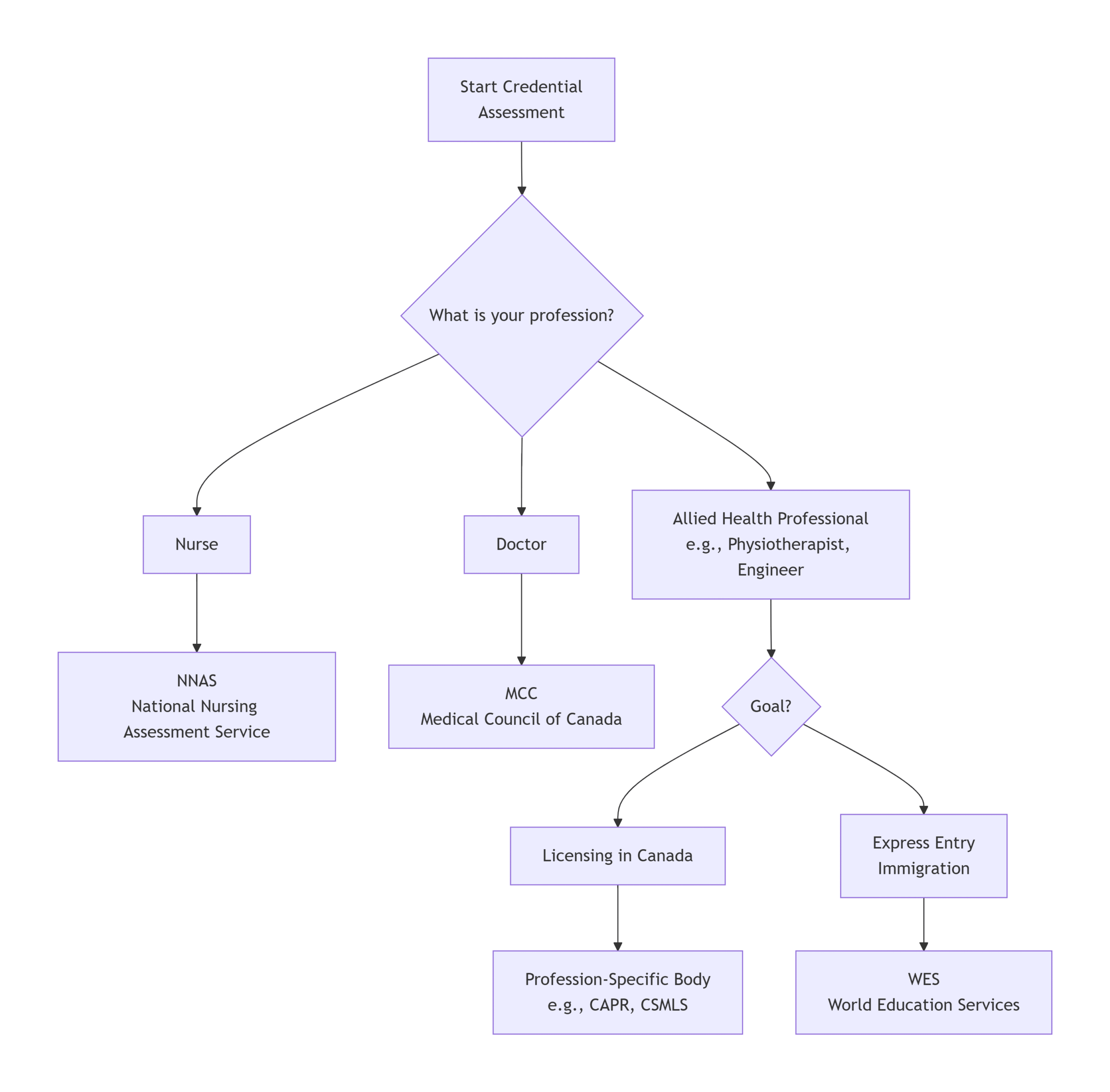
The organization you need depends entirely on your profession and goals. The chart below provides a quick guide with detailed steps for each to follow.

For Nurses: The National Nursing Assessment Service (NNAS)

The NNAS is the centralized gateway for all internationally educated nurses (IENs) applying to most Canadian provinces (except Quebec).

Step-by-Step Process:

  1. Create an NNAS Online Account: Go to the NNAS website and select the province where you want to be licensed and your nursing category (RN, LPN, RPN).
  2. Submit the Application Form: Complete the online application and pay the required fee.
  3. Prepare Your Documents: This is the most detailed part. You will need to send:
    • Academic Form: Sent directly from your nursing school, detailing your curriculum and clinical hours.
    • Professional Regulation/Licensure Form: From every jurisdiction where you have ever been licensed.
    • Employment Form: From your previous employers.
    • Identity Documents: Passport photos and copies.
    • Language Test Results: IELTS or CELPIP for English.
  4. Send Documents to NNAS: All forms must be sent directly by the institutions to NNAS in sealed envelopes. Do not send them yourself.
  5. Receive Your Advisory Report: NNAS will compile your documents and issue an Advisory Report to the provincial nursing college you selected (e.g., College of Nurses of Ontario). This report recommends what you need to do next (e.g., bridging program, exams).

Timeline: 3-6 months (can be longer if documents are delayed).
Cost: ~$650 USD + additional fees for language testing and document notarization.

For Doctors: The Medical Council of Canada (MCC)

The MCC oversees the qualification and assessment of all physicians in Canada.

Step-by-Step Process:

  1. Create a PhysiciansApply.ca Account: This is the MCC’s online portal for all services.
  2. Submit Credential Source Verification (CVS):
    • Request that your medical diploma and final medical school transcript be sent directly from your university to the MCC.
    • The MCC will verify their authenticity—this is a mandatory step before taking any exams.
  3. Take the MCCQE Part I: The Medical Council of Canada Qualifying Examination Part I is a computer-based test that assesses core medical knowledge.
  4. Register for the NAC OSCE: The National Assessment Collaboration Objective Structured Clinical Examination is a clinical skills exam required by most provinces.
  5. Apply for Provincial Registration: After passing your exams, you apply for a license with the provincial college (e.g., College of Physicians and Surgeons of Ontario), which involves a lengthy practice-ready assessment (residency or supervised practice).

Timeline: 2-4+ years for the full process.
Cost: $1,500+ (just for MCC fees, excluding exam prep and provincial college fees).

Click Here To Learn More: Best NHS Trusts and Care Homes Recruiting Overseas Healthcare Workers

For Allied Health Professionals & General Immigration (WES)

The World Education Services (WES) is used for two main purposes:

  1. For Immigration (Express Entry): To get an Educational Credential Assessment (ECA) for your Express Entry profile.
  2. For Licensing (Some Professions): As the first step for certain allied health professions.

Step-by-Step Process for WES:

  1. Choose the Right WES Application: For immigration, select the “ECA for IRCC” option. For licensing, check what your specific provincial regulator requires (e.g., Physiotherapists often use CAPR, not WES).
  2. Create a WES Account & Pay the Fee: The standard ECA costs about $250 CAD.
  3. Request Academic Documents from Your University:
    • For a degree, you must request that your university send your final transcript in a sealed, stamped envelope directly to WES.
    • You must also send a verified copy of your diploma.
  4. Mail Your Documents (If Required): While many institutions send transcripts electronically, some may require you to mail them. Follow WES’s instructions precisely.
  5. Receive Your ECA Report: WES will complete its assessment and send you a digital and physical report stating the Canadian equivalence of your education (e.g., “Bachelor’s Degree, four years”).

Timeline: 1-2 months after WES receives all documents.
Cost: ~$250 – $400 CAD.

Other Key Assessment Bodies

  • Canadian Society for Medical Laboratory Science (CSMLS): Handles credential assessment and certification for Medical Laboratory Technologists.
  • Canadian Alliance of Physiotherapy Regulators (CAPR): Manages the credentialing and examination process for physiotherapists.
  • Pharmacy Examining Board of Canada (PEBC): Assesses the qualifications of internationally educated pharmacists.

Pro Tips for a Smooth Credential Assessment

  1. START EARLY: This is the longest part of the process. Begin 1-2 years before you plan to move.
  2. Read Instructions Meticulously: Each body has specific requirements for how documents must be sent. A small mistake can cause a 2-3 month delay.
  3. Order Multiple Copies: When requesting transcripts from your university, order 2-3 sealed copies for your own records and potential future needs.
  4. Use a Tracking Number: Always send your documents using a courier or postal service that provides a tracking number.
  5. Be Patient and Persistent: Follow up with institutions to ensure they have sent your documents. Keep copies of everything you submit.

Common Pitfalls to Avoid

  • Sending Documents Yourself: If the requirement is for the institution to send it, you cannot mail the sealed envelope yourself. It will be rejected.
  • Choosing the Wrong Type of WES Report: For immigration, you must select the “ECA for IRCC” option.
  • Underestimating Costs: Budget for assessment fees, courier costs, language tests, and potential notarization.
  • Letting Credentials Expire: Some assessment reports and language tests are only valid for 2 years for immigration purposes.

Your Credential Assessment Starter Checklist

  • Identified the correct assessment body for my profession and goal.
  • Researched the specific document requirements on their official website.
  • Contacted my university/college to request official transcripts.
  • Created an online account with the relevant assessment body.
  • Prepared my budget for all associated fees.
  • Booked my language test (if required).

The credential assessment journey requires significant effort, organization, and patience. However, by understanding the correct pathway for your profession and following these steps meticulously, you can build a solid foundation for your successful healthcare career in Canada.

Your Canadian dream is valid. Start your credential assessment today!

Best NHS Trusts and Care Homes Recruiting Overseas Healthcare Workers

The United Kingdom remains a top destination for internationally educated healthcare professionals, offering world-class career opportunities, structured pathways, and a chance to make a real difference. For nurses, doctors, senior carers, and allied health staff, knowing which organisations are actively recruiting is the first step to securing a sponsored role.

This 2025 guide highlights the top NHS Trusts and care providers known for their robust international recruitment programs, detailing what they offer and how you can get hired.

Why the UK is Actively Recruiting in 2025

The UK’s National Health Service (NHS) and social care sector continue to face significant staffing shortages, driven by an ageing population and workforce retirement. This has created a sustained, high demand for skilled professionals from overseas. Key benefits for international hires include:

  • Sponsored Health and Care Worker Visas: Leading to settlement (Indefinite Leave to Remain).
  • Exemption from the Immigration Health Surcharge (IHS): A massive financial saving.
  • Structured OSCE & Adaptation Programs: Support to pass UK licensing exams.
  • Relocation Packages: Many top employers offer flight tickets, accommodation support, and settling-in allowances.

Part 1: Top NHS Trusts Hiring International Staff in 2025

These NHS Trusts have established reputable international recruitment programs. They don’t just hire you; they support your transition into the UK healthcare system.

1. Manchester University NHS Foundation Trust (MFT)

  • Why They’re a Top Employer: As one of the largest NHS Trusts in the country, MFT offers unparalleled career opportunities and a massive scope of specialities.
  • Roles They Recruit For: Registered Nurses (across all specialities), Midwives, Theatre Staff, Doctors.
  • International Recruitment Support: They offer a dedicated international recruitment team, a structured OSCE training program, and a comprehensive preceptorship program for newly registered nurses.
  • Location: Manchester, a vibrant and affordable major city.
  • How to Apply: Check the MFT Careers website and filter by “International Recruitment.”

2. Guys and St Thomas’ NHS Foundation Trust

  • Why They’re a Top Employer: Renowned for its world-class clinical reputation and location in the heart of London.
  • Roles They Recruit For: Nurses (especially in ICU, Theatres, and Renal), Midwives, Allied Health Professionals.
  • International Recruitment Support: Offers a robust pastoral care system, OSCE funding and preparation, and support with finding accommodation.
  • Location: Central London.
  • How to Apply: Visit the Guys and St Thomas’ Careers portal.

3. University Hospitals Birmingham NHS Foundation Trust (UHB)

  • Why They’re a Top Employer: A leading Trust known for its innovation and massive scale, including the Queen Elizabeth Hospital Birmingham.
  • Roles They Recruit For: Nurses, Operating Department Practitioners (ODPs), Doctors, and Healthcare Assistants.
  • International Recruitment Support: Provides a full OSCE program, meet-and-greet services, and a 2-week supernumerary period upon arrival.
  • Location: Birmingham, the UK’s second-largest city.
  • How to Apply: Search the UHB Jobs website.

4. NHS Scotland – Various Health Boards

  • Key Health Boards: NHS Greater Glasgow and ClydeNHS Lothian (Edinburgh).
  • Why They’re a Top Employer: Scotland offers a fantastic work-life balance, stunning landscapes, and a slightly different but equally rewarding healthcare system.
  • Roles They Recruit For: All nursing specialities, mental health staff, and general practitioners.
  • International Recruitment Support: Many Scottish Health Boards offer dedicated relocation packages and strong mentorship programs.
  • How to Apply: Use the national NHS Scotland Jobs platform.

5. Oxford University Hospitals NHS Foundation Trust

  • Why They’re a Top Employer: A world-famous teaching hospital trust associated with Oxford University, offering exceptional opportunities for professional development.
  • Roles They Recruit For: Registered Nurses, Doctors, and specialist allied health staff.
  • International Recruitment Support: Provides a comprehensive induction and OSCE support.
  • Location: Oxford, a historic and academic city.
  • How to Apply: Browse vacancies on the OUH Careers site.

Click Here To Learn More: The UK Health and Care Worker Visa: Ultimate Guide

Part 2: Top Care Home Providers Hiring Senior Carers in 2025

Crucial Note: As of March 2024, the standard “Care Worker” visa route was closed. However, the Health and Care Worker visa remains open for “Senior Care Workers” (SOC code 6146). These are the major providers hiring for these eligible senior roles.

1. HC-One

  • Why They’re a Top Employer: One of the UK’s largest and most established care home providers, with a focus on ‘kindness.’
  • Roles They Recruit For: Senior Care Assistants/Workers, Registered Nurses.
  • Support Offered: Sponsorship for Senior Carers, support with NMC registration for nurses, and a structured induction.
  • How to Apply: Visit the HC-One Careers page.

2. Barchester Healthcare

  • Why They’re a Top Employer: A highly respected provider of luxury care homes across the UK.
  • Roles They Recruit For: Senior Carer, Registered Nurse (RMN and RGN).
  • Support Offered: Known for a strong commitment to training and development, and offering visa sponsorship.
  • How to Apply: Check the Barchester Healthcare Careers website.

3. Bupa Care Services

  • Why They’re a Top Employer: A global healthcare giant with a massive network of care homes in the UK.
  • Roles They Recruit For: Senior Care Assistants, Registered Nurses.
  • Support Offered: A well-defined international recruitment process with relocation support.
  • How to Apply: Search for “visa sponsorship” roles on the Bupa Careers global site.

4. Care UK

  • Why They’re a Top Employer: A dynamic and growing provider with modern facilities.
  • Roles They Recruit For: Senior Care Workers, Nurses.
  • Support Offered: Active international recruitment and sponsorship programs.
  • How to Apply: Explore opportunities on the Care UK Careers page.

How to Get Hired: Your 5-Step Action Plan for 2025

  1. Get Your UK Professional Registration First (Non-Negotiable):
    • Nurses: You must be registered with the Nursing & Midwifery Council (NMC). This involves a multi-step process: CBT, OSCE, and credential assessment.
    • Senior Carers: While not a formal register, you must prove you have the necessary experience and qualifications for a senior role.
  2. Prepare a UK-Style CV (Curriculum Vitae):
    • Keep it to two pages maximum.
    • Include an “NMC Pin Status” or “Professional Registration” section.
    • Tailor your personal statement to the specific NHS Trust or care home.
  3. Apply Directly and Strategically:
    • Use the career portals listed above.
    • Set up job alerts for keywords like “international nurse,” “visa sponsorship,” or “senior care worker.”
  4. Ace the Virtual Interview:
    • Be prepared for competency-based questions (e.g., “Tell me about a time you dealt with a difficult situation?”).
    • Research the Trust or care home provider thoroughly.
    • Have professional, reliable technology for the video call.
  5. Understand the Visa Process:
    • Once you have a job offer, your employer will provide a Certificate of Sponsorship (CoS).
    • You will then apply for the Health and Care Worker visa, which provides IHS exemption.

Common Pitfalls to Avoid

  • Paying a Recruitment Fee: Reputable NHS Trusts and care providers do not charge candidates fees. The employer pays the recruitment agency.
  • Applying Without Registration: Do not apply for nursing roles until you have at least started your NMC application. Your PIN is your license to work.
  • Ignoring the “Senior” Title: For care roles, ensure the job is explicitly for a “Senior Care Worker” (SOC 6146) to be eligible for the visa.

Your 2025 Job Search Checklist

  • Initiated my NMC/GMC registration process.
  • Prepared a UK-formatted CV.
  • Researched 3-5 target NHS Trusts or care providers from this list.
  • Bookmarked their career websites.
  • Set up job alerts for my specific profession.

The demand for your skills in the UK has never been higher. By targeting these leading employers and following a structured approach, you can secure a rewarding role with a supportive organisation in 2025.

Your future in the UK’s health and care sector starts now. Begin your application today!

The UK Health and Care Worker Visa: Ultimate Guide

The United Kingdom’s National Health Service (NHS) and social care sector rely on talented professionals from around the world. The UK Health and Care Worker visa is the dedicated immigration pathway that makes this possible. Offering lower fees, faster processing, and valuable benefits, it’s the key for medical professionals seeking to build their career in the UK.

This ultimate 2025 guide provides everything nurses, doctors, and senior carers need to know—from eligibility and costs to the step-by-step application process.

Why Choose the UK Health and Care Worker Visa?

This visa is specifically designed for qualified medical professionals. Its advantages are significant:

  • Reduced Fee Structure: You pay substantially less than the standard Skilled Worker visa.
  • Exemption from the Immigration Health Surcharge (IHS): This is the biggest financial benefit, saving you thousands of pounds.
  • Dedicated Processing: Applications are typically processed within 3 weeks.
  • Path to Settlement: It leads directly to Indefinite Leave to Remain (ILR) after 5 years.
  • Bring Your Family: Your partner and children can apply to join you.

Eligibility: Who Can Apply in 2025?

You must meet several key criteria to be eligible for the Health and Care Worker visa.

1. You Must Be a Qualified Professional in an Eligible Occupation

The visa is not for all health roles. Your job must be on the UK’s eligible occupations list, which includes:

  • Healthcare Professionals:
    • All registered nurses (NMC registered)
    • Doctors (GMC registered)
    • Paramedics (HCPC registered)
    • Pharmacists (GPhC registered)
    • Physiotherapists (HCPC registered)
  • Senior Care Workers:
    • Senior care workers (SOC code 6146) are explicitly eligible.
  • Other Allied Health Professionals:
    • Occupational therapists, radiographers, podiatrists, and many more.

Crucial Note: The standard “Care Worker” visa (SOC 6145) was removed from the eligibility list in March 2024. However, Senior Care Workers (SOC 6146) remain eligible for the Health and Care Worker visa. Always check the official UK Government website for the most current list.

2. You Must Have a Valid Certificate of Sponsorship (CoS)

This is your most important document.

  • What it is: An electronic certificate from a UK employer that holds a valid Sponsor Licence.
  • How to get it: You must secure a job offer from an approved UK employer in the health and care sector (e.g., an NHS trust, a private hospital, or a regulated care home).
  • The “Skilled Worker” Requirement: Your job offer must be at or above the required skill level (RQF Level 3 or above). All eligible health and care roles meet this.

3. You Must Be Paid the Minimum Salary Threshold

You must be paid at least the “going rate” for your profession or the general salary threshold, whichever is higher.

  • General Threshold: £23,200 per year (as of 2024, check for 2025 updates).
  • Going Rate: This varies by profession. For example:
    • Nurses: £28,407 per year
    • Doctors in training: £23,189 to £43,923 (depending on the grade)
    • Senior Care Workers: £23,200 (must meet the general threshold)

4. You Must Meet the English Language Requirement

You can prove your knowledge of English by:

  • Being a national of a majority-English speaking country.
  • Passing a secure English language test (SELT) from an approved provider (e.g., IELTS for UKVI) at CEFR Level B1 (intermediate).
  • Having a degree-level academic qualification that was taught in English and is recognised by UK NARIC.

5. You Must Have Sufficient Savings

You must have at least £1,270 in your bank account for 28 consecutive days before applying, unless your sponsor (employer) can certify your maintenance on your CoS.

Click Here To Learn More: Internationally Educated Healthcare Workers: How To Get Licensed in Canada.

The Step-by-Step Application Process

Step 1: Secure Your Job Offer & Certificate of Sponsorship (CoS)

This is the foundational step. Your UK employer will provide you with your CoS reference number, which you will need for the application.

Step 2: Prepare Your Documents

You will need:

  • Your Certificate of Sponsorship (CoS) reference number.
  • A valid passport or other travel document.
  • Proof of your English language ability.
  • Proof of your personal savings (if applicable).
  • A current tuberculosis (TB) test result if you’re from a listed country.
  • Your job title and annual salary.
  • Your sponsor’s licence number (found on your CoS).

Step 3: Apply Online

You must apply online on the official GOV.UK website. You can apply from outside the UK or, in some cases, switch from within the UK.

Step 4: Pay the Fees

  • Application Fee:
    • Up to 3 years: £284
    • More than 3 years: £551
  • Immigration Health Surcharge (IHS): You are exempt from this fee, which is a huge saving (the standard IHS is £1,035 per year).

Step 5: Prove Your Identity

You’ll usually need to provide your biometric information (fingerprints and a photo) at a visa application centre.

2025 Fees & Costs at a Glance

Fee TypeStandard Skilled Worker VisaHealth and Care Worker Visa
Application Fee (3 yrs)£827£284
Immigration Health Surcharge (IHS)£1,035/year£0 (EXEMPT)
Total Cost for 3 Years£3,932£284

As you can see, the savings with the Health and Care Worker visa are substantial.

Bringing Your Family (Dependants)

Your partner and children can apply to join you as your ‘dependants’ if you can support them financially without needing public funds. They will need to apply online and will also be exempt from the IHS.

Visa Duration & Path to Permanent Residence

  • The visa can be granted for up to 5 years.
  • You can extend it as many times as you like, provided you still meet the eligibility criteria.
  • After 5 years of continuous lawful residence in the UK on this visa, you can apply for Indefinite Leave to Remain (ILR), which is permanent settlement.

Common Pitfalls to Avoid in Your 2025 Application

  1. Applying for the Wrong Job Code: Confusing a “Senior Care Worker” role (eligible) with a standard “Care Worker” role (not eligible for this visa).
  2. Incorrect English Test: Ensure you take a UKVI-approved SELT, not a general English test.
  3. Insufficient Maintenance Funds: If your employer is not certifying maintenance, you must show the funds for the full 28-day period.
  4. Letting Your Registration Lapse: You must maintain your professional registration with the relevant UK body (e.g., NMC, GMC) throughout your employment.

Frequently Asked Questions (FAQ)

Q: Do I need to be registered with a UK professional body before I apply for the visa?
A: Yes. This is mandatory. You must have full or provisional registration with the NMC (nurses), GMC (doctors), or other relevant regulator before you can be granted the visa.

Q: Can I work for a different employer in the UK?
A: Your visa is tied to your sponsor. If you want to change jobs, your new employer must sponsor you, and you will need to apply to update your visa.

Q: Can I access public funds?
A: No. You cannot claim most public funds (state benefits) while on this visa.

Q: What is the processing time?
A: Typically, within 3 weeks when applying from outside the UK.

Your 2025 Action Plan

  • Get Registered: Start the process with the UK professional body for your field (NMC, GMC, HCPC, etc.).
  • Secure a Job Offer: Apply for roles with UK NHS Trusts or approved private providers.
  • Obtain Your CoS: Your new employer will provide this.
  • Take a UKVI SELT English Test (if required).
  • Gather Your Documents, including proof of savings.
  • Submit Your Online Application.

The UK Health and Care Worker visa is one of the most attractive immigration pathways for medical professionals globally. By understanding the requirements and preparing a thorough application, you can confidently embark on a rewarding career within the UK’s world-renowned health and care system.

Your skills are vital to the UK’s health. Start your application journey today!

Internationally Educated Healthcare Workers: How To Get Licensed in Canada.

For internationally educated healthcare professionals, Canada represents a land of tremendous opportunity—but the path to practicing your profession requires navigating a rigorous licensing process. This journey is non-negotiable; you cannot work in a regulated healthcare role in Canada without a license from the provincial regulatory body.

This definitive guide breaks down the licensing process for nurses, medical laboratory technologists, therapists, and other health professionals, providing a clear roadmap to help you successfully integrate into the Canadian healthcare system.

Why Licensing is Your #1 Priority (Before Immigration!)

Many make the mistake of focusing only on visas and job offers. However, the licensing process is often the longest and most complex part of the journey. Starting early—even 1-2 years before you plan to move—is critical for a smooth transition. Licensing ensures:

  • Public Safety: Upholds consistent, high standards of patient care across Canada.
  • Professional Credibility: Validates that your international training meets Canadian benchmarks.
  • Employment Eligibility: Is the legal requirement for you to be hired in your field.

The Universal 5-Step Licensing Roadmap

While each profession and province has unique requirements, most follow a similar pattern.

Step 1: Research Your Specific Provincial Regulatory Body

Healthcare is regulated at the provincial level, not the federal level. You must be licensed by the college in the province where you plan to live and work.

Key Regulatory Bodies by Profession:

  • For Nurses:
    • National: National Nursing Assessment Service (NNAS) – often the first step.
    • Provincial: College of Nurses of Ontario (CNO), College of Registered Nurses of British Columbia (CRNBC), etc.
  • For Medical Laboratory Technologists:
    • Canadian Society for Medical Laboratory Science (CSMLS) – handles the national certification, which is then used for provincial licensure.
  • For Physiotherapists:
    • National: The Canadian Alliance of Physiotherapy Regulators (CAPR) – administers the national exams.
    • Provincial: College of Physiotherapists of Ontario, College of Physical Therapists of British Columbia, etc.
  • For Physicians:
    • Medical Council of Canada (MCC) – oversees the qualifying examinations.
    • Provincial: College of Physicians and Surgeons of the specific province.

Action: Google “[Your Profession] regulatory body [Province Name]” to find the exact website. This will be your most important resource.

Step 2: Submit Your Credentials for Assessment

You must prove that your education and training are comparable to Canadian standards.

  • What it is: A detailed review of your academic transcripts, diplomas, and course syllabi.
  • How it Works:
    • You will apply to the relevant organisation (e.g., NNAS for nurses, CES for physicians, WES for others as part of immigration).
    • You must request that your educational institution send your official transcripts directly to the assessing body.
  • Possible Outcomes: The assessment may conclude that your education is:
    • Substantially equivalent (no further study needed).
    • Requires some additional coursework or training.
    • Requires completion of a full bridging program.

Click Here To Learn More: Canada Caregiver PR Pathways: The Best Route for You

Step 3: Demonstrate Language Proficiency

You must prove you can communicate effectively and safely in English or French (or both, in some provinces like New Brunswick).

  • Minimum Requirement: Most regulated health professions require a Canadian Language Benchmark (CLB) of 7 or higher in all four skills (reading, writing, listening, speaking).
  • Accepted Tests:
    • English: IELTS Academic, CELPIP-General, or the OET (Occupational English Test). The OET is specifically designed for healthcare and is widely accepted.
    • French: TEF Canada or TCF Canada.

Step 4: Pass Licensing Examinations

This is where you demonstrate your theoretical knowledge and clinical competency.

  • Written Exams: Test your academic knowledge (e.g., NCLEX-RN for nurses, CSMLS exam for lab techs, Physiotherapy Competency Exam – Written).
  • Clinical/Practical Exams: Assess your hands-on skills and decision-making in a simulated environment (e.g., OSCEs for physicians, the Clinical Practice Exam for physiotherapists).

Pro Tip: Invest in exam preparation resources. Canadian exams often test critical thinking and application of knowledge in a way that may differ from your home country.

Step 5: Complete any Required Additional Training or Practice

Depending on your credential assessment, you may need to complete a:

  • Bridging Program: A university or college program designed to fill educational gaps for internationally educated professionals.
  • Supervised Practice Period: A period of clinical practice under the supervision of a licensed Canadian professional.

Profession-Specific Licensing Snapshots

For Internationally Educated Nurses (IENs)

  1. Apply to NNAS: Submit your credentials from your country of education.
  2. NNAS Advisory Report: Receive a report sent to your chosen provincial college.
  3. Apply to Provincial College: Apply to the provincial college (e.g., CNO).
  4. Complete Requirements: Fulfil any additional education, language, or jurisprudence (law & ethics) requirements.
  5. Pass the NCLEX-RN: The national registration exam.
  6. Receive Registration: Become licensed to practice.

For Medical Laboratory Technologists (MLTs)

  1. Apply for Documentation Review: Submit your academic and professional documents to the CSMLS.
  2. CSMLS Assessment: Receive a gap analysis indicating any missing competencies.
  3. Fill Competency Gaps: Complete any required courses or training.
  4. Pass the CSMLS Certification Exam: A comprehensive national exam.
  5. Register Provincially: Use your CSMLS certification to apply for a license with the provincial body (e.g., CMLTO in Ontario).

For Physiotherapists / Physical Therapists

  1. Apply for Credentialling: Submit your credentials to the Canadian Alliance of Physiotherapy Regulators (CAPR).
  2. Take the Physiotherapy Competency Exam (PCE) – Written Component.
  3. Take the PCE – Clinical Component.
  4. Register with the Provincial College: Apply for a license in your province once you have passed both exams.

Common Pitfalls to Avoid

  1. Starting Too Late: This is the #1 mistake. The process can take 2-4 years for some professions. Start now.
  2. Underestimating Costs: Budget for thousands of dollars for application fees, exams, courses, and potential bridging programs.
  3. Poor Language Test Preparation: A CLB 7 is a firm requirement. Do not underestimate the test.
  4. Using the Wrong Documentation: Ensure all transcripts and verifications are sent directly from the issuing institution as required.
  5. Going It Alone: Utilise free government-funded bridging programs and settlement services designed to help you.

Resources to Support Your Journey

  • Health Force Ontario: Provides extensive resources and funding for internationally educated health professionals settling in Ontario.
  • Health Match BC: A free recruitment and integration service in British Columbia.
  • Immigration, Refugees and Citizenship Canada (IRCC): Offers pathways like the Express Entry Healthcare category, but remember, a visa does not equal a license.

Your Licensing Action Plan

  • Identify the exact provincial regulatory body for my profession.
  • Review their application guide for internationally educated professionals.
  • Contact my university to request official transcripts.
  • Book a high-stakes language test (aim for CLB 8+).
  • Research and enrol in exam preparation courses.
  • Connect with a bridging program or settlement agency for support.

The path to becoming a licensed healthcare professional in Canada is a marathon of diligence and dedication. While challenging, it is a structured and achievable process. By understanding the requirements and taking consistent, organised steps, you will be well on your way to a rewarding career caring for patients in your new home.

Your skills are needed. Start your licensing journey today!

Canada Caregiver PR Pathways: The Best Route for You

For compassionate individuals who provide essential care to children, seniors, and those with medical needs, Canada offers dedicated immigration pathways that lead directly to permanent residence. However, navigating these programs can be confusing. Should you apply through the new pilots? Or is the older Home Child Care Provider program better for you?

This definitive 2025 guide breaks down all active Caregiver PR pathways in Canada, comparing eligibility, processing times, and benefits to help you choose the best route for your Canadian dream.

Why Canada Values Caregivers

Canada’s aging population and growing families have created a sustained demand for skilled caregivers. The Canadian government has responded by creating specialized immigration programs that recognize your vital role in Canadian society. These pathways offer:

  • Direct access to Permanent Residence for you and your family
  • Job mobility in most programs
  • Spousal open work permits so your partner can work too
  • Study permits for children so they can attend Canadian schools

The Two Main Pathways: An Overview

Canada currently offers two parallel systems for caregiver immigration:

  1. The 2019 Pilots: Home Child Care Provider Pilot & Home Support Worker Pilot
  2. The Temporary to Permanent Residence (TR to PR) Stream

Let’s examine each in detail.

Pathway 1: The 2019 Caregiver Pilots (Direct PR Pathway)

These two pilots are the most popular choice for caregivers outside Canada. Their key feature is that you can apply for permanent residence before you have any Canadian work experience.

Home Child Care Provider Pilot (NOC 44100)

  • For: Caregivers who work with children in a private home.
  • Duties include: Supervising children, preparing meals, bathing and dressing infants, and overseeing routines.

Home Support Worker Pilot (NOC 44101)

  • For: Caregivers who work with seniors or people with disabilities in a private home.
  • Duties include: Personal care, companionship, meal preparation, and routine health-related duties.

Key Requirements for Both Pilots:

  • A Valid Job Offer: Full-time (≥30 hrs/week) from a Canadian employer (not an embassy).
  • Language Skills: CLB 5 in English or French (IELTS ~5.0 in all bands).
  • Education: Canadian 1-year post-secondary credential or foreign equivalent (ECA required).
  • No Prior Canadian Experience Required to apply.

The “Two-Stage” Process:

  1. Stage 1: You apply for PR from abroad. If eligible, you receive approval in principle and a specific work permit to come to Canada.
  2. Stage 2: You work in Canada for at least 24 months of full-time experience within 36 months of arriving.
  3. Final PR Grant: Once you submit proof of your work experience, you will receive final PR approval.

2025 Processing Times:

  • Initial Work Permit: ~12 months
  • Final PR after work experience: ~6 months
  • Total Timeline: ~3-4 years

Best For: Caregivers outside Canada with the required education and language scores, who are willing to wait for the two-stage process.

Click Here To Learn More: Best Websites to Find Healthcare Jobs Abroad: The Ultimate Guide

Pathway 2: Temporary to Permanent Residence (TR to PR) Stream

This pathway is better suited for caregivers who are already in Canada with recent work experience.

Key Requirements:

  • Current Work Experience: At least 12 months of full-time Canadian work experience in a caregiver occupation (NOC 44100 or 44101) within the last 36 months.
  • Current Status: Must be legally working in Canada with a valid temporary status.
  • Language Skills: CLB 5 for NOC B (same as pilots).
  • Education: High school diploma completed outside or inside Canada.

The Process:

  1. Gain Experience: Work in Canada for 12 months.
  2. Create Express Entry Profile: Enter the pool and indicate your Canadian work experience.
  3. Receive ITA: Get invited through a category-based draw (caregivers are a priority category).
  4. Apply for PR: Submit your application, typically processed in 6 months or less.

2025 Processing Times:

  • PR Application after ITA: ~6 months
  • Total Timeline: ~1.5-2 years (including 12 months of work experience)

Best For: Caregivers already in Canada (e.g., on a work permit) who can quickly meet the 12-month experience requirement.

Comparison Table: Which Pathway Wins in 2025?

Feature2019 Pilots (Home Child Care/Support)TR to PR Stream
Best ForApplicants outside CanadaApplicants inside Canada
Canadian Experience Needed?No (needed later for final PR)Yes (12 months required)
Application TimingApply for PR before workingApply for PR after gaining experience
Job MobilityYes (can change employers)Yes (standard Express Entry rule)
Spouse/Partner Open Work PermitYesNo (but spouse can apply separately)
Total Processing Time~3-4 years~1.5-2 years
Language RequirementCLB 5CLB 5
Education Requirement1-year post-secondaryHigh School

Other Potential Pathways to Consider

Provincial Nominee Programs (PNPs)

Some provinces have streams for caregivers, but they are less common. For example, British Columbia’s Entry Level and Semi-Skilled (ELSS) stream includes certain caregiver occupations. These are typically slower and require a specific provincial nomination.

Express Entry (Federal Skilled Worker Program)

If you have substantial continuous work experience as a caregiver (outside Canada) and high language scores (CLB 7+), you might qualify directly through Express Entry without a specific caregiver program. This is rare but possible for highly qualified candidates.

Your Decision Guide: Which Route Should You Choose?

Choose the 2019 PILOTS if:

  • You are currently outside Canada.
  • You have at least one year of post-secondary education.
  • You can achieve CLB 5 in English/French.
  • You are patient and can wait 3-4 years for full PR.
  • Bringing your spouse (who wants to work immediately) is a priority.

Choose the TR to PR STREAM if:

  • You are already in Canada on a valid work permit.
  • You have, or will soon have, 12 months of Canadian caregiver experience.
  • You want the fastest possible PR pathway.
  • You meet the CLB 5 and high school education requirements.

Common Pitfalls to Avoid in Your 2025 Application

  1. Choosing the Wrong NOC: Applying under Home Child Care for a job that is actually Home Support (or vice-versa) will lead to refusal.
  2. Insufficient Language Proof: CLB 5 is a strict minimum. If you score CLB 4 in any category, you are ineligible.
  3. Not Starting Licensing Early: Some provinces require certification. Research provincial requirements early.
  4. Missing Deadlines: For the pilots, you must complete your 24 months of work within 36 months of arriving.

2025 Outlook & Recommendations

The caregiver immigration landscape in Canada is stable and favorable. The 2019 Pilots are extended until at least June 2025, with a high likelihood of further extension.

Our Recommendation:

  • If you are outside Canada, begin the process for the 2019 Pilots now. The upfront PR application provides security.
  • If you are already in Canada, focus on qualifying for the TR to PR Stream—it’s significantly faster.

Your Action Plan for 2025

  • Determine Your Pathway: Are you outside Canada (Pilots) or inside Canada (TR to PR)?
  • Take a Language Test: Aim for CLB 5 or higher.
  • Get Your Education Assessed (for Pilots): Start your Educational Credential Assessment (ECA).
  • Find a Job: Secure a genuine job offer from a Canadian employer.
  • Prepare Documents: Gather passports, reference letters, and police certificates.

Canada’s caregiver pathways are among the most generous in the world, offering a direct reward for your compassionate work. By choosing the right path and preparing a strong application, you can secure a bright future for yourself and your family in Canada.

Your skills are needed. Start your journey today!

Best Websites to Find Healthcare Jobs Abroad: The Ultimate Guide

The world is facing a global healthcare talent shortage, creating unprecedented opportunities for doctors, nurses, and allied health professionals to take their careers international. But where do you even begin your job search?

Navigating the international healthcare job market requires a targeted approach. Generic job boards won’t cut it. This definitive guide for 2025 breaks down the best websites to find healthcare jobs abroad, categorised by speciality and region, to connect you directly with the right opportunities.

Why 2025 is the Perfect Time to Work in Healthcare Abroad

  • Global Staffing Shortages: Countries like the UK, Canada, Australia, and Germany have launched aggressive recruitment campaigns.
  • Competitive Salaries & Benefits: Many destinations offer attractive packages, including relocation assistance and visa sponsorship.
  • Professional Growth: Gain experience in different healthcare systems and with diverse patient populations.
  • Adventure & Lifestyle: Immerse yourself in a new culture while advancing your career.

Top 5 Global Healthcare Job Boards for 2025

These platforms are excellent starting points, offering thousands of listings across multiple countries.

1. World Health Organisation (WHO) Career Site

  • Best For: Public health professionals, epidemiologists, and healthcare administrators seeking roles in global health policy and emergency response.
  • Why it’s Great: Offers impactful careers with UN agencies and NGOs worldwide. Roles are often highly competitive but incredibly rewarding.
  • Link: WHO Careers

2. LinkedIn

  • Best For: All healthcare professionals, especially for networking and being discovered by recruiters.
  • Why it’s Great: In 2025, LinkedIn is more crucial than ever.
    • Optimise Your Profile: Use keywords like “Registered Nurse,” “Seeking roles in Canada,” “MCQE Part 1,” or “NMC PIN eligible.”
    • Use the Job Board: Set alerts for your target role and country.
    • Network proactively: Connect with international recruiters and professionals already working in your desired country.
  • Link: LinkedIn Jobs

3. Indeed International

  • Best For: A broad search to gauge the market in a specific country.
  • Why it’s Great: Indeed has localised sites for almost every country (e.g., Indeed.co.ukIndeed.caIndeed.com.au). You can filter for “Visa Sponsorship” on many of these localised sites.
  • Pro Tip: Search using the local job title. For example, search for “Physiotherapist” in the UK, not “Physical Therapist.”
  • Link: Indeed Global

4. Glassdoor

  • Best For: Researching salaries, company culture, and interview processes for specific international employers.
  • Why it’s Great: While a job board, its real power lies in the “Reviews” and “Salaries” sections. Learn what it’s really like to work for a specific hospital or healthcare group abroad before you apply.
  • Link: Glassdoor

Specialised & Regional Recruitment Websites

For healthcare, specialised sites often yield better results than general ones.

For Nurses & Midwives:

  • Florence International: Excellent for the UK National Health Service (NHS) and private sector roles. They offer strong support with OSCE preparation and NMC registration.
  • Geneva Health: A global agency with a strong presence in the UK, the Middle East, Australia, and New Zealand.
  • O’Grady Peyton: Well-known for placing nurses in the USA (NCLEX and visa sponsorship support) and the Middle East.

For Physicians & Specialists:

  • BMJ Careers: A premier site for doctor jobs, particularly strong in the UK, Ireland, Australia, and New Zealand.
  • MDLinx: Curates physician jobs from around the world, with a strong focus on the United States.
  • Lokales: A leading platform for connecting physicians with German hospitals, offering intensive language and integration support.

For Allied Health Professionals:

  • Therapy Direct (UK): Specialises in roles for Physiotherapists, Occupational Therapists, and Radiographers in the UK.
  • Health Match BC (Canada): An incredible, free service that helps internationally educated health professionals (including allied health) find jobs and navigate licensing in British Columbia, Canada.

Click To Learn More: How to Prepare for International Healthcare Licensing Exams: The Ultimate 2025 Strategy Guide

Country-Specific Healthcare Job Portals

The most effective strategy is often to go directly to the source.

United Kingdom (UK)

  • NHS Jobs: The official portal for the National Health Service. Almost all public health sector jobs are posted on this platform. This is a must-use site for anyone targeting the UK.
  • Link: NHS Jobs

Canada

  • Health Authority Career Sites: In Canada, healthcare is provincially run. Apply directly through the health authority websites:
    • Alberta Health Services Careers
    • BC Health Careers (Fraser Health, Vancouver Coastal Health, etc.)
    • Ontario Health Careers
  • HealthForceOntario: The official recruitment portal for Ontario’s health system, with dedicated resources for internationally educated professionals.

Australia & New Zealand

  • Seek (AU) & Seek (NZ): These are the dominant job boards in both countries, equivalent to Indeed. Use the filters to find healthcare roles offering visa sponsorship.
  • MedicalOne (NZ): A leading site for medical jobs across New Zealand.

Middle East (UAE, Saudi Arabia, Qatar)

  • Bayt.com: The leading job site in the Middle East. Major hospital groups like the Cleveland Clinic Abu Dhabi, King Faisal Specialist Hospital, and Sidra Medicine (Qatar) post vacancies here.
  • Direct Hospital Career Pages: Always check the “Careers” section of world-renowned hospitals in the region, such as the American Hospital Dubai or King Faisal Specialist Hospital.

Pro Tips for a Successful International Job Search in 2025

  1. Get Your Credentials in Order First: Before you even apply, research the licensing requirements for your destination country. Mentioning that you’ve started the process (e.g., “NMC PIN in progress”) makes your application infinitely stronger.
  2. Tailor Your CV/Resume: Adapt your CV to the standard of the country you’re targeting. A UK CV looks different from a US Resume. Highlight your international eligibility and language skills.
  3. Leverage Recruitment Agencies: A good agency can be your best advocate, guiding you through visas, licensing, and relocation. They are often paid by the employer, so their services are free for you.
  4. Be Prepared for Virtual Interviews: In 2025, the first few interview rounds will almost certainly be virtual. Test your tech, ensure a professional background, and be mindful of time zones.
  5. Ask the Right Questions: During interviews, ask about:
    • Visa sponsorship details
    • Relocation assistance (flights, accommodation)
    • Orientation and mentorship programs
    • Support for licensing and registration

Your 2025 International Job Search Action Plan

  • Research & Target: Choose 2-3 target countries and research their specific licensing bodies.
  • Optimise Your Profile: Completely update your LinkedIn and CV for your target market.
  • Go Direct: Bookmark the key country-specific and specialised sites listed above.
  • Set Up Alerts: Create job alerts on 3-5 of the most relevant platforms.
  • Network: Connect with at least 5 recruiters or professionals in your target country on LinkedIn.

The demand for your healthcare skills has never been higher. By using these targeted websites and strategies, you can move beyond dreaming and start building a successful and fulfilling career caring for patients in a new corner of the world.

The world needs your expertise. Where will you go in 2025?

How to Prepare for International Healthcare Licensing Exams: The Ultimate 2025 Strategy Guide

For doctors, nurses, and allied health professionals dreaming of an international career, passing a licensing exam is the most critical hurdle you will face. Whether it’s the USMLE for the United States, the PLAB/MCQE for the UK/Canada, or the NCLEX for nurses, these high-stakes tests can feel overwhelming.

This ultimate guide provides a proven, step-by-step strategy to prepare effectively, manage stress, and pass your international healthcare licensing exam on your first attempt.

Why Licensing Exams Are Your Gateway to a Global Career

Licensing exams are designed to ensure all healthcare professionals, regardless of their country of training, meet the same high standard of patient care and medical knowledge. Passing them is non-negotiable and serves as your ticket to:

  • Professional Licensure: The legal requirement to practice in your destination country.
  • Employer Confidence: Proof of your competency and commitment.
  • Immigration Success: A key requirement for most skilled healthcare visa categories.

Phase 1: The Foundation – Strategic Pre-Planning (6-12 Months Before)

Rushing into studying without a plan is the biggest mistake you can make.

Step 1: Choose Your Destination & Understand the Exam Ecosystem

Your preparation strategy is entirely dependent on the specific exam.

  • For Doctors:
    • USA: USMLE (United States Medical Licensing Examination)
    • UK: PLAB (Professional and Linguistic Assessments Board) or UKMLA (UK Medical Licensing Assessment)
    • Canada: MCCQE (Medical Council of Canada Qualifying Examination)
    • Australia: AMC (Australian Medical Council) Exams
  • For Nurses:
    • USA & Canada: NCLEX-RN or NCLEX-PN
    • UK: CBT (Computer-Based Test) & OSCE (Objective Structured Clinical Examination) through the NMC
    • Australia: NCLEX-RN (for some) or AHPRA-approved assessments

Action: Go to the official website of the exam body (e.g., NMC, NCSBN, MCC) and download the official test plan or blueprint. This document is your bible.

Step 2: Create a Master Timeline & Budget

These exams are a marathon, not a sprint.

  • Timeline: Map out your entire journey from today to your exam date. Include time for content review, question banks, and final revisions.
  • Budget: Exam fees, study materials (question banks, textbooks), and potential courses can cost thousands. Plan accordingly.

Step 3: Assemble Your Study Arsenal

Invest in high-quality, exam-specific resources. Don’t rely on your old medical school notes.

  • Popular Resources:
    • USMLE: UWorld QBank, First Aid for the USMLE, Pathoma, SketchyMedical.
    • NCLEX: UWorld, Archer, Hurst Review, Saunders Comprehensive Review.
    • PLAB/MCQE: Passmedicine, OnExamination, Geeky Medics (for clinical skills).

Phase 2: The Execution – A Proven Study Methodology (3-6 Months Before)

The “Cycle of Success” Method

This three-part cycle is more effective than passive reading.

1. Active Content Review (40% of your time)

Don’t just read—engage with the material.

  • Create Your Own Notes: Use flashcards (digital tools like Anki are excellent), mind maps, and summary sheets.
  • Teach the Concept: Explain complex topics out loud as if you were teaching a student. This forces true understanding.
  • Focus on High-Yield Topics: Use the official test plan to prioritize areas with the heaviest weighting.

2. Aggressive Question Bank Practice (50% of your time)

This is the single most important part of your preparation.

  • Simulate Exam Conditions: Do blocks of questions timed and without interruptions.
  • Review Every Single Question: Whether you got it right or wrong, read the explanation thoroughly. Understand why the correct answer is right and, crucially, why the wrong answers are tempting but incorrect.
  • Track Your Performance: Use the analytics in your QBank to identify weak areas and go back to review them.

3. Spaced Repetition & Consolidation (10% of your time)

Your brain needs reinforcement to retain information.

  • Daily Anki Reviews: Spend 20-30 minutes each day reviewing your self-made flashcards.
  • Weekly Recap: Dedicate one afternoon per week to reviewing all the notes and mistakes from that week.

Step 4: Master the Exam Format & Question Styles

Each exam has a unique “personality.”

  • NCLEX: Uses Computerized Adaptive Testing (CAT). The difficulty of the next question depends on whether you got the previous one right. It tests safety and critical thinking above all.
  • USMLE Step 1: Now pass/fail, but still requires deep, integrated knowledge. Step 2 CK is paramount and is heavily focused on clinical application.
  • PLAB/MCQE: Often feature “Best Answer” or “Single Best Answer” questions where multiple options may seem plausible, testing your clinical reasoning and UK/Canada-specific guidelines.

Click Here To Learn More: Canada’s Home Care Worker Pilot: Complete Guide to Requirements, Documents & Processing Times

Phase 3: The Final Countdown – Test-Taking Strategy (1 Month Before

Step 5: Take Full-Length Mock Exams

This is non-negotiable. You must practice stamina and pressure.

  • Schedule at least 2-3 full-length, timed practice exams.
  • Mimic real conditions: same time of day, no phone, scheduled breaks.
  • Your score on these is a strong predictor of your actual performance.

Step 6: Develop Your Mental & Test-Day Strategy

  • Question Strategy: Learn to eliminate wrong answers first. If you’re stuck between two, make an educated guess and move on. Don’t waste time.
  • Time Management: Know how much time you have per question and stick to it.
  • Mindset: For adaptive exams like the NCLEX, remember that feeling like the questions are getting harder is a good sign.

Phase 4: Beyond the Books – The Practicalities

Step 7: Apply and Schedule Your Exam

  • Apply Early: Testing slots can fill up months in advance, especially for clinical exams like OSCEs.
  • Choose Your Date Wisely: Give yourself a buffer. If you don’t feel ready 2-3 weeks out, reschedule. It’s cheaper than a failed attempt.

Step 8: Manage Your Well-Being

You cannot perform well if you are burnt out.

  • Schedule Breaks: Include one full rest day per week with no studying.
  • Exercise & Nutrition: Regular physical activity and a healthy diet improve cognitive function and manage stress.
  • Sleep: Prioritize 7-8 hours of sleep. Sleep is when memory consolidation happens.

Special Focus: Preparing for Clinical Exams (OSCEs)

For exams with a clinical component (PLAB 2, MCCQE Part II, NMC OSCE), the strategy shifts:

  • Practice with Partners: You cannot practice clinical communication and examination alone. Form a study group.
  • Standardize Your Approach: Develop a systematic method for taking a history and performing a physical exam that you can apply to any patient presentation.
  • Focus on Communication & Safety: Examiners are looking for a professional, empathetic manner and a safe, structured approach more than they are looking for a zebra diagnosis.

Common Pitfalls to Avoid

  1. Passive Learning: Simply re-reading notes or watching videos without active recall.
  2. Ignoring Question Banks: Thinking you’re “saving” them for the end. They are a learning tool, not an assessment tool.
  3. Cramming: These exams test deep understanding built over time, not last-minute memorization.
  4. Neglecting Self-Care: Burnout is a real threat and will sabotage your performance.

Your Licensing Exam Preparation Checklist

  • Researched the exact exam requirements for my target country.
  • Created a detailed study plan and timeline.
  • Acquired high-yield, exam-specific study resources and a question bank.
  • Integrated active learning (flashcards, teaching) into my routine.
  • Scheduled and completed multiple full-length mock exams.
  • Booked my official exam date.
  • Prioritized sleep, exercise, and nutrition throughout the process.

Preparing for an international healthcare licensing exam is one of the most challenging but rewarding endeavors you will undertake. It is a test of your knowledge, resilience, and dedication to your profession. By following this strategic, disciplined approach, you can walk into the exam center with confidence, ready to pass and take the next step in your global career.

You have the knowledge and the skill. Now, you just need the plan. Start today!

Canada’s Home Care Worker Pilot: Complete Guide to Requirements, Documents & Processing Times

For compassionate individuals with experience in caregiving, Canada offers a dedicated pathway to permanent residence. The Home Child Care Provider Pilot and Home Support Worker Pilot are unique immigration programs designed to address the growing need for in-home care while providing caregivers and their families a direct route to Canadian life.

This complete 2025 guide breaks down the eligibility requirements, required documents, and current processing times for the Home Care Worker Immigration Pilot, giving you everything you need to start your application.

Why Canada Created These Caregiver Pilots

Canada recognises the vital role that caregivers play in supporting families, children, and seniors. These pilots were designed to fix previous shortcomings by:

  • Offering a Direct Path to PR: Successful applicants receive permanent residence upfront, for themselves and their family, upon arrival in Canada.
  • Providing Job Flexibility: You are not tied to a single employer, giving you the freedom to change jobs within the same occupation.
  • Fast-Tracking Family Unity: Your spouse and dependent children can come with you to Canada, and your spouse can obtain an open work permit.

Understanding the Two Pilots: Which One is For You?

There are two distinct streams under this program. It’s crucial to apply for the correct one based on your job offer and experience.

1. Home Child Care Provider Pilot (NOC 44100)

This pilot is for you if you have a job offer to provide care for children in a private home. Your duties may include:

  • Supervising and caring for children
  • Preparing meals and organising meals
  • Bathing, dressing, and feeding infants and children
  • Overseeing children’s activities and routines

2. Home Support Worker Pilot (NOC 44101)

This pilot is for you if you have a job offer to provide care for seniors or persons with disabilities in a private home. Your duties may include:

  • Providing care and companionship
  • Assisting with personal care, such as bathing and dressing
  • Preparing and serving meals
  • Performing routine health-related duties, like administering medication

Eligibility Requirements for the 2025 Intake

To be eligible for either pilot, you must meet the following core requirements:

1. A Valid Job Offer

You must have a genuine, full-time job offer from a Canadian employer to work as a:

  • Home Child Care Provider (NOC 44100) OR
  • Home Support Worker (NOC 44101)

The job offer must be for full-time work (at least 30 hours per week) and must not be from an embassy, high commission, or consulate.

2. Language Proficiency

You must prove your language ability in English or French by taking a designated test.

  • Minimum Requirement: Canadian Language Benchmark (CLB) 5 in all four abilities: reading, writing, listening, and speaking.
  • Accepted Tests: IELTS General Training or CELPIP-General for English; TEF Canada or TCF Canada for French.

3. Education

You must have completed the equivalent of a Canadian post-secondary education credential of at least one year.

  • You will need an Educational Credential Assessment (ECA) from a designated organisation (like World Education Services – WES) to verify that your foreign education is equal to a Canadian standard.

4. Relevant Work Experience

While you do not need prior work experience to apply, you must demonstrate that you can perform the duties of the job. However, to be granted permanent residence, you must later prove you have acquired the required experience.

The “Two-Stage” Process Explained:
This is the unique aspect of these pilots.

  1. Stage 1 (Application for Permanent Residence): You apply for PR from outside Canada. If you meet the initial criteria (job offer, language, education), you receive stage 1 approval.
  2. Stage 2 (Work Experience in Canada): You come to Canada on a specific work permit and begin working. Once you have accumulated 24 months of full-time work experience in Canada within the last 36 months, you submit this proof to IRCC to receive final approval for your permanent residence.

Required Documents Checklist

Gathering the correct documents is critical for a successful application. Here’s what you’ll need:

For the Initial Application:

  • Forms: Complete, validated IMM 5984 and other required generic forms.
  • Job Offer: A copy of your signed job offer from your Canadian employer, using the IRCC-specific offer of employment form (IMM 5983).
  • Proof of Language Ability: Original test results from an approved language test (e.g., IELTS, CELPIP).
  • Educational Credential Assessment (ECA) Report: The original report from a designated organisation.
  • Passports/Travel Documents: For you, your spouse, and all dependent children.
  • Proof of Relationship: Marriage certificate (if applicable) and birth certificates for all children.
  • Police Certificates: From every country you (and your spouse) have lived in for 6 months or more since the age of 18.
  • Photos: Recent photos that meet IRCC’s specifications for you and each family member.

For the Final PR Approval (After Gaining Experience):

  • Proof of Work Experience: Pay stubs, T4 slips, NOAs (Notice of Assessment from the CRA), and a letter from your employer(s) confirming you completed 24 months of eligible work.

Click Here To Learn More: Saskatchewan Health Talent Pathway: Permanent Residency Made Easy for Healthcare Workers

2025 Processing Times: What to Expect

Processing times are broken into two stages:

  1. Initial Work Permit Processing: After you submit your complete application, IRCC aims to process the work permit portion within 12 months. This allows you to come to Canada and start working.
  2. Final Permanent Residence Processing: After you submit proof of your 24 months of work experience in Canada, IRCC aims to process the final PR application within 6 months.

Total Timeline: From initial application to final PR grant, the entire process can take approximately 3-4 years.

Common Pitfalls to Avoid in Your 2025 Application

  1. Choosing the Wrong NOC Code: Applying under the Home Child Care Provider Pilot for a job that is actually home support work (or vice-versa) will lead to refusal.
  2. Insufficient Language Scores: A CLB 4 or lower in any single category (reading, writing, listening, speaking) will make you ineligible. Always aim for a CLB 5 or higher.
  3. Incomplete Job Offer: The job offer must be for full-time work (minimum 30 hours/week) and must not be live-in unless the live-in requirement is clearly stated.
  4. Missing the Work Experience Deadline: You must complete your 24 months of eligible work experience within 36 months of arriving in Canada. Plan your employment carefully to meet this deadline.

Frequently Asked Questions (FAQ)

Q: Can my family come with me?
A: Yes! This is a major advantage. Your spouse/common-law partner and dependent children can accompany you. Your spouse will be eligible for an open work permit, allowing them to work for any employer in Canada.

Q: Do I need a Labour Market Impact Assessment (LMIA)?
A: No. One of the key benefits of these pilots is that your employer does not need a positive LMIA. This simplifies the hiring process for them.

Q: What happens if I lose my job in Canada?
A: The pilots offer job mobility. You are allowed to change employers, as long as your new job is still within the same NOC code (44100 or 44001). You must inform IRCC of the change.

Q: Is the “live-in” requirement mandatory?
A: No. Your job can be live-in or live-out. If it is live-in, it must be clearly stated in your job offer, and your employer must ensure the accommodations meet safety and health standards.

Your Action Plan for 2025

  • Secure a valid job offer from a Canadian employer for NOC 44100 or 44101.
  • Book and take your language test (aim for CLB 5 or higher).
  • Apply for your Educational Credential Assessment (ECA).
  • Gather all required personal and professional documents.
  • Complete and validate the application forms meticulously.
  • Submit your complete application to the IRCC before the pilot’s intake cap is filled.

The Canada Home Care Worker Immigration Pilot is a life-changing program that recognises the invaluable work of caregivers by offering them the security of Canadian permanent residence. By understanding the requirements and preparing a thorough application, you can confidently embark on a new future for yourself and your family in Canada.

Saskatchewan Health Talent Pathway: Permanent Residency Made Easy for Healthcare Workers

For healthcare professionals dreaming of Canadian permanent residence, Saskatchewan offers one of the most direct and efficient pathways available. The Saskatchewan Immigrant Nominee Program (SINP) International Health Worker (IHW) EOI Pool is a dedicated stream designed to fast-track doctors, nurses, and allied health workers to life in the Prairies.

This complete guide breaks down the Saskatchewan Health Talent Pathway, detailing the eligibility requirements, application process, and how you can leverage this program for a swift journey to Canadian Permanent Residence.

Why Choose Saskatchewan for Your Healthcare Career?

Saskatchewan is more than just breathtaking prairies and vibrant northern lights. It’s a province with a booming economy and a critical need for your skills.

  • High Job Vacancy Rates: Saskatchewan’s health sector has hundreds of vacant positions, meaning your skills are in immediate demand.
  • Affordable Living: Enjoy a high quality of life with a lower cost of living than many other Canadian provinces, especially when it comes to housing.
  • Welcoming Communities: Saskatchewan is known for its friendly, multicultural communities and strong support networks for newcomers.
  • Focused Immigration Pathway: The IHW pool is not a general stream; it’s a targeted system for health workers, leading to faster processing and a higher chance of success.

What is the International Health Worker EOI Pool?

The SINP International Health Worker EOI Pool is a dedicated selection pool for healthcare professionals. Instead of competing with candidates from all industries, you are placed in a specialized category where the Saskatchewan Ministry of Health actively reviews and refers eligible candidates to the SINP for nomination.

Think of it as an express lane for healthcare talent.

Eligibility: Who Qualifies for the Health Talent Pathway?

To be eligible for the IHW EOI Pool, you must meet the following core criteria:

1. Work Experience in an Eligible Occupation

You must have work experience in one of Saskatchewan’s designated high-demand health occupations. The list is updated regularly but consistently includes:

Key Eligible Occupations (with NOC 2021 codes):

  • Physicians:
    • NOC 31100 – Specialists in Clinical and Laboratory Medicine
    • NOC 31101 – Specialists in Surgery
    • NOC 31102 – General Practitioners and Family Physicians
  • Nursing Professionals:
    • NOC 31300 – Registered Nurses and Registered Psychiatric Nurses
    • NOC 32101 – Licensed Practical Nurses
  • Allied Health Professionals:
    • NOC 32109 – Other Technical Occupations in Therapy and Assessment (Includes Medical Radiation Technologists, Medical Sonographers, etc.)
    • NOC 32121 – Medical Radiation Technologists
    • NOC 32122 – Medical Sonographers
    • NOC 32129 – Other Medical Technologists and Technicians (Includes Cardiology Technologists, Electroencephalographic Technologists, etc.)
    • NOC 33101 – Medical Laboratory Technologists
    • NOC 33102 – Nurse Aides, Orderlies, and Patient Service Associates

2. Language Proficiency

  • Minimum language score of Canadian Language Benchmark (CLB) 4 is required for NOC TEER 4 or 5 occupations.
  • For NOC TEER 0, 1, 2, or 3, a minimum of CLB 5 is required.
  • Pro Tip: Aim for a CLB 7 or higher to make your profile more competitive and to be eligible for other immigration programs.

3. Educational Credential Assessment (ECA)

You must have an ECA from a designated organization (like World Education Services – WES) to verify that your foreign education is equivalent to a Canadian secondary or post-secondary credential.

4. Saskatchewan Licensure Eligibility (The Critical Step)

This is non-negotiable. You must be eligible for full, provisional, or conditional licensure in your profession from the respective Saskatchewan regulatory body.

  • For Physicians: College of Physicians and Surgeons of Saskatchewan (CPSS)
  • For Nurses: Saskatchewan Registered Nurses Association (SRNA) or Saskatchewan Association of Licensed Practical Nurses (SALPN)
  • For Med Lab Techs: Saskatchewan Society of Medical Laboratory Technologists (SSMLT)

You must start the licensing process with the regulatory body before you receive a nomination.

5. A Genuine Job Offer

You must have a full-time, permanent job offer from the Saskatchewan Health Authority (SHA) or a health employer approved by the SHA.

Click To Learn More: How to Convert Your Healthcare Credentials for Any Country: The Ultimate 2025 Guide

Your 6-Step Guide to a Successful Application

Navigating the IHW Pathway requires a precise approach. Follow these steps:

Step 1: Secure Your Saskatchewan License (Start Here!)

Contact the Saskatchewan regulatory body for your profession immediately. Understand the requirements, which may include submitting documents, taking exams, and completing adaptation programs. This is the longest step, so begin now.

Step 2: Find a Job with the Saskatchewan Health Authority

The SHA is the primary employer. Monitor their careers page and apply for positions that match your qualifications. A successful job offer is your key to the next step.

Step 3: Get Your Credentials Ready

  • Take a Language Test: Book your IELTS/CELPIP (English) or TEF/TCF (French) test.
  • Get an ECA: Apply for your Educational Credential Assessment through WES.

Step 4: Submit an Expression of Interest (EOI) to the SINP Health Pool

Once you have your license eligibility and job offer, create an EOI profile in the SINP system and select the “International Health Worker” category. You will be ranked based on your credentials, language, and experience.

Step 5: Receive an Invitation to Apply (ITA)

The Ministry of Health reviews the EOI pool and refers the most qualified candidates to the SINP. If you are selected, the SINP will issue you an ITA for provincial nomination.

Step 6: Apply for Nomination and Then Permanent Residence

  • Submit SINP Application: After receiving the ITA, you have a limited time to submit a complete application to the SINP with all supporting documents.
  • Receive Provincial Nomination: If approved, you will receive a Saskatchewan Provincial Nomination Certificate.
  • Apply for PR: Use this nomination to apply for permanent residence to Immigration, Refugees and Citizenship Canada (IRCC). A provincial nomination significantly fast-tracks your federal application.

Processing Times & Fees

  • SINP Processing: The SINP aims to process complete applications within 6-8 weeks for the IHW pathway, though this can vary.
  • Federal PR Processing: After nomination, IRCC processing can take an additional 12-18 months.
  • Fees:
    • SINP Application Fee: $0 (There is no cost to apply for the provincial nomination).
    • Federal PR Application Fee: $1,365 CAD for a principal applicant.

Why the Saskatchewan Pathway is a “Fast PR” Option

  • Dedicated Pool: You are not competing with IT professionals or accountants. The system is designed specifically for you.
  • Priority Processing: Applications in the IHW pool are treated as a priority by the SINP.
  • Strategic Need: Saskatchewan’s government is highly motivated to fill these critical roles, which translates into a streamlined and supportive process.
  • 600 CRS Points: A successful nomination gives you 600 additional points in the Express Entry system, guaranteeing you an Invitation to Apply for PR from the federal government.

Common Pitfalls to Avoid

  1. Delaying the Licensing Process: This is the #1 cause of delays. Start the moment you decide Saskatchewan is your goal.
  2. Applying Without a Valid Job Offer: You cannot enter the IHW EOI pool without a confirmed job from an approved Saskatchewan health employer.
  3. Inaccurate EOI Information: Any discrepancy between your EOI and your application can lead to refusal. Be precise and honest.
  4. Letting Documents Expire: Ensure your language tests and ECA report will be valid throughout the entire application process.

Your Saskatchewan Health Talent Pathway Checklist

  • Researched and contacted my Saskatchewan regulatory body.
  • Initiated the licensing process (submitted documents, booked exams).
  • Created a profile and applied for jobs on the Saskatchewan Health Authority careers page.
  • Booked and passed a language proficiency test.
  • Applied for an Educational Credential Assessment (ECA).
  • Prepared all my personal and professional documents (passports, reference letters, diplomas).

The Saskatchewan International Health Worker EOI Pool is a golden opportunity for healthcare professionals seeking a stable, rewarding career and a fast track to Canadian permanent residence. By understanding the requirements and following this strategic guide, you can efficiently navigate the process and soon be calling the land of living skies your new home.

How to Convert Your Healthcare Credentials for Any Country: The Ultimate 2025 Guide

Dreaming of taking your healthcare career global? Whether you’re a nurse eyeing Canada, a doctor considering Australia, or a physiotherapist planning for the UK, one universal challenge stands in your way: credential recognition. Navigating the maze of international credential conversion can feel overwhelming, but it’s the non-negotiable key to unlocking your international career.

This ultimate guide breaks down the complex process into a clear, actionable roadmap. We’ll cover the steps, costs, timelines, and strategies to successfully convert your healthcare credentials for any country in the world.

Why Credential Conversion is Your #1 Priority

Before you can treat patients, apply for visas, or even seriously job-hunt abroad, you must prove your qualifications are equivalent to the standards of your destination country. This process:

  • Protects Public Safety: Ensures all healthcare professionals meet a consistent standard of care.
  • Validates Your Education: Confirms your training is comparable to local graduates.
  • Unlocks Licensing: Is the mandatory first step toward obtaining a professional license to practice.
  • Satisfies Immigration Requirements: Many countries require credential assessments as part of your visa application.

The Universal 5-Step Roadmap to Credential Conversion

While each country has its own specifics, the general journey follows a predictable path. Follow these steps to navigate the process like a pro.

Step 1: Deep Research & Strategic Planning (The “Where and How”)

Do NOT skip this step. Rushing in without a plan is the biggest mistake you can make.

  • Identify Your Target Country’s Regulatory Body: Every healthcare profession is governed by a national or regional regulatory college. This is your most important source of truth.
    • Examples:
      • For Nurses in the USA: State Board of Nursing (e.g., California Board of Registered Nursing).
      • For Doctors in Canada: the Medical Council of Canada (MCC) and the provincial college (e.g., College of Physicians and Surgeons of Ontario).
      • For Physiotherapists in Australia: Australian Health Practitioner Regulation Agency (AHPRA).
  • Determine the Specific Pathway: Most regulators have different pathways for:
    • Internationally Educated Professionals
    • Recent Graduates
    • Specialists vs. Generalists
  • Create a Master Checklist & Timeline: Document every requirement, deadline, and point of contact. This will become your project plan.

Step 2: The Educational Credential Assessment (ECA)

This is the formal evaluation of your academic degrees and diplomas.

  • What it is: A report from a designated organisation that verifies the authenticity of your education and states its equivalence in the destination country.
  • Key Organisations by Destination:
    • Canada: World Education Services (WES) is the most popular, but others are accepted (ICAS, IQAS).
    • USA: For nurses, the Commission on Graduates of Foreign Nursing Schools (CGFNS) is often required. For other professions, agencies like ECFMG for doctors or FCCPT for physiotherapists are used.
    • Australia: Most professions use the Australian Health Practitioner Regulation Agency (AHPRA) directly or in partnership with assessing bodies.
    • United Kingdom: The UK NARIC service provides statements of comparability.
  • What You’ll Need: Typically, you must submit sealed transcripts and certified copies of your diplomas sent directly from your educational institution.

Step 3: Language Proficiency Testing

If your destination country’s primary language is not your native tongue, you will need to prove your proficiency.

  • Common Tests:
    • English: IELTS (Academic or OET – Occupational English Test), PTE Academic, or TOEFL iBT.
    • French: TEF Canada or TCF Canada.
    • German: TestDaF or Goethe-Zertifikat.
  • Pro Tip: The OET (Occupational English Test) is specifically designed for healthcare professionals and is widely accepted by regulators in the UK, Australia, New Zealand, and Singapore. It uses healthcare scenarios, which many find more relevant.

Step 4: Licensing Examinations & Competency Assessments

This is where you prove your clinical knowledge and skills are up to standard.

  • Written Exams: Test your theoretical knowledge (e.g., NCLEX-RN for nurses in the USA/Canada, PLAB/MCQE for doctors in the UK/Canada).
  • Clinical Skills/Practical Exams: Assess your hands-on abilities in a simulated environment (e.g., OSCEs – Objective Structured Clinical Examinations).
  • Adaptation Programs/Bridging Courses: Some countries require you to complete a supervised practice period or a bridging course to familiarize you with local protocols and healthcare systems.

Step 5: The Final Lap – Application for Full Licensure

Once you have passed all the required exams and met all pre-conditions, you can apply for full registration/licensure with the regulatory body. This often involves:

  • A final application form and fee.
  • Providing proof of identity and good standing from your home country.
  • A criminal background check.

Country-Specific Snapshot: A Quick Comparison

CountryKey Regulatory Body (Example)Common Credential AssessorKey Exam (Nursing Example)
CanadaProvincial College (e.g., CNO for Ontario nurses)World Education Services (WES)NCLEX-RN
USAState Board of NursingCGFNS InternationalNCLEX-RN
United KingdomNursing & Midwifery Council (NMC)UK NARICCBT & OSCE
AustraliaAHPRAAHPRA & relevant National BoardNCLEX-RN or Ahpra-approved exam
New ZealandNursing Council of New ZealandNZQANCLEX-RN or CAP

Click Here To Learn More: 2025 British Columbia Healthcare Pathway: Requirements, Job Opportunities & PR

Pro Tips for a Smooth Credential Conversion Journey

  1. Start Early, Very Early: The entire process can take 1-3 years, especially for physicians. Begin your research at least 2 years before you plan to move.
  2. Budget Wisely: Credential conversion is expensive. Budget for:
    • Credential Assessment: $200 – $500
    • Language Tests: $300 – $500 (per attempt)
    • Licensing Exams: $500 – $2,000+ (per attempt)
    • Application/Licensing Fees: $500 – $1,500
  3. Network with Those Who’ve Done It: Join Facebook groups and online forums for internationally educated healthcare professionals in your target country. Their firsthand experience is invaluable.
  4. Never Misrepresent Your Credentials: Be brutally honest and transparent throughout the process. Any discrepancies can lead to a permanent ban.
  5. Consider Using a Specialist Recruiter: Many international healthcare recruitment agencies guide you through the process and may even cover some costs.

Common Pitfalls to Avoid

  • The “I’ll Figure It Out Later” Approach: This leads to wasted time and money. You must have a clear plan from day one.
  • Underestimating the English Test: Even native English speakers can struggle with the specific format and requirements of tests like the IELTS or OET. Prepare diligently.
  • Letting Credentials Expire: Some assessment reports and exam results have a validity period (e.g., 2 years). Ensure your documents will be valid when you submit your final application.
  • Ignoring the “Good Standing” Requirement: You will need a letter/certificate of good standing from every professional regulatory body you have been registered with in the past.

Your Credential Conversion Starter Checklist

  • Identified the exact regulatory body for my profession in my target country.
  • Downloaded and reviewed the application guide for internationally educated professionals.
  • Contacted my university/college to request official transcripts.
  • Researched and booked my required language proficiency test.
  • Created a dedicated budget and timeline for the entire process.
  • Joined online communities of healthcare professionals who have made the move.

Converting your healthcare credentials is a marathon, not a sprint. It requires patience, organisation, and a significant investment. However, by following this structured approach, you can systematically break down the barriers and confidently embark on a gratifying career caring for patients in a new part of the world.

Your expertise is needed globally. Take the first step on your international journey today!