Best USA Immigration Pathways for Radiologic and Imaging Technologists

Radiologic technologists, sonographers, MRI technicians, and other imaging professionals are among the most sought-after healthcare workers in the United States. With aging populations and advancing medical imaging technology, the demand for skilled imaging professionals continues to grow—creating exceptional immigration opportunities. This comprehensive guide details every pathway for internationally trained imaging technologists to build a career in the United States.
The American Imaging Technology Landscape: Why the USA?
Current Demand & Projections:
- 70,000+ job openings annually for radiologic technologists
- 19% growth projected 2022-2032 (much faster than average)
- Critical shortages in rural areas and specialized modalities
- Average salaries: $65,000-$110,000+ depending on specialization and location
- Highest demand specialties: MRI, CT, Mammography, Interventional Radiology, Radiation Therapy
Certification & Licensure Overview:
- Primary certifier: American Registry of Radiologic Technologists (ARRT)
- State licensure: Most states require (check ASRT.org for state requirements)
- Specialty certifications: CT, MRI, Mammography, Cardiac-Interventional, Vascular-Interventional
- Ultrasound certifications: American Registry for Diagnostic Medical Sonography (ARDMS)
Step 1: Credential Evaluation & Certification Eligibility
ARRT Educational Requirements:
To be eligible for ARRT certification, international candidates must prove their education is equivalent to:
- Associate degree minimum (2-year program in radiologic technology)
- Curriculum includes: Radiation protection, patient care, image production, procedures
- Clinical competency in various imaging procedures
Credential Evaluation Process:
1. IERF Evaluation (International Education Research Foundation)
- Official evaluation for ARRT
- Determines if your education meets ARRT requirements
- Required documents: Transcripts, diploma, course descriptions, clinical hours documentation
- Processing time: 8-12 weeks
- Cost: $350-$550
2. ARRT Application After IERF Approval
- Apply for ARRT certification
- Pay fees: $200-$400
- Schedule ARRT examination
- Pass exam to become ARRT-certified
Alternative Pathway: CAAHEP-Accredited US Programs
If your education isn’t equivalent:
- Complete a CAAHEP-accredited radiography program in the US (2 years)
- Some programs offer “bridge” options for internationally trained technologists
- Cost: $15,000-$40,000 for full program
Step 2: State Licensure Requirements
State-by-State Variations:
- Licensure States (Majority): Require state license + ARRT certification
- Non-Licensure States: Only ARRT certification required
- Limited License States: Permit to practice while completing requirements
Most International-Friendly States:
- Texas: Clear pathways, high demand
- Florida: Large international communities, many healthcare facilities
- Illinois: Chicago has extensive hospital systems familiar with international hires
- California: High salaries but stricter requirements
- New York: Major medical centers with immigration experience
License Verification for Immigration:
For visa applications, you’ll need either:
- Active state license
- Letter of eligibility showing you meet requirements
- Proof of ARRT certification (or eligibility)
Step 3: Immigration Pathways for Imaging Technologists
Pathway 1: H-1B Visa (Most Common for Technologists)
Requirements:
- ARRT certification or state license
- Job offer from US employer
- Position requires bachelor’s degree or equivalent (associate degree + experience may qualify)
- Employer willing to sponsor
H-1B Process:
- Labor Condition Application (LCA) filed by employer
- H-1B petition filed with USCIS
- Lottery participation (April for October start)
- Approval and visa issuance
2026 Considerations:
- Annual cap: 65,000 regular + 20,000 advanced degree
- Premium processing: $2,805 for 15-day processing
- Cap-exempt employers: Universities, non-profit research organizations, government facilities
Pathway 2: TN Visa (For Canadian & Mexican Citizens Only)
Under NAFTA/USMCA:
- Category: Medical Technologist (includes radiologic technologists)
- Requirements: Job offer, ARRT certification, proof of Canadian/Mexican citizenship
- Advantages: No annual cap, obtain at border/port of entry
- Duration: 3-year increments, renewable indefinitely
Pathway 3: EB-3 Green Card (Skilled Worker)
Process:
- PERM Labor Certification (proving no qualified US workers available)
- I-140 Immigrant Petition
- Adjustment of Status or Consular Processing
- Green Card issuance
Timeline: 2-4 years typically
Priority: Imaging technologists often qualify for Schedule A occupations (pre-certified shortage)
Pathway 4: J-1 Visa (Exchange Visitor)
- For training programs or research
- Typically 1-3 years
- 2-year home residency requirement usually applies
- Waiver options: Conrad 30 (underserved areas), VA hospitals, Appalachian Regional Commission
Pathway 5: F-1 OPT & STEM OPT
- For those completing US imaging technology programs
- 12 months OPT post-graduation
- An additional 24 months if the program is STEM-designated
- Path to H-1B during OPT period
Click Here To Learn More: Foreign-Trained Dentists: How to Move to the USA (2026 Guide)
Step 4: Finding Employment & Sponsorship
High-Demand Specialties for 2026:
- MRI Technologists
- Growing demand: 10% annual increase
- Average salary: $75,000-$95,000
- Certification: ARRT(MR) or ARMRIT
- CT Technologists
- Essential for emergency and oncology departments
- Average salary: $70,000-$90,000
- Certification: ARRT(CT)
- Radiation Therapists
- Cancer treatment specialization
- Average salary: $85,000-$110,000
- Certification: ARRT(T)
- Ultrasound/Sonographers
- Multiple specialties: Abdominal, OB/GYN, Cardiac, Vascular
- Average salary: $75,000-$100,000
- Certification: ARDMS
Employers Most Likely to Sponsor:
- Major Hospital Systems:
- Mayo Clinic
- Cleveland Clinic
- Johns Hopkins Medicine
- Massachusetts General Hospital
- University of California hospitals
- Private Imaging Centers:
- RadNet
- SimonMed
- Radiology Partners
- Mobile Imaging Companies
- Rural/Underserved Hospitals (often qualify for visa waivers)
Job Search Strategy:
- Specialize: Obtain additional certifications before applying
- Network: Attend RSNA (Radiological Society of North America) conferences
- Use specialized recruiters: Med Travelers, Club Staffing, Aureus Medical
- Target immigrant-friendly states: Texas, Florida, Illinois
- Consider travel technology positions initially (often offer sponsorship)
Step 5: The Complete Process Timeline
Fast Track (With ARRT-equivalent education): 12-18 months
Standard Track: 18-30 months
Extended Track (Need US education): 30-48 months
Sample Timeline (Standard):
- Months 1-3: IERF credential evaluation
- Months 4-6: ARRT application and exam preparation
- Months 7-9: ARRT examination, state license application
- Months 10-12: Job search, interviews, offer negotiation
- Months 13-15: H-1B lottery/application (if April cycle)
- Months 16-18: Visa processing, relocation
- Month 19+: Begin employment in USA
Financial Considerations & Costs (2026 Estimates)
| Expense | Cost Range |
|---|---|
| IERF Evaluation | $350-$550 |
| ARRT Application & Exam | $225-$400 |
| State License Application | $100-$300 |
| Specialty Certification Exams | $250-$400 each |
| Visa Application Fees | $2,000-$5,000 |
| Relocation Costs | $5,000-$15,000 |
| US Education (if needed) | $15,000-$40,000 |
| Living Expenses (first 3 months) | $6,000-$12,000 |
Total Estimated (without US education): $8,000-$20,000
Total Estimated (with bridge program): $25,000-$60,000
Special Considerations by Country of Origin
Philippine-Trained Technologists:
- Strong English proficiency
- US-style education at some institutions
- Large existing community in US healthcare
- Consider: Direct applications to hospitals with Filipino staff
Indian-Trained Technologists:
- Strong theoretical background
- May need additional clinical training
- Networking through Indian radiologist associations
- Consider: Advanced certifications before applying
European-Trained Technologists:
- EURAMET recognition may help with credential evaluation
- Consider: EDiR (European Diploma in Radiology) as a supplemental credential
- Language advantage in diverse US cities
Canadian-Trained Technologists:
- Simplest pathway via TN visa
- CAMRT certification may have reciprocity with ARRT
- No IERF evaluation needed if CAMRT-certified
Salary Expectations & Regional Variations
2026 National Averages:
- Radiologic Technologist: $65,000-$85,000
- CT Technologist: $70,000-$95,000
- MRI Technologist: $75,000-$100,000
- Ultrasound Technologist: $75,000-$100,000
- Radiation Therapist: $85,000-$115,000
- Interventional Radiology Tech: $80,000-$110,000
Highest Paying States:
- California: $95,000-$130,000
- Alaska: $90,000-$120,000
- Hawaii: $85,000-$115,000
- District of Columbia: $85,000-$110,000
- Massachusetts: $80,000-$110,000
Best Value (Salary vs. Cost of Living):
- Texas (especially Houston, Dallas suburbs)
- Georgia (Atlanta metro)
- North Carolina (Research Triangle)
- Tennessee (Nashville, Memphis)
- Arizona (Phoenix metro)
Continuing Education & Career Advancement
Required for ARRT:
- 24 ECE credits every 2 years
- Ethics requirement for renewal
- Specialty certifications increase earning potential
Career Ladder in US Healthcare:
- Staff Technologist (entry-level)
- Senior/Lead Technologist (3-5 years experience)
- Chief Technologist/Manager (5-10 years, often requires a BS degree)
- PACS Administrator (IT focus)
- Applications Specialist (vendor/industry position)
- Educator (clinical instructor or program director)
Bachelor’s & Master’s Opportunities:
- BS in Radiologic Sciences (often online while working)
- MS in Medical Imaging
- MBA in Healthcare Administration
- Additional certifications: CT, MRI, Mammography, Quality Management
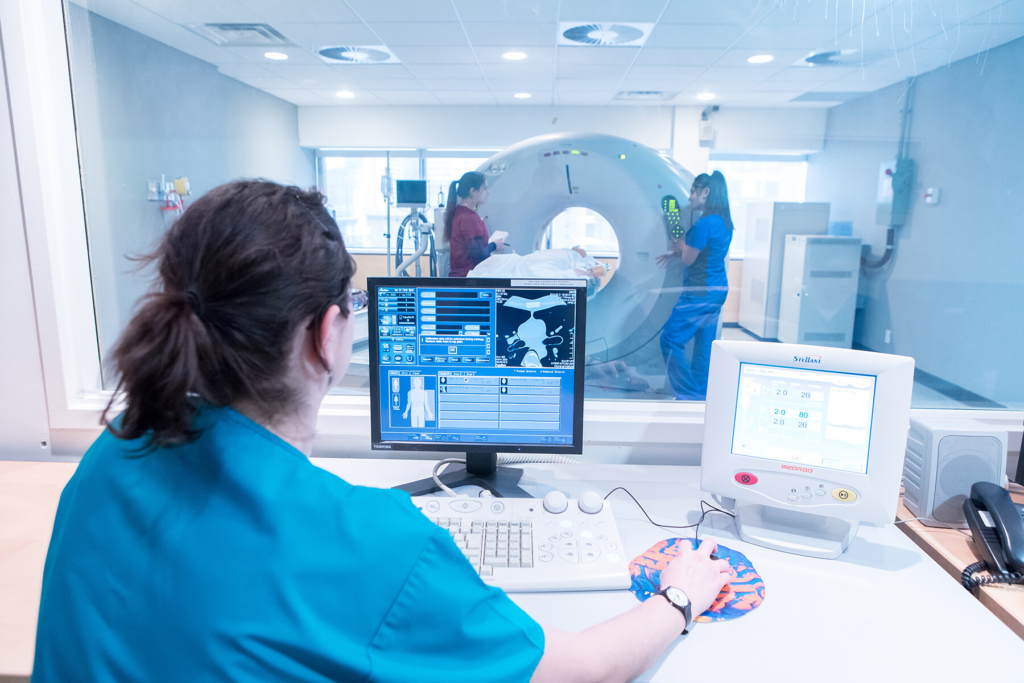
Emerging Trends & 2026 Opportunities
Technological Advances:
- AI-assisted imaging is creating new specialist roles
- Hybrid imaging (PET-CT, PET-MRI) requires dual certifications
- Tele-radiology support positions
- 3D printing from imaging data
Specialized Growth Areas:
- Oncology Imaging: Radiation therapy, PET scans
- Cardiovascular Imaging: Cardiac CT, vascular sonography
- Neurological Imaging: Functional MRI, neuro-interventional
- Musculoskeletal Imaging: Sports medicine, orthopedic centers
Immigration Policy Developments:
- Potential expansion of Schedule A occupations
- Healthcare worker-specific visa categories proposed
- Rural healthcare initiatives with immigration incentives
- State-specific programs for healthcare professionals
Resources & Professional Organizations
Essential Websites:
- ARRT.org (Primary certification)
- ASRT.org (Professional association, state licensure info)
- ARDMS.org (Ultrasound certification)
- IERF.org (Credential evaluation)
- USCIS.gov (Immigration forms and updates)
Professional Associations:
- American Society of Radiologic Technologists (ASRT)
- Society of Diagnostic Medical Sonography (SDMS)
- American Healthcare Radiology Administrators (AHRA)
- Radiological Society of North America (RSNA)
Job Boards Specializing in Imaging:
- RADWORKING.com
- ImagingCareers.org
- ASRT Career Center
- Hospital-specific career sites
Common Challenges & Solutions
Challenge 1: Non-Equivalent Education
Solutions:
- Bridge programs at US community colleges
- Clinical competency exams in some states
- Supplemental courses to fill educational gaps
- Consider starting as a limited license/X-ray technician while upgrading
Challenge 2: Visa Lottery Uncertainty
Solutions:
- Apply to cap-exempt employers initially
- Consider a J-1 visa with waiver planning
- Target rural/underserved areas for easier sponsorship
- Have a backup plan for timing
Challenge 3: State License Variations
Solutions:
- Research thoroughly before committing to a state
- Start with license-optional states if possible
- Use temporary/limited permits while completing requirements
- Consider compact states if agreements develop (monitor legislation)
Challenge 4: Cultural & Practice Differences
Solutions:
- US clinical rotations, if possible, before immigration
- Cultural competency training
- Mentorship programs through professional associations
- Observe US imaging departments via virtual tours or in-person visits
Success Strategies for 2026 Applicants
- Specialize Early: Choose high-demand modality (MRI, CT, Radiation Therapy)
- Certification Stack: Obtain multiple ARRT specialties before applying
- Network Strategically: Connect with department managers, not just HR
- Target Growth Regions: Sun Belt states have healthcare expansion
- Consider Alternative Settings: Outpatient centers often have easier sponsorship than hospitals
- Document Everything: Keep detailed records of all training, procedures, and cases
- Prepare for Exams Seriously: ARRT pass rates for international candidates are ~70%
- Understand the US Healthcare System: Insurance, protocols, patient communication styles
Alternative & Creative Pathways
Travel Technology Positions:
- Companies like Aureus Medical, Club Staffing often sponsor
- 13-week assignments across the US
- Higher pay, housing stipends
- Path to a permanent position at facilities you like
Vendor/Industry Roles:
- Equipment companies: GE Healthcare, Siemens Healthineers, Philips
- Applications specialist positions
- Sales/support roles
- Often easier to secure sponsorship than clinical positions
Academic/Research Institutions:
- University hospitals often have more immigration experience
- Research technologist positions
- Teaching opportunities
- May qualify for cap-exempt H-1B
Government Facilities:
- VA hospitals (Veterans Affairs)
- Military treatment facilities
- Public health departments
- Often have dedicated immigration support
The Future of Imaging Technology Immigration
Predicted 2026-2030 Trends:
- Increased automation but continued need for skilled operators
- Tele-presence allows remote guidance of imaging
- Global standardization of credentials is progressing slowly
- Immigration policies potentially favoring healthcare workers
- Specialization is becoming more critical for career advancement
Long-Term Career Planning:
- Consider advanced degrees for management roles
- Develop IT/PACS skills for hybrid roles
- Maintain flexibility to learn new modalities
- Build a professional network for career mobility
Conclusion: Your American Imaging Career Awaits
The United States offers imaging technologists exceptional career opportunities, competitive compensation, and the chance to work with cutting-edge technology. While the immigration pathway requires careful planning, significant investment, and persistence, the growing demand for skilled imaging professionals makes this an opportune time for internationally trained technologists to pursue American careers.
The key to success lies in strategic preparation: obtaining the right certifications, targeting receptive employers and states, and understanding the multi-step process from credential evaluation to visa sponsorship. By specializing in high-demand modalities and demonstrating both technical excellence and cultural adaptability, you can position yourself as a valuable candidate for US healthcare facilities.
Remember that each year, hundreds of international imaging technologists successfully navigate this process and build rewarding careers across the United States. With systematic preparation and professional guidance, you can join them in contributing to American healthcare while achieving your personal and professional goals.
Begin today with a careful assessment of your credentials against ARRT requirements, and take the first step toward your American imaging technology career.
