Healthcare Workers: When to Change Countries for Better PR Chances (2026)

For healthcare professionals seeking permanent residency abroad, strategic country selection and timing can dramatically impact your success timeline. This comprehensive guide analyzes when and why to consider changing destination countries to optimize your permanent residency prospects in 2026.

The Global PR Landscape for Healthcare in 2026

Permanent Residency (PR) vs. Citizenship:

  • PR: Right to live/work indefinitely in a country (pathway to citizenship)
  • Critical factor: Healthcare professionals have accelerated pathways in most countries
  • 2026 trend: Increasingly competitive with evolving rules

Country Rankings by PR Speed for Healthcare Workers:

Fastest to PR (< 2 years):

  1. Canada: Express Entry + French (6-12 months)
  2. New Zealand: Straight to Residence Green List (6-12 months)
  3. Australia: Regional sponsored pathways (12-18 months)

Medium Speed (2-3 years):
4. Germany: EU Blue Card + language (21-33 months)
5. UK: Health & Care Visa → ILR (5 years but stable)
6. Sweden: Work permit → Permanent residency (4 years)

Longer Term (3-5+ years):
7. USA: H-1B → Green Card (3-6 years+)
8. Switzerland: Permit L → Permit B → Permit C (5-10 years)
9. Japan: Highly Skilled Professional points (1-3 years)

The Strategic Country-Switching Framework

When Switching Countries Makes Sense:

Scenario 1: The “Points Stagnation” Problem

Situation: Stuck in Australia’s points pool at 75-85 points for years
Solution: Switch to Canada, where the healthcare category draws at 480-520 points
Example: Australian-trained nurse with 80 points for 189 visa → Canadian Express Entry with 500+ CRS

Scenario 2: The “Visa Lottery Limbo”

Situation: Multiple H-1B lottery failures in the USA
Solution: Move to Canada PR first, then potentially TN visa to the USA later
Example: Indian doctor failed H-1B 3x → Canada PR in 8 months → potentially USA later via TN

Scenario 3: The “Language Barrier Realization”

Situation: Struggling with German B2/C1 after 18 months
Solution: Switch to an English-speaking country where language isn’t a barrier
Example: Filipino nurse struggling with German → UK Health & Care Visa (English proficiency already proven)

Scenario 4: The “Dead-End Visa” Situation

Situation: On a temporary visa with no PR pathway in the current country
Solution: Strategic move to a country with clear healthcare PR pathways
Example: UAE nurse on employment visa (no PR pathway) → New Zealand Straight to Residence

Scenario 5: The “Family Timing” Pressure

Situation: Children approaching university age, needing PR for domestic fees
Solution: Move to a country with the fastest PR for healthcare + good education
Example: South African doctor with teens → Canada PR for domestic university fees

Country-by-Country Exit Analysis

When to Leave the USA for Better PR Chances:

Exit Triggers:

  1. 3+ H-1B lottery failures with no backup plan
  2. EB-2/EB-3 backlog from your country > 5 years (India, China, Philippines)
  3. J-1 waiver completion with no clear Green Card pathway
  4. Age > 40 and still on temporary visas with an uncertain future

Best Exit Destinations from the USA:

  • Primary: Canada (recognizes US experience, fast Express Entry)
  • Secondary: Australia (competent authority pathway for some professions)
  • Tertiary: UK (similar language, recognizes US qualifications)

Optimal Timing: After completing 2+ years of US experience (valuable for points)

When to Leave the UK for Better PR Chances:

Exit Triggers:

  1. Approaching 5-year ILR but salary below £38,700 threshold (2026 requirement)
  2. NHS burnout with desire for better work-life balance
  3. Brexit-related uncertainty affecting long-term plans
  4. Family wanting faster citizenship (UK: 6 years vs Canada: 3 years)

Best Exit Destinations from UK:

  • Primary: Australia (similar system, recognizes UK qualifications)
  • Secondary: Canada (Commonwealth preference, language advantage)
  • Tertiary: New Zealand (similar culture, straight to residence for healthcare)

Optimal Timing: After obtaining full UK registration (valuable for recognition elsewhere)

When to Leave Australia for Better PR Chances:

Exit Triggers:

  1. Points stagnation (<85 points for 189/190 visas for 12+ months)
  2. Regional commitment dissatisfaction (stuck in a rural area for a visa)
  3. Age points decrease (losing 5-10 points as you age)
  4. Skills assessment expiring with no invitation

Best Exit Destinations from Australia:

  • Primary: Canada (reciprocal qualification recognition in some fields)
  • Secondary: New Zealand (trans-Tasman agreement, easy movement)
  • Tertiary: UK (Health & Care Visa, similar language)

Optimal Timing: Before skills assessment expires (2-year validity)

When to Leave the Middle East for PR Opportunities:

Exit Triggers:

  1. Contract ending with no long-term residency options
  2. Savings accumulated are ready to invest in the PR country
  3. Children reaching school age need a stable education system
  4. Career stagnation in temporary positions

Best Exit Destinations from the Gulf:

  • Primary: Canada (points for foreign experience, fast processing)
  • Secondary: Australia (regional sponsored pathways)
  • Tertiary: UK (Health & Care Visa, language advantage)

Optimal Timing: After 3-5 years, tax-free savings accumulated

The “Two-Step” or “Three-Step” Immigration Strategy

The Canada-Australia-UK Triangle Strategy:

Step 1: Gain registration and experience in the most accessible country
Step 2: Transfer to a country with better PR pathways
Step 3: Optional: Move to ideal long-term destination

Example Pathways:

Pathway A: UK → Canada

  1. 2 years UK NHS experience
  2. Canada Express Entry with high CRS (UK experience + language)
  3. Canadian PR in 6 months
  4. Optional: Canadian citizenship → TN visa to USA

Pathway B: Australia → Canada

  1. Australian registration + 1 year experience
  2. Canadian PR via Express Entry
  3. Work in Canada 3 years
  4. Canadian citizenship → E-3 visa to USA (Australians only)

Pathway C: USA → Canada → Optional Return

  1. US experience (even without a Green Card)
  2. Canada PR via Express Entry (recognizes US experience)
  3. Canadian citizenship
  4. Return to the USA via TN (Canadians only) or explore other options

The “Bridge Country” Strategy:

Concept: Use a country as a stepping stone to the ultimate destination

Example 1: Caribbean/Indian medical graduate → UK → Canada

  • Medical degree not directly recognized in Canada
  • UK PLAB pathway is easier
  • UK experience, then Canadian PR via Express Entry

Example 2: African nurse → Saudi Arabia → Australia

  • Saudi for savings and experience
  • Australia regional sponsorship
  • Faster than direct from Africa due to financial readiness

Example 3: European doctor → Ireland → Australia/Canada

  • EU qualifications recognized in Ireland
  • English-speaking experience in Ireland
  • Then Australia/Canada with English advantage

Timing Your Move: The 2026 Calendar

Best Times to Initiate Country Change:

Q1 (Jan-Mar):

  • Advantage: Start process for academic year transitions (if children)
  • Countries: Canada Express Entry draws consistently year-round
  • Consider: The Australian financial year starts in July, plan accordingly

Q2 (Apr-Jun):

  • Critical: USA H-1B lottery results known by June
  • Action: If the H-1B failed, initiate alternative country plans
  • Note: UK NHS recruitment often peaks in spring

Q3 (Jul-Sep):

  • Advantage: Australian points test changes announced in July
  • Action: Decide Australia vs other destinations based on changes
  • Note: Canadian fall often has increased PNP nominations

Q4 (Oct-Dec):

  • Advantage: Complete moves before holiday slowdown
  • Consider: UK Health & Care Visa processing slows in December
  • Action: Submit applications before year-end administrative closures

Age-Based Timing Considerations:

Under 30: Maximum flexibility, can afford 2-step approaches
30-35: Prime age for points systems, act before losing age points
35-40: Some point systems penalize, consider countries valuing experience
40+: Focus on countries with employer sponsorship rather than points

Family Lifecycle Timing:

Pre-children: Maximum risk tolerance, can try multiple countries
Young children (<5): Good mobility, consider education systems long-term
School-age children: Time moves with academic years, minimize disruption
Teenagers: Prioritize stability for final school years and university planning

The Points System Arbitrage Strategy

Comparing Points Systems (2026 Estimates):

Points FactorAustraliaCanadaNew Zealand
Age (30-35)3010530
Masters Degree1513570
Experience (5 yrs)158050
English Superior2014050
Second Language050-700
Job Offer5-1550-20050
Regional10-150-60030
Invitation Threshold85-95480-520180-200

Arbitrage Opportunities:

If You Have French Skills:

  • Canada: Up to 70 additional CRS points
  • Strategy: Focus on Canada regardless of other factors

If You Have UK/Australian Experience:

  • Canada: Recognized for CRS points
  • Australia: Local experience valued more than overseas
  • Strategy: Gain experience in the UK/Australia then move to Canada

If You Have US Experience but No Green Card:

  • Canada: US experience recognized and valued
  • Australia: Competent authority pathway for some US-trained
  • Strategy: Use US experience as a stepping stone

The “Lowest Hanging Fruit” Analysis:

For Nurses:

  1. New Zealand: Straight to Residence Green List
  2. Canada: Express Entry healthcare draws
  3. UK: Health & Care Visa (5 years to ILR but stable)

For Doctors:

  1. Canada: Provincial nominations for physicians
  2. Australia: Competent authority pathway for some
  3. New Zealand: Straight to Residence for GPs

For Allied Health:

  1. Australia: Regional sponsored pathways
  2. Canada: Express Entry with a job offer
  3. UK: Health & Care Visa for eligible roles

Financial Considerations in Country Switching

Cost-Benefit Analysis Framework:

Calculate:

  1. Current Country Earnings × Years to PR (if staying)
  2. New Country Earnings × Years to PR (if moving)
  3. Switching Costs: Visa fees, relocation, lost income during transition
  4. Long-Term Value: Citizenship benefits, passport strength, retirement

Example Comparison:

USA H-1B → Green Card Pathway:
- Time: 5-10 years (India/Philippines backlog)
- Salary: $150,000 USD average
- Uncertainty: High (lottery, layoff risks)
- Total 10-year earnings: ~$1.5M

Canada Express Entry:
- Time: 1-2 years to PR
- Salary: $100,000 CAD average
- Certainty: High (points-based transparent)
- Total 10-year earnings: ~$1M CAD + citizenship in 3 years

Switching Cost: $20,000 + 6 months lower income
Net Benefit: Canadian citizenship + stability vs higher US earnings

The “Earn in USD, Retire in CAD/AUD” Strategy:

Approach:

  1. Work in the Middle East/USA for high savings
  2. Accumulate $100,000+ tax-free/in a high salary
  3. Move to Canada/Australia/NZ with a financial cushion
  4. Purchase property immediately upon arrival
  5. Work at a local salary but with a significant head start

Timing: Switch when savings target met (typically 3-5 years in a high-earning location)

Tax Implications of Country Switching:

Key Considerations:

  1. Exit taxes: Some countries tax unrealized gains when leaving
  2. Pension transfers: International pension planning
  3. Double taxation agreements: Between origin and destination
  4. Wealth taxes: Some European countries have annual wealth taxes

Professional Advice: Essential for complex moves, especially with significant assets

Click Here To Learn More: How to Switch Employers on a UK Healthcare Visa in 2026

Risk Assessment in Country Switching

Low-Risk Moves:

  • Commonwealth country to Commonwealth country: Similar systems
  • English-speaking to English-speaking: Language advantage maintained
  • Temporary visa to PR pathway: Clear upgrade in immigration status
  • Within the same healthcare system model, the NHS is similar to the Australian public system

Medium-Risk Moves:

  • Different language requirements: Adding language learning time
  • Different qualification recognition: May need bridging/assessments
  • Economic uncertainty: Moving during a recession in the destination
  • Family disruption: School changes, spouse career impacts

High-Risk Moves:

  • Leaving PR/citizenship pathway in progress: Restarting clock elsewhere
  • Moving to a country with an aging population, healthcare crises, and Sustainability concerns
  • Political instability in the destination: Changing immigration policies
  • Professional devaluation: Senior role in origin to junior in destination

Risk Mitigation Strategies:

  1. Parallel applications: Apply to multiple countries, choose the best offer
  2. Phased approach: Temporary visa first, assess before committing to PR
  3. Reconnaissance visits: Work short-term before permanent move
  4. Contingency planning: Keep options open in the origin country if possible

The Digital Nomad Healthcare Professional

Emerging 2026 Opportunities:

  1. Telehealth roles: Allowing location independence
  2. Medical writing/consulting: Digital healthcare services
  3. Healthcare tech companies: Remote positions in digital health
  4. International organizations: WHO, NGOs with flexible locations

Country Options for Digital Healthcare Workers:

  • Portugal: D7/D8 visas for remote workers
  • Spain: Digital Nomad Visa
  • UAE: Virtual Working Programme
  • Barbados: Welcome Stamp
  • Georgia: Remote Worker visa

Strategy: Use digital nomad visas to experience countries before committing to the PR pathway

Children & Family Considerations

Education-Driven Timing:

Critical Decision Points:

  1. Before primary school: Maximum flexibility
  2. Before high school: Settle in the final destination for uninterrupted education
  3. Before university: Establish residency for domestic tuition fees

Country Comparisons for Education:

  • Canada: PR → domestic tuition in 3 years (some provinces immediately)
  • Australia: PR → domestic tuition immediately
  • UK: ILR → domestic tuition immediately
  • USA: Green Card → domestic tuition immediately

Special Needs Considerations:

Country Support Systems Vary Dramatically:

  • Canada/Australia/UK: Strong public support systems
  • USA: Variable by state, often insurance-dependent
  • Middle East: Limited support, often private only

Strategy: Research destination country support before moving with special needs family members

Elderly Parent Considerations:

Parent Visa Options:

  • Canada: Super Visa (long-stay visitor visa)
  • Australia: Contributory Parent Visa (expensive, long queue)
  • UK: Adult Dependent Relative (very strict requirements)
  • New Zealand: Parent Retirement Category (investment required)

Strategy: Consider which countries allow family reunification if important

The 2026 Political Landscape Impact

Upcoming Elections Impacting Immigration:

2024 Elections (Affecting 2026 Policy):

  • USA: Presidential election (Nov 2024)
  • UK: General election (by Jan 2025)
  • EU Parliament: (June 2024)

Potential Scenarios:

  • Conservative governments elected: Tighter immigration, higher thresholds
  • Pro-immigration governments: Expanded pathways, faster processing
  • Coalition governments: Policy uncertainty, implementation delays

Geopolitical Factors:

  • US-China tensions: May affect researcher mobility
  • Russia-Ukraine war: European migration pattern changes
  • Middle East stability: Gulf state recruitment variations
  • Climate migration: Increasing pressure on healthcare systems

Strategy: Have flexible plans that can adapt to political changes

Health & Aging Considerations

Healthcare System Comparisons:

For Healthcare Workers Themselves:

  • Pre-existing conditions: Coverage varies by country
  • Aging healthcare workforce: Support for older workers differs
  • Retirement healthcare: Some countries have better aged care for healthcare retirees

Country Rankings for Healthcare Worker Benefits:

  1. Scandinavia: Strong worker protections, excellent benefits
  2. Canada/Australia: Good public systems with decent benefits
  3. UK: NHS has strong worker benefits, but system pressures
  4. USA: Variable by employer, often good insurance but high costs

Retirement Planning:

Pension Portability Issues:

  • UK NHS pension: Can be frozen or transferred (complex)
  • Australia Superannuation: Generally portable
  • Canada RRSP: Retirement account system
  • USA 401 (k): Can maintain, but tax implications when withdrawing abroad

Strategy: Consider retirement destination early in career moves

The “Forever Home” vs. “Stepping Stone” Decision

Questions to Determine Your Strategy:

  1. What is your ultimate citizenship goal?
    • Powerful passports (USA, Canada, Germany, Australia all strong)
    • Specific lifestyle (climate, culture, language)
    • Family proximity
  2. How mobile do you want to remain?
    • Settle permanently in the next destination
    • Keep options open for further moves
    • Plan to return to the home country eventually
  3. What are your non-negotiable requirements?
    • Education system for children
    • Healthcare for family members
    • Climate preferences
    • Cultural/religious community availability

The 10-Year Vision Exercise:

Imagine yourself in 2036:

  • Where are you living?
  • What citizenship(s) do you hold?
  • Where are your children educated/working?
  • Where will you retire?

Work backward to determine 2026 actions

Success Stories: Strategic Country Switching

Case Study 1: Indian Doctor → USA → Canada

Path: MBBS India → USMLE → H-1B failed 3x → Canada Express Entry
Timeline: 5 years USA (residency + work) → 8 months Canada PR
Result: Canadian PR, working in Ontario, eligible for citizenship in 2027
Key Insight: “Should have applied to Canada directly after residency.”

Case Study 2: Filipino Nurse → Saudi → Australia

Path: Philippines BSN → Saudi Arabia 4 years → Australia 482 → 186 PR
Timeline: 4 years Saudi → 2 years Australia regional → PR
Result: Australian PR, bought a house in Queensland
Key Insight: “Saudi savings allowed immediate house purchase in Australia.”

Case Study 3: Nigerian Doctor → UK → Canada

Path: Nigeria MBBS → UK PLAB → NHS 3 years → Canada Express Entry
Timeline: 3 years UK → 6 months Canada PR process
Result: Canadian PR, higher salary than UK, family reunited
Key Insight: “UK experience gave maximum CRS points for Canada.”

Case Study 4: Brazilian Dentist → Portugal → Ireland → Australia

Path: Brazil DDS → Portugal (language advantage) → Ireland (EU recognition) → Australia
Timeline: 2 years Portugal → 2 years Ireland → Australia skills assessment
Result: Australian PR via 189 visa, dental practice in Sydney
Key Insight: “Used EU mobility to reach English-speaking countries with a good PR pathway.”

The Decision Matrix: Should You Switch Countries?

Score Your Situation:

Add 1 point for each YES answer:

  1. Is your current PR pathway > 3 years away?
  2. Have you been in a points pool > 12 months without invitation?
  3. Is your visa tied to a single employer with no PR guarantee?
  4. Are you >35 years old and losing points in the current system?
  5. Do you have language skills that aren’t valued in your current country?
  6. Is your profession on priority lists in other countries?
  7. Do you have savings to cover switching costs?
  8. Is your family situation flexible for moving?
  9. Are there political uncertainties in your current destination?
  10. Do you have qualifications recognized in multiple countries?

Scoring:

  • 0-3 points: Stay put, optimize current pathway
  • 4-6 points: Research alternatives, prepare exit strategy
  • 7-10 points: Seriously consider switching, begin planning immediately

The “No Regrets” Minimum Viable Move:

If uncertain, take these steps:

  1. Get skills assessed in 2-3 potential destination countries
  2. Take language tests even if not immediately needed
  3. Build savings equivalent to 6 months’ expenses + moving costs
  4. Network with professionals in potential destination countries
  5. Consult immigration professionals about multiple pathways

Implementation Timeline for 2026 Country Switch

6-Month Preparation Phase:

Month 1-2: Research & Assessment

  • Identify 2-3 potential destination countries
  • Complete preliminary points calculations
  • Research qualification recognition processes
  • Estimate costs and timeline

Month 3-4: Skill & Document Preparation

  • Begin any needed skills assessments
  • Take the required language tests
  • Gather documentation (employment records, qualifications)
  • Update professional portfolio

Month 5-6: Application Initiation

  • Submit primary applications
  • Begin job search in destination countries
  • Plan financial transition
  • Consult with immigration professionals

3-6 Month Transition Phase:

  • Receive invitations/approvals
  • Secure job offers
  • Submit visa applications
  • Give notice to current employer
  • Plan relocation logistics

Settlement Phase:

  • Arrive in a new country
  • Complete any registration requirements
  • Begin employment
  • Initiate PR application if not already done

Conclusion: Your 2026 Strategic Mobility Plan

For healthcare professionals in 2026, strategic country selection and timing are not just about immediate opportunities but about optimizing your entire career and your family’s future. The global demand for healthcare skills creates unprecedented mobility options, but requires careful planning to maximize PR chances.

Key 2026 Principles:

  1. Don’t let sunk costs dictate future decisions: Time spent in a country without PR progress isn’t wasted if you leverage that experience elsewhere.
  2. Points systems reward strategic moves: Sometimes a lateral move accelerates your vertical progression.
  3. Family timing is immigration timing: Align country moves with education milestones and family needs.
  4. Multiple citizenships are healthcare career insurance: Each additional passport expands future options.
  5. The best country is the one where you can build the life you want, not just the one with the fastest PR.

Final Recommendation:
Conduct a thorough audit of your current trajectory versus alternative pathways. If you’re in a slow or uncertain PR pathway, 2026 may be the year to make a strategic pivot. The healthcare skills shortage means your qualifications are globally valuable—position yourself where they’re most valued for long-term stability.

Begin today by researching just one alternative destination. You might discover that a country switch could cut years off your PR timeline and dramatically improve your family’s prospects. Your healthcare skills are your ticket to global mobility—use them strategically.

How to Switch Employers on a UK Healthcare Visa in 2026

Switching employers while on a UK healthcare visa requires careful navigation of immigration rules, sponsorship transfers, and professional registration requirements. This comprehensive guide details the step-by-step process, 2026-specific considerations, and strategies for a smooth transition between healthcare employers in the UK.

Understanding Your Current Visa Status

UK Healthcare Visa Categories (2026):

  1. Health and Care Worker Visa:
    • Most common for healthcare professionals
    • Validity: Up to 5 years
    • Benefits: Reduced fee, exempt from Immigration Health Surcharge
    • Tied to: Specific employer (sponsor)
  2. Skilled Worker Visa:
    • For healthcare roles not on the shortage list
    • Higher costs: £1,423 application fee + Immigration Health Surcharge
    • Same sponsorship requirements as the Health and Care visa
  3. Temporary Worker – Government Authorised Exchange:
    • For training or research positions
    • Maximum 12 months
    • More restrictive for employer switching

Critical 2026 Updates:

  • Salary threshold increase: £38,700 by 2026 for Skilled Worker (Health and Care exempt)
  • Certificate of Sponsorship (CoS) allocations: May be limited for some trusts
  • Increased compliance checks: On both previous and new employers
  • Digital Right to Work checks: Mandatory for all employers

Pre-Switch Assessment: Are You Eligible to Change Employers?

Check Your Current Visa Conditions:

  1. Visa type: Health and Care Worker or Skilled Worker visas allow employer changes
  2. Visa validity: Minimum 6 months remaining recommended
  3. No employment restrictions: Some visas limit work type/hours
  4. Current employer compliance: No unresolved issues with Home Office

Professional Registration Considerations:

  • NMC PIN: Must remain valid and in good standing
  • GMC registration: Check if the new role requires a different registration type
  • HCPC registration: For allied health professionals
  • Specialist registers: May need transfer between employers

Contractual Obligations to Current Employer:

  • Notice period: Typically 1-3 months in the NHS
  • Training repayment clauses: Common for international recruitment packages
  • Relocation repayment: If within the repayment period (usually 1-3 years)
  • Bond agreements: Check for financial penalties for early departure

Step-by-Step Process for Switching Employers in 2026

Phase 1: Preparation & Job Search (1-3 Months)

Step 1: Understand Your Notice Period

NHS Standard Notice Periods:

  • Band 5-6: 1 month notice
  • Band 7-8a: 3 months’ notice
  • Consultants: 3-6 months’ notice

Private Sector: Varies, check contract

Strategy: Begin job search 2-3 months before intended departure

Step 2: Secure New Job Offer

2026 Job Search Channels:

  1. NHS Jobs: https://www.jobs.nhs.uk
  2. Trust-specific career sites
  3. Specialist healthcare recruiters
  4. Professional networks and referrals

Key Requirements for New Offer:

  • Salary: Must meet visa requirements (£20,960 minimum or going rate)
  • Role: Must be eligible for Health and Care Worker visa
  • Sponsor license: Employer must have a valid license
  • CoS allocation: Employer must have available Certificate of Sponsorship

Step 3: Verify New Employer’s Sponsorship Capability

Essential Checks:

  1. Sponsor license validity:
  2. CoS availability:
    • Employers have annual allocations
    • Some may need to request additional CoS
    • Can take 1-4 weeks if allocation is exhausted
  3. Compliance history:
    • Ask about previous sponsorship experience
    • Check if any compliance actions against the sponsor
    • Speak to other sponsored employees if possible

Phase 2: Resignation & Transition (1-2 Months)

Step 4: Formal Resignation

Best Practices:

  1. Written resignation: Email + formal letter
  2. Professional tone: Maintain positive relationships
  3. Clear end date: Align with notice period
  4. Offer transition support: Handover, training replacement

Dealing with Repayment Clauses:

  • Review the contract carefully
  • Negotiate: Some employers waive if leaving for another NHS role
  • Payment plans: May be possible if the lump sum is difficult
  • Legal advice: If the clause seems unreasonable or unenforceable

Step 5: Secure New Certificate of Sponsorship (CoS)

2026 CoS Process:

  1. New employer requests CoS via Sponsor Management System
  2. CoS type: “Change of Employment” (not new application)
  3. Information required:
    • Your personal details
    • Job details (SOC code, salary, location)
    • Start date (must be after current employment ends)
    • Proof of qualifications and registration
  4. CoS issuance: Typically 1-5 working days
  5. CoS details: 9-digit number needed for visa application

Step 6: Submit Visa Application

2026 Application Process:

  1. Timing: Apply before the current visa expires, after receiving the CoS
  2. Online application: https://www.gov.uk/health-care-worker-visa/switch-to-this-visa
  3. Documents required:
    • CoS reference number
    • Proof of identity (passport)
    • Proof of relationship (if dependents switching with you)
    • Criminal record certificate (if required for your role)
    • TB test results (if from the listed country)
  4. Fees (2026 estimates):
    • Health and Care Worker Visa: £247 (up to 3 years)
    • Skilled Worker Visa: £1,423 (up to 3 years)
    • Priority service: £500 (5 working day decision)
    • Super priority service: £1,000 (next working day)
  5. Immigration Health Surcharge:
    • Health and Care Workers: EXEMPT
    • Skilled Workers: £1,035 per year per person

Phase 3: Implementation & Compliance (First Month at New Job)

Step 7: Start New Employment

Critical Timing:

  • Cannot start until a new visa is granted
  • Gap between jobs: Keep to a minimum, maintain continuous residence
  • Right to Work check: The New employer must complete this before you start

Professional Registration Update:

  • Notify NMC/GMC/HCPC of employer change
  • Update contact details with the regulatory body
  • Check if the new role requires additional registration

Step 8: Notify the Previous Employer’s Compliance

Legal Requirement: The Previous sponsor must report your departure

  • Report via SMS: Within 10 working days of your last day
  • Update sponsorship records: Mark you as “leaving employment”
  • Return BRP? Only if the visa was tied solely to that employer (uncommon)

Step 9: Update Home Office Records

Your Responsibilities:

  1. Report change of employer: Through the online account
  2. Update contact details: If moving accommodation
  3. Maintain evidence: Keep records of employment dates and visas
  4. BRP update: May need a new BRP if significant details change

2026-Specific Considerations & Challenges

Increased Compliance Scrutiny:

New 2026 Requirements:

  1. Digital Right to Work checks: Mandatory for all employers
  2. Enhanced sponsor audits: More frequent compliance visits
  3. Salary verification: Stricter checks against going rates
  4. Role suitability assessments: Ensuring role matches SOC code

Protection Strategy:

  • Keep meticulous records of all communications
  • Ensure job description matches the SOC code exactly
  • Verify salary meets 2026 requirements early
  • Use official channels for all visa communications

NHS Workforce Pressures:

2026 Context: NHS is experiencing severe staffing shortages
Impact on Employer Switching:

  • Current employers may resist releasing staff
  • Some trusts are implementing retention strategies
  • Moral considerations: Leaving understaffed departments

Ethical Switching Strategy:

  • Provide adequate notice and handover
  • Consider internal transfers within the same trust
  • Explore flexible arrangements (part-time, job share)
  • Maintain professional relationships

Brexit Legacy Issues:

2026 Implications:

  • EU qualifications: Now the same process as non-EU qualifications
  • Recognition delays: Some European qualifications are taking longer
  • Language requirements: Stricter for all non-UK qualifications

Mitigation:

  • Start NMC/GMC registration early with a new employer
  • Ensure qualifications are recognised before a job offer
  • Prepare for potential additional testing

Special Scenarios & Complex Cases

Scenario 1: Switching from NHS to Private Sector

Additional Considerations:

  1. Pension implications: NHS Pension vs. private pension
  2. Terms and conditions: Often less favourable in the private sector
  3. Sponsorship experience: Private employers may have less experience
  4. Registration requirements: May differ between sectors

Due Diligence Checklist:

  • Verify the private employer’s sponsorship track record
  • Compare total compensation package (not just salary)
  • Understand career progression opportunities
  • Check regulatory compliance history

Scenario 2: Moving Between UK Nations

England ↔ Scotland ↔ Wales ↔ Northern Ireland
Key Differences:

  1. Healthcare systems: Slightly different structures
  2. Registration: Separate processes for some professions
  3. Pay scales: Different NHS pay agreements
  4. Sponsorship: Different health board systems

Preparation:

  • Research the destination nation’s healthcare system
  • Check registration requirements with the national body
  • Understand any additional language requirements (Wales)
  • Verify the sponsor license of the new health board/trust

Scenario 3: Changing Healthcare Profession

Example: Nurse moving to management, doctor moving to research
Visa Implications:

  1. New SOC code: May require a different visa category
  2. Salary requirements: Different going rates
  3. Registration: May not need clinical registration for non-clinical roles
  4. Sponsorship: Employer must still be licensed for the new SOC code

Process:

  • Verify the new role is eligible for sponsorship
  • Check if it requires a different regulatory registration
  • Ensure salary meets requirements for new SOC code
  • May need a new CoS with a different classification

Scenario 4: Gap Between Employment

Risks of Employment Gaps:

  • Visa validity: Must maintain a valid visa throughout
  • Continuous residence: Gaps may affect the settlement timeline
  • Financial requirements: Must support yourself during the gap
  • Professional registration: Must maintain active registration

Safe Gap Management:

  • Keep the gap under 60 days if possible
  • Maintain a valid visa (apply for extension if needed)
  • Consider temporary/locum work through an agency
  • Keep NMC/GMC registration active and in good standing

Click Here To Learn More: Avoiding Healthcare Immigration Mistakes in Australia & New Zealand (2026 Guide)

Financial Considerations for 2026

Cost Breakdown for Employer Switch:

ExpenseCost (2026 Estimate)Who Pays
CoS allocation£199 (employer cost)Employer
Visa application£247-£1,423Usually employee
Priority processing£500-£1,000Optional/employee
Legal advice£500-£2,000Optional/employee
Registration fees£120-£1,500Employee
Relocation costsVariableOften employee
Repayment clausesUp to £10,000+Employee if applicable

Negotiating Relocation Package:

What to Request from New Employer:

  • Visa application fees reimbursement
  • Legal fee coverage
  • Temporary accommodation (2-4 weeks)
  • Relocation allowance (£2,000-£5,000)
  • Registration fee payment
  • Travel costs for interviews/relocation

NHS vs. Private Sector:

  • NHS: Standard packages are often available
  • Private: More negotiation possible, but less standardised

Tax Implications:

Key Considerations:

  1. P45/P60: Ensure correct tax coding transfer
  2. Student loan repayments: Continue correctly
  3. Pension contributions: NHS vs. private differences
  4. Benefits in kind: Relocation packages may be taxable
  5. Professional fees: May be tax-deductible

Action: Consult with an accountant familiar with UK healthcare immigration

Professional Registration Transfer Process

For Nurses (NMC):

Steps to Update NMC:

  1. Online account: Log in to NMC Online
  2. Update employer: In the employment details section
  3. Verify new employer: May require confirmation
  4. Update contact details: Especially if moving
  5. Renewal timing: Ensure PIN renewal is aligned with new employment

Special Considerations:

  • Revalidation: Ensure dates align with employment change
  • Scope of practice: Verify new role within scope
  • Temporary registration: If moving to a different type of setting

For Doctors (GMC):

Employer Change Process:

  1. GMC Online: Update employment details
  2. License to practice: Ensure it covers the new employment type
  3. Revalidation: Inform the responsible officer at the new employer
  4. Specialist register: Update if changing specialities

Additional Requirements:

  • Designated body: Must have one for revalidation
  • Responsible officer: Assigned by the new employer
  • Appraisal: Schedule with the new employer’s system

For Allied Health (HCPC):

Registration Update:

  1. Online portal: Update employer information
  2. CPD requirements: Ensure continuity
  3. Scope of practice: Confirm new role within scope
  4. Renewal: Align with employment dates

Avoiding Common Pitfalls in 2026

Pitfall 1: Starting Too Early at a New Job

Consequence: Illegal working, visa cancellation, ban from the UK
2026 Enforcement: Digital Right to Work checks make this almost impossible to hide

Solution:

  • Wait for formal visa approval
  • Complete Right to Work check with new employer
  • Get confirmation in writing before starting

Pitfall 2: Gap in Sponsorship

Consequence: Breach of visa conditions, which affects the settlement timeline
Solution:

  • Ensure CoS dates align with employment dates
  • Apply for a visa change before the current visa expires
  • Consider priority processing if timing is tight

Pitfall 3: Salary Below Threshold

2026 Thresholds:

  • Health and Care Worker: £20,960 or going rate (whichever is higher)
  • Skilled Worker: £38,700 or going rate (whichever is higher)

Solution:

  • Verify the going rate for the exact SOC code
  • Get salary confirmation in writing
  • Ensure meets 2026 minimums

Pitfall 4: Incorrect SOC Code

Consequence: Visa refusal, compliance issues for the employer
Solution:

  • Match the job description exactly to the SOC code
  • Use official ONS SOC 2020 classifications
  • Consult with the employer’s immigration team

Pitfall 5: Overlooking Repayment Clauses

Consequence: Significant financial liability
Solution:

  • Review the original contract carefully
  • Negotiate a waiver or reduction
  • Seek legal advice if a substantial amount

Impact on Settlement (ILR) Timeline

Continuous Residence Requirements:

For ILR after 5 years:

  • Must maintain continuous lawful residence
  • Gaps between employment should be minimal
  • Must meet salary requirements throughout

Employer Switch Impact:

  • No reset of the 5-year clock if switching sponsors
  • Maintains continuity if done correctly
  • Evidence needed: Keep all visas and employment records

Salary Requirements for ILR:

2026 ILR Salary Threshold: £38,700 (subject to confirmation)
Health and Care Workers: May have different requirements

Strategy: Ensure salary progression meets ILR requirements by year 5

Absences from the UK:

Switching employers may involve:

  • Travel for interviews
  • Brief return to the home country between jobs
  • Holiday during notice period

Rule: Must not exceed 180 days of absence in any 12 months

Employer Perspectives & Negotiation Strategies

What New Employers Want (2026):

  1. Smooth transition: Minimal disruption to service
  2. Compliance certainty: No visa issues
  3. Retention likelihood: Plan to stay with them
  4. Skills match: Exactly what they need

Negotiation Points:

During the Offer Stage:

  1. Visa costs: Who pays what
  2. Relocation support: Package details
  3. Start date flexibility: Align with visa processing
  4. Contract terms: Notice period, probation

If Counteroffer from Current Employer:

  • Consider carefully before accepting
  • May affect future sponsor relationships
  • Ensure any promises are in writing

Exit Strategy with Current Employer:

Professional Approach:

  1. Give proper notice: Respect contractual obligations
  2. Offer handover: Train replacement if possible
  3. Leave positively: Maintain professional network
  4. Complete obligations: Repayment agreements, equipment return

Digital Transformation & 2026 Processes

Online Systems You’ll Use:

  1. Sponsor Management System (SMS): Employer uses for CoS
  2. UKVI Online Application: For visa submission
  3. UK Immigration: ID Check app: For biometrics
  4. Right to Work Share Code: Digital proof for new employer

Biometric Reuse (2026 Enhancement):

  • May not need new biometrics if recent ones are on file
  • Digital identity verification is expanding
  • Faster processing for low-risk applicants

Document Upload Standards:

  • Format: PDF or JPEG
  • Size: Under 6MB per document
  • Quality: Clear, legible, colour
  • Naming: Descriptive names (e.g., “Passport_BioPage.pdf”)

Emergency Situations & Problem Resolution

If Visa Delayed:

Options:

  1. Priority services: Available for most applications
  2. Escalation process: After the standard processing time has exceeded
  3. MP involvement: Can inquire on your behalf
  4. Legal action: Judicial review for unreasonable delay

If Job Offer Withdrawn:

Immediate Actions:

  1. Do not resign from your current position
  2. Seek clarification from the new employer
  3. Consult an immigration advisor
  4. Consider interim options (agency work, extension with current employer)

If Current Employer Refuses to Release:

Legal Position:

  • Cannot force you to stay beyond the notice period
  • Can enforce contractual terms (repayment clauses)
  • Must report departure to the Home Office

Strategy:

  • Formal resignation in writing
  • Seek HR mediation if needed
  • Legal advice for contractual disputes

Timeline Summary for 2026 Employer Switch

Optimal 4-Month Timeline:

Month 1: Preparation

  • Research new opportunities
  • Update CV and professional profiles
  • Check current visa conditions
  • Review the contract for obligations

Month 2: Job Search & Offer

  • Apply for positions
  • Interviews and selection process
  • Receive and negotiate the offer
  • Verify the new employer’s sponsorship capability

Month 3: Resignation & Application

  • Give formal notice to current employer
  • New employer requests CoS
  • Submit the visa application
  • Begin handover at current job

Month 4: Transition

  • Receive visa decision
  • Complete notice period
  • Start new employment
  • Update professional registration

Fast-Track 8-Week Timeline (Possible with Priority):

  • Week 1-2: Secure job offer
  • Week 3: Resign and receive CoS
  • Week 4: Submit visa with priority service
  • Week 5: Receive visa decision
  • Week 6-7: Complete notice period
  • Week 8: Start new role

Post-Switch Compliance & Future Planning

First Month at New Job Checklist:

  • Right to Work check completed
  • Professional registration updated
  • Tax code correct (check first payslip)
  • Pension enrollment processed
  • Induction completed
  • Revalidation/appraisal schedule confirmed
  • Home Office records updated if needed

Long-Term Career Planning:

After Successful Switch:

  1. Settlement timeline: Track progress toward ILR
  2. Career progression: Ensure meets future salary requirements
  3. Professional development: Maintain registration and revalidation
  4. Network building: Establish in a new organisation

Next Switch Considerations:

  • Wait at least 12 months, ideally
  • Build a strong performance record
  • Understand the new employer’s sponsorship policies
  • Plan for any future repayment clauses

Resources & Support for 2026

Official Government Resources:

  1. Home Office Sponsor Guidance: https://www.gov.uk/government/publications/sponsor-a-tier-2-or-5-worker
  2. Healthcare Worker Visa Information: https://www.gov.uk/health-care-worker-visa
  3. Sponsor Register: https://www.gov.uk/government/publications/register-of-licensed-sponsors-workers

Professional Support:

  1. Immigration advisors: OISC-regulated level 2 or 3
  2. Professional unions: RCN, BMA, Unison
  3. NHS Employers organisation: Guidance for healthcare professionals
  4. Regulatory bodies: NMC, GMC, HCPC advice services

Financial & Legal:

  1. Citizens Advice: Free immigration guidance
  2. Legal aid: May be available for some situations
  3. Tax advisors: Specialists in healthcare professionals
  4. Contract review services: Through professional unions

Conclusion: Successful Employer Switching in 2026

Switching employers on a UK healthcare visa in 2026 requires careful planning, strict adherence to immigration rules, and professional handling of transitions. While the process involves multiple steps and considerations, thousands of healthcare professionals successfully navigate employer changes each year.

Key 2026 Success Factors:

  1. Early planning: Start 3-4 months before the intended move
  2. Verification: Thoroughly check the new employer’s sponsorship capability
  3. Timing: Align notice period, CoS issuance, and visa processing
  4. Professionalism: Maintain positive relationships with both employers
  5. Compliance: Follow all immigration and registration requirements

Remember: Your skills are in high demand in the UK healthcare system. While your current visa ties you to a specific employer, the system does allow for mobility. By following proper procedures and maintaining your professional standing, you can advance your career while remaining compliant with UK immigration rules.

Final Advice: When in doubt, seek professional advice. The cost of professional guidance is often far less than the cost of a visa refusal or compliance breach. Your career in UK healthcare is worth protecting through proper processes and planning.

UK Mental Health Nurse Immigration Pathway: Everything You Need to Know as an Applicant in 2026

The UK is experiencing an unprecedented mental health nursing crisis, with over 10,000 vacancies in mental health services and a government commitment to expand mental health provision by 2027. This creates exceptional opportunities for internationally trained mental health nurses. This comprehensive 2026 guide details every step of the UK immigration pathway for mental health nursing professionals.

Why the UK Desperately Needs Mental Health Nurses in 2026

Current Crisis & Opportunities:

  • 42% increase in mental health service demand since 2020
  • £2.3 billion NHS investment in mental health services (2024-2027)
  • 50,000 additional mental health staff targeted by NHS Long Term Plan
  • Highest vacancy rates in London, the Southeast, and rural areas
  • New roles: Community mental health transformation, creating new positions

Salary Expectations (2026):

  • Band 5 (Newly Qualified): £28,407 – £34,581
  • Band 6 (Experienced): £35,392 – £42,618
  • Band 7 (Advanced): £43,742 – £50,056
  • London weighting: Additional 15-20%
  • Private sector: Often higher base salaries (NHS pension remains a superior benefit)

Step 1: Understanding the UK Nursing Registration Process

Nursing & Midwifery Council (NMC) Registration

Mandatory for all nurses practising in the UK:

1. Eligibility Assessment

  • Submit the application to NMC with qualification evidence
  • Pay assessment fee: £140 (2026)
  • Decision: Your training compared to UK nursing standards
  • Three possible outcomes:
    • Meet all standards (proceed to Test of Competence)
    • Partially meet (may need additional training)
    • Do not meet (may need a full nursing program)

2. English Language Requirements

Must meet ONE of these:

  • IELTS Academic: 7.0 overall (minimum 6.5 in writing, 7.0 in other sections)
  • OET (Nursing): Grade B (minimum 350) in all sections
  • Pre-registration nursing qualification taught and examined in English (approved countries only)
  • Recent practice in a majority English-speaking country (1+ years)

NEW 2026 Option: Combined OET/OSCE package now accepted by some NHS trusts

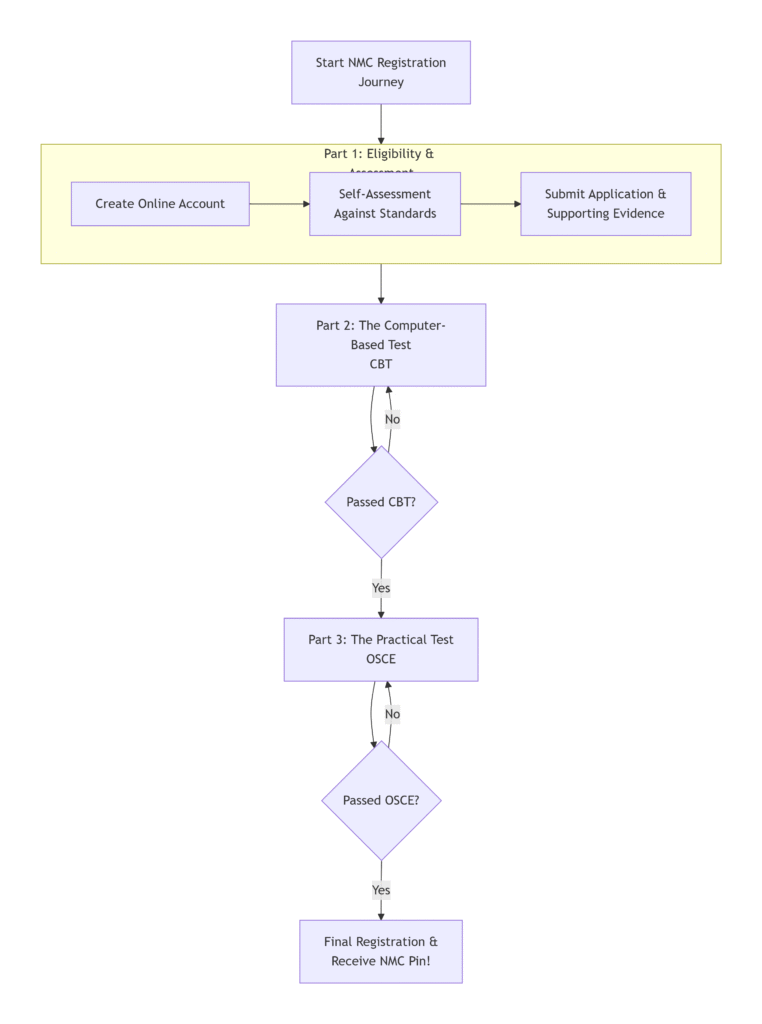
3. Test of Competence

Two-part examination:

Part A: Computer-Based Test (CBT)

  • 175 multiple-choice questions
  • Covers: Professional values, communication, nursing practice
  • Test centers worldwide (Pearson VUE)
  • Fee: £83 (2026)
  • Pass mark: Approximately 68%

Part B: Objective Structured Clinical Examination (OSCE)

  • Practical examination at UK test centres
  • Six stations testing clinical skills
  • Manchester, London, or Oxford test centres
  • Fee: £794 (2026)
  • Preparation courses available (recommended)

4. NMC Registration & PIN

  • Final registration upon OSCE pass
  • Receive Personal Identification Number (PIN)
  • Annual renewal: £120 (2026)
  • Revalidation is required every 3 years

Step 2: The 2026 Immigration Pathways

Primary Route: Health and Care Worker Visa

Replaced Tier 2 (General) for healthcare professionals:

Eligibility Requirements:

  1. NMC registration (or decision letter proving eligibility)
  2. Job offer from the UK NHS or an approved healthcare provider
  3. Certificate of Sponsorship (CoS) from the employer
  4. Salary threshold: £23,200 minimum (Band 5 nurses start at £28,407)
  5. English language: Already met through NMC registration

Application Process:

  1. Secure a job offer with a licensed sponsor
  2. Employer assigns CoS
  3. Apply online with documents
  4. Biometric appointment
  5. Decision: Typically 3 weeks (priority available)

Visa Benefits:

  • Reduced fee: £247 (vs. £625 for standard skilled worker)
  • Exempt from Immigration Health Surcharge (IHS) – saving £624/year
  • Path to settlement: After 5 years
  • Family can accompany: From day one
  • Dependents can work/study

Alternative Route: Skilled Worker Visa

  • For private sector mental health roles
  • Higher fees (£625 application + IHS)
  • Same 5-year settlement path

Short-Term Option: Temporary Worker – Government Authorised Exchange

  • For training/development
  • Maximum 12 months
  • No direct path to settlement
  • Useful for OSCE preparation

Step 3: Securing Employment in 2026

High-Demand Specialities:

  1. CAMHS (Child & Adolescent Mental Health Services)
  2. Perinatal Mental Health
  3. Forensic Mental Health
  4. Liaison Psychiatry (A&E departments)
  5. Community Mental Health Teams
  6. Eating Disorder Services
  7. Substance Misuse Services

Major Employers:

NHS Mental Health Trusts:

  • South London and Maudsley NHS Foundation Trust (the largest in the UK)
  • Central and North West London NHS Foundation Trust
  • Manchester Mental Health NHS Foundation Trust
  • Birmingham and Solihull Mental Health NHS Foundation Trust

Private Providers:

  • Priory Group (largest private provider)
  • Elysium Healthcare
  • Cygnet Health Care
  • St Andrew’s Healthcare

Recruitment Process:

  1. International Recruitment Programs: Many NHS trusts have dedicated programs
  2. Job Portals: NHS Jobs, Indeed, Totaljobs
  3. Recruitment Agencies:
    • NHS Professionals
    • Protocol Education
    • Specialist mental health recruiters
  4. Virtual Recruitment Fairs: Regular NHS international events

Interview Preparation:

  • Values-Based Recruitment: The NHS uses a specific framework
  • Clinical scenarios: Mental health crisis management
  • Safeguarding knowledge: UK legislation (Mental Health Act, Mental Capacity Act)
  • UK healthcare system: NHS structure, community transformation

Click Here To Learn More: Best USA Immigration Pathways for Radiologic and Imaging Technologists

Step 4: The Complete Timeline (2026 Edition)

Fast Track (With NMC pre-assessment): 6-9 months

Standard Track: 9-15 months

Extended Track (Need additional training): 12-18 months

Sample Timeline (Standard):

  • Months 1-3: NMC eligibility application, English test preparation
  • Months 4-6: CBT preparation and examination, job search begins
  • Months 7-9: Job interviews, OSCE preparation course (if needed)
  • Months 10-12: OSCE examination, CoS assignment, visa application
  • Month 13: Relocation to the UK, pre-employment checks
  • Month 14+: Begin employment, complete any employer inductions

Costs & Financial Planning (2026 Estimates)

ExpenseCost
NMC Application£140
IELTS/OET Exam£200-£350
CBT Examination£83
OSCE Examination£794
Visa Application£247
Biometric Appointment£19.20
Tuberculosis Test£100-£200
Document Certifications£50-£200
Relocation Costs£3,000-£6,000
Initial Accommodation£1,000-£2,000
UK Nursing Union£150-£250/year

Total Estimated: £5,000-£10,000+

Financial Support Options:

  • NHS Trust Relocation Packages: Many offer £5,000-£10,000
  • Golden Hello Payments: Some roles offer a £5,000 starting bonus
  • Advance Salary: Some employers offer the first month’s salary in advance
  • Government Support: Check the Health Careers website for current incentives

Specialised Mental Health Nursing Requirements

UK-Specific Knowledge Needed:

  1. Mental Health Act 1983 (amended 2007): Sectioning process, community treatment orders
  2. Mental Capacity Act 2005: Deprivation of Liberty Safeguards (DoLS)
  3. Care Programme Approach (CPA): Standard for community mental health
  4. Safeguarding Adults/Children: UK legislation and procedures
  5. Recovery Model: Central to UK mental health services

Recommended Preparatory Training:

  • Mental Health Act e-learning (free via NHS)
  • Safeguarding training
  • Preceptorship programs (first 12 months in UK)
  • Cultural competency specific to UK diverse populations

Regional Opportunities & NHS Structure

Highest Demand Regions:

  1. London & Southeast: Highest vacancies, London weighting allowance
  2. Midlands: Major service expansions in Birmingham, Leicester
  3. Northwest: Manchester, Liverpool transforming services
  4. Southwest: Rural mental health challenges creating opportunities

NHS Banding System Explained:

  • Band 5: Newly qualified, preceptorship period
  • Band 6: Experienced with additional responsibilities
  • Band 7: Advanced practitioner, team leader
  • Band 8: Modern matron, senior management

Career Progression:

  1. Preceptorship Year: Structured support for international nurses
  2. Specialist Pathways: CBT, psychotherapy, nurse prescribing
  3. Advanced Practice: MSc in Advanced Mental Health Practice
  4. Management: Ward manager, modern matron
  5. Consultant Nurse: Highest clinical grade (Band 8c)

2026 Policy Updates & Changes

New Immigration Rules:

  • Shortage Occupation List: Mental health nurses remain on SOL
  • Salary threshold increase: £23,200 (but Band 5 exceeds this)
  • The Health and Care Visa remains the most advantageous route
  • Dependent rules: Maintained (family can accompany)

NHS Long Term Plan Impact:

  • Community mental health transformation, creating new roles
  • Integrated care systems are changing service delivery
  • Digital mental health services expansion
  • 24/7 crisis services development

Brexit Considerations:

  • EU nurses now follow the same pathway as other international nurses
  • No preferential treatment for EU qualifications
  • Language requirements apply equally to all non-UK applicants

Family & Dependents Information

Bringing Family Members:

  • Spouse/partner and children under 18 are eligible
  • Apply simultaneously or separately
  • Same visa duration as the main applicant
  • Dependents are exempt from IHS if the main applicant is on a Health and Care Visa

Dependent Rights:

  • Work: No restrictions
  • Study: Access to education (children’s free school)
  • Healthcare: Free NHS access
  • Public funds: Some restrictions apply

Schooling for Children:

  • State schools: Free for children 5-18
  • Application process: Contact the local council
  • Best areas: Varies by Ofsted ratings
  • International schools: Available but expensive

Settlement & Citizenship Pathway

Indefinite Leave to Remain (ILR):

  • After 5 years on a Health and Care/Skilled Worker visa
  • Requirements:
    • Continuous residence (maximum 180 days’ absence per year)
    • Still employed in an eligible job
    • Pass the Life in the UK test
    • Meet English language requirement (if not already proven)
  • Application fee: £2,404 (2026)
  • Processing time: 6 months standard, super priority available

British Citizenship:

  • After 12 months with ILR status
  • Additional requirements:
    • Good character
    • Intention to live in the UK
    • Citizenship ceremony
  • Dual citizenship: Allowed with most countries

Support Systems & Professional Integration

Pre-Arrival Support:

  • NMC adaptation programs: Some employers offer pre-OSCE support
  • Virtual induction: Many trusts now offer online orientation
  • Accommodation assistance: Often provided for the first 3-6 months
  • Buddy systems: Paired with an experienced UK nurse

Post-Arrival Support:

  1. Trust Induction: Mandatory 1-2 week program
  2. Preceptorship: 6-12 months structured support
  3. Clinical supervision: Regular sessions
  4. Professional development: Access to training
  5. Pastoral care: Many trusts have international nurse support groups

Professional Organisations:

  • Royal College of Nursing (RCN): Union and professional body
  • Mental Health Nurses Association (MHNA)
  • British Association for Behavioural and Cognitive Psychotherapies (BABCP)
  • Nursing & Midwifery Council: Mandatory registration

Common Challenges & Solutions

Challenge 1: OSCE Failure Rates

Solutions:

  • Preparation courses: Highly recommended (cost: £800-£1,500)
  • Practice with UK-trained nurses
  • Understand UK-specific protocols
  • Multiple attempt allowance (within time limits)

Challenge 2: Cultural Adaptation

Solutions:

  • Cultural competency training
  • Understanding UK mental health models (recovery-focused vs medical model)
  • Communication styles: UK indirect communication patterns
  • Patient expectations: Different in the UK vs other countries

Challenge 3: UK Nursing Documentation

Solutions:

  • Training on electronic systems: RiO, SystmOne, EMIS
  • Care planning standards
  • Risk assessment frameworks
  • Confidentiality protocols (Caldicott principles)

Challenge 4: Cost of Living Pressures

Solutions:

  • NHS accommodation initially
  • Location choice: Outside London/Southeast reduces costs
  • Budget planning support from employers
  • Additional shifts/overtime available

Success Strategies for 2026 Applicants

  1. Start with English: Begin language preparation immediately
  2. Specialise: Consider additional mental health qualifications
  3. Target high-need areas: Higher likelihood of sponsorship
  4. Network: Connect with current international mental health nurses in the UK
  5. Understand UK models: Recovery approach, social inclusion focus
  6. Document experience: Detailed portfolio of mental health experience
  7. Prepare for interviews: NHS values, STAR technique
  8. Plan financially: Have 3-6 months’ living expenses saved

Emerging Trends & Future Opportunities

2026-2030 Projections:

  • Digital mental health: Increasing telepsychiatry roles
  • Integrated care: Physical and mental health combined roles
  • Preventative focus: Early intervention services expansion
  • Specialist services: Growth in perinatal, eating disorders, and autism services

Advanced Roles Development:

  • Nurse Prescribers: Independent prescribing for mental health conditions
  • Consultant Nurses: Highest clinical grade expansion
  • Research Nurses: Clinical trials in mental health
  • Educational Roles: Practice educators, university lecturers

Essential Resources

Official Websites:

  1. NMC: nmc.org.uk
  2. NHS Health Careers: healthcareers.nhs.uk
  3. UK Government Visas: gov.uk/health-care-worker-visa
  4. NHS Jobs: jobs.nhs.uk
  5. Mental Health Networks: england.nhs.uk/mental-health

Support Organisations:

  • Refugee Council: Support for refugee healthcare professionals
  • NHS Employers International Recruitment: Guidance for applicants
  • British Council: Information for international professionals
  • Migrant Help: Free immigration advice

Preparation Resources:

  • OSCE preparation providers: OSCEpass, Nursing OSCE Success
  • English for Nursing: Specialist OET/IELTS preparation
  • UK Mental Health Legislation: Free e-learning via NHS
  • Clinical skills refreshers: Many UK universities offer short courses

Conclusion: Your UK Mental Health Nursing Career Awaits

The UK’s mental health nursing shortage presents a historic opportunity for internationally trained professionals. While the pathway requires significant preparation, investment, and adaptation, the rewards include job security in a respected profession, competitive NHS salaries with excellent pension benefits, and the chance to contribute to one of the world’s most established public healthcare systems.

The 2026 landscape is particularly favourable due to sustained government investment in mental health services and maintained immigration pathways for healthcare professionals. By methodically addressing each requirement—NMC registration, English proficiency, OSCE success, and visa procedures—you can successfully transition to a rewarding mental health nursing career in the UK.

Begin with NMC eligibility assessment—this determines your entire timeline and pathway. Simultaneously, develop your English language skills to the required level, as this remains the most significant barrier for many international applicants.

Remember that the UK values diverse perspectives in mental health care, and your international experience can be a significant asset in providing culturally competent care to the UK’s diverse population. With dedication and proper preparation, you can join the thousands of international mental health nurses building successful careers and making vital contributions to UK mental health services.

UK Schools Offering Very Affordable Healthcare Conversion Programs

or career changers and international graduates, the UK’s healthcare sector offers remarkable opportunities, but traditional routes can be expensive. This comprehensive guide identifies universities and institutions offering the most affordable conversion programs to enter nursing, midwifery, and allied health professions in 2025—featuring pathways under £10,000 and creative funding solutions.

Understanding Healthcare Conversion Programs

Healthcare conversion programs (often called pre-registration or graduate-entry programs) allow those with a bachelor’s degree in another field to fast-track into healthcare professions. These accelerated programs are typically 2-3 years instead of the standard 3-4.

Key Professions Available:

  • Adult Nursing (most common conversion)
  • Mental Health Nursing
  • Midwifery
  • Occupational Therapy
  • Physiotherapy
  • Radiography
  • Paramedic Science
  • Dietetics

Most Affordable UK Universities for Healthcare Conversion (2025)

1. University of the West of Scotland (UWS)

Location: Paisley, Ayr, Dumfries, London
Affordability Rating: ★★★★★

Programs & Fees:

  • MSc Adult Nursing (Pre-registration): £16,500 total (2 years)
    Note: Scottish students may access SAAS funding; international fees are higher
  • MSc Mental Health Nursing: Same fee structure
  • Per year cost: Effectively £8,250/year

Why it’s affordable:

  • Lower cost of living in Scottish campuses
  • Partnerships with NHS boards offering sponsorship
  • January intakes allow faster workforce entry

Unique Offering: Dumfries campus offers rural placement opportunities with potential additional NHS support.

2. University of Cumbria

Location: Carlisle, Lancaster, London
Affordability Rating: ★★★★★

Programs:

  • MSc Nursing (Adult/Mental Health): £17,000 total (2 years)
  • BA/BSc top-up programs for overseas qualified nurses: £12,500/year

Financial Advantages:

  • Carlisle has among the UK’s lowest living costs
  • NHS Learning Support Fund eligible
  • Travel expenses reimbursed for placements >16 miles

Special Opportunity: Their “Step into Nursing” program offers paid healthcare assistant roles while studying, reducing financial pressure.

3. University of Bolton

Location: Bolton, Greater Manchester
Affordability Rating: ★★★★☆

Programs & Fees:

  • MSc Adult Nursing: £9,250/year (Home students, 2 years)
  • Total cost: £18,500
  • BSc Top-up Nursing: £9,250/year (1 year for overseas nurses)

Value Proposition:

  • Traditional industrial town with very affordable accommodation
  • Strong NHS partnerships with Manchester Foundation Trust
  • Flexible start dates throughout the year

Bolton Advantage: Estimated living costs are 30% lower than in London, with excellent transport links to Manchester’s major hospitals.

Click Here To Learn More: How to Migrate to Germany as a Nurse or Caregiver in 2026

4. University of Sunderland

Location: Sunderland, London
Affordability Rating: ★★★★☆

Programs:

  • MSc Nursing (Adult): £9,250/year (Home)
  • MSc Occupational Therapy: Same fee structure
  • MSc Physiotherapy: £9,250/year

North East Benefits:

  • Sunderland has the lowest rent prices among UK cities
  • NHS bursaries available for some programs
  • Placement travel support up to £50/week

London Campus Note: Their London campus charges £14,000/year—consider studying in Sunderland for true affordability.

5. University of Worcester

Location: Worcester, Hereford
Affordability Rating: ★★★★☆

Programs:

  • MSc Nursing (Adult/Mental Health): £9,250/year
  • MSc Midwifery: £9,250/year (3 years accelerated)
  • MSc Occupational Therapy: Same

Financial Perks:

  • Hereford campus is specifically designed for healthcare, with lower living costs
  • NHS-funded placements with salary supplements possible
  • Rural locations mean cheaper accommodation

Worcester’s Edge: Strong focus on return-to-practice and mature students, with exceptional support services.

6. Cardiff University (Wales)

Location: Cardiff
Affordability Rating: ★★★★☆

Programs:

  • MSc Nursing (Adult): £9,000/year (Welsh rates)
  • Important: Welsh students pay £1,000/year; English students £9,000

Welsh Advantage:

  • NHS Wales Bursary: £4,491 maintenance grant + tuition fees
  • Living costs are lower than in most English university cities
  • Bilingual environment, but English-only required

Funding Quirk: Welsh domiciled students receive the most generous NHS funding in the UK—consider establishing residency if possible.

7. University of Highlands and Islands (UHI)

Location: Multiple across Scotland (Inverness, Perth, Stornoway)
Affordability Rating: ★★★★★

Programs:

  • MSc Nursing (Adult): £6,120/year (Scottish/SAAS-funded)
  • MSc Midwifery: Same
  • BSc Paramedic Practice: £1,820/year (Scottish rates)

Remote Advantage:

  • Living costs in the Highlands are among the UK’s most affordable
  • Remote and Rural allowance: Additional NHS funding for placements
  • SAAS funding: Covers tuition for Scottish residents

Unique Model: Distributed learning with local placements minimises relocation needs and costs.

Ultra-Affordable Alternative Pathways

1. NHS Sponsored Degree Apprenticeships

Cost: £0 tuition + earn while you learn
Duration: 4 years (longer but no debt)

How it works:

  • Employed by NHS trust as apprentice
  • Salary: £20,000-£25,000 from year 1
  • Study part-time at partner university
  • Qualify as registered nurse with BSc

Providers:

  • Manchester University NHS Foundation Trust
  • Barts Health NHS Trust (London)
  • Leeds Teaching Hospitals NHS Trust

2025 Expansion: Government target of 5,000 nursing apprenticeships annually.

2. Nursing Associate Route (Band 4 to Band 5)

Pathway:

  1. 2-year Nursing Associate Foundation Degree (£0 via apprenticeship)
  2. 18-month top-up to Registered Nurse
    Total time: 3.5 years
    Total cost: £0 tuition + earning throughout

Affordable Providers:

  • The Open University: Flexible, work-based
  • Local NHS trusts with FE college partnerships

3. Postgraduate Diploma vs. Masters

Cost-Saving Strategy: Opt for PGDip instead of MSc:

  • PGDip Nursing: £8,500-£11,000 total
  • MSc Nursing: £16,000-£22,000 total
  • Same registration outcome with NMC
  • Can convert PGDip to MSc later with 1 extra module

Universities offering PGDip option:

  • University of Plymouth
  • University of Brighton
  • Anglia Ruskin University

Creative Funding Solutions for 2025

1. NHS Learning Support Fund (England)

  • Training Grant: £5,000/year (non-repayable)
  • Specialist Subject Payment: £1,000/year (mental health, LD, children’s)
  • Parental Support: £2,000/year if you have children
  • Travel & Accommodation: Reimbursed for clinical placements

2. Scottish Funding (SAAS)

  • Tuition fees: Fully covered for Scottish residents
  • Bursary: Up to £10,000/year (non-repayable)
  • Best deal in the UK for those eligible

3. Welsh NHS Bursary

  • Tuition fees: Covered in full
  • Maintenance grant: £4,491 minimum
  • Incentive payments: £1,000-£2,000 for hard-to-fill specialties

4. Northern Ireland Support

  • Tuition fees: Paid + bursary up to £6,578
  • Limited places, but excellent value

5. Employer Sponsorship

The 2025 Trend: NHS trusts increasingly offering:

  • Tuition fee payments
  • Guaranteed employment post-qualification
  • Salary during studies (particularly for return-to-practice)

Top Sponsors:

  • Guy’s and St Thomas’ NHS FT (London)
  • University Hospitals Birmingham
  • Sheffield Teaching Hospitals

International Students: Affordable Pathways

Most Affordable for International Students:

UniversityAnnual International FeeTotal Program Cost
University of Bolton£14,000£28,000 (2 years)
University of Sunderland£15,500£31,000
University of Cumbria£14,500£29,000

Strategy: Study in Northern England, Scotland, or Wales, where living costs are 40-60% lower than in London.

Scholarships for International Students:

  1. Chevening Scholarships (fully funded, competitive)
  2. Commonwealth Scholarships
  3. University-specific discounts (early payment, alumni, sibling)
  4. Home country government scholarships

Cost Comparison: Traditional vs. Affordable Routes

Scenario: Becoming a Registered Nurse

PathwayTotal Tuition CostTimeEarnings During Study
Traditional BSc£27,7503 yearsLimited
Graduate Entry MSc£18,500-£22,0002 yearsLimited
NHS Degree Apprenticeship£04 years£80,000+ total
Nursing Associate + Top-up£03.5 years£60,000+ total

Application Strategy for Maximum Affordability

1. Domicile Considerations

  • Establish Scottish residency for 3 years before application for SAAS funding
  • Consider Welsh universities if eligible for the NHS Wales bursary
  • Northern Ireland offers the best value, but has limited spaces

2. Timing Matters

  • Apply for January intakes (less competitive, sometimes more funding)
  • Check clearing for the last-minute funded places
  • Postgraduate loans in England cover conversion courses

3. Location Strategy

  • Study where you plan to work—NHS trusts often sponsor local students
  • Commute from home if possible to save accommodation costs
  • Choose universities in low-cost-of-living areas

4. Combined Work-Study Models

  • Healthcare Assistant alongside studies (NHS Band 2/3: £22,000-£24,000)
  • Bank staff with flexible hours
  • Weekend/night shifts during placement breaks

Hidden Costs & How to Minimise Them

Expected Additional Costs:

  1. Placement expenses: Travel, parking, uniforms (£500-£1,500/year)
  2. Professional memberships: NMC registration, union fees (£300-£500)
  3. Equipment: Stethoscope, books, technology (£200-£800)
  4. DBS check & health clearance: £100-£200

Cost-Reduction Tips:

  • Claim travel expenses from the NHS Learning Support Fund
  • Buy second-hand uniforms and equipment
  • Use university libraries instead of buying textbooks
  • Share accommodation with other healthcare students

Future-Proof Your Investment: High-Demand Specialities

To maximise return on your educational investment, consider these growing specialities:

Highest Demand Areas (2025-2030):

  1. Mental Health Nursing (additional £1,000/year NHS incentive)
  2. Learning Disability Nursing (£1,000/year incentive)
  3. Community Nursing (growing with NHS shift to community care)
  4. Theatre Nursing (specialist skills = higher Band 6 potential)
  5. Geriatric Care (aging population = job security)

Salary Progression:

  • Band 5 (Newly Qualified): £28,407-£34,581
  • Band 6 (Specialist): £35,392-£42,618
  • Band 7 (Advanced): £43,742-£50,056
  • Additional: London weighting + unsocial hours (20-60% extra)

Warning: Programs to Approach Cautiously

High-Cost Options with Questionable Value:

  • Private university programs charging £18,000+/year
  • London-based programs without substantial scholarships
  • Short “fast-track” programs that may not provide adequate preparation
  • Programs without guaranteed NHS placements

Red Flags:

  • No mention of NHS funding eligibility
  • Unclear placement support
  • High international student ratio (may indicate profit focus)
  • Limited graduate employment data

Step-by-Step Action Plan for 2025 Entry

Months 1-3 (Jan-Mar 2025):

  • Research affordable programs
  • Establish residency if seeking home fees
  • Begin healthcare volunteering for the UCAS application
  • Apply for NHS Healthcare Assistant roles for experience

Months 4-6 (Apr-Jun):

  • Submit UCAS application (deadline: January, but many accept later)
  • Apply for the NHS Learning Support Fund
  • Secure accommodation in a low-cost area
  • Attend university open days (virtual options save money)

Months 7-9 (Jul-Sep):

  • Accept the offer from the most affordable option
  • Apply for student finance
  • Complete pre-course requirements (DBS, health check)
  • Join student nursing Facebook groups for cost-saving tips

Months 10-12 (Oct-Dec):

  • Begin program (January 2026 intake)
  • Register with NMC
  • Set up a student bank account with an interest-free overdraft
  • Create a budget using student budgeting apps

The Best Value Choice for Different Situations

For Career Changers with Financial Constraints:

NHS Degree Apprenticeship → Zero debt + income from day one

For Recent Graduates Wanting Speed:

University of Cumbria or UWS MSc → 2 years, under £18,000 total

For International Students:

University of Bolton or Sunderland → Lower international fees + north England living costs

For Those with Family Commitments:

The Open University → Flexible study + work alongside

For Maximum Financial Support:

Scottish university with SAAS funding or Welsh university with NHS bursary

Conclusion: Smart Investment in Your Healthcare Future

The UK’s healthcare conversion landscape offers genuinely affordable pathways for those willing to research strategically and consider location flexibility. The most financially sensible approach in 2025 combines:

  1. A university in a low-cost region (Scotland, Northern England, Wales)
  2. Maximum NHS funding utilisation (Learning Support Fund, bursaries)
  3. Strategic timing (January intakes, clearing opportunities)
  4. Work-study balance (apprenticeships, healthcare assistant roles)

Remember that “affordable” doesn’t mean “low quality.” Many of these universities have outstanding NHS partnerships and employment rates. Your investment in a conversion program—especially when kept under £20,000—can yield returns within 2-3 years of qualifying, with lifelong career security in a profession that’s both financially stable and personally rewarding.

Final Recommendation: Start with the NHS Learning Support Fund calculator, then contact the University of Cumbria, UWS, and Bolton to determine their most affordable 2026 entry options. Consider apprenticeship routes seriously—they represent the ultimate affordability: getting paid to qualify.

How to Prepare for UK NHS Nursing Interviews (2025 Sample Questions)

Landing a nursing role within the UK’s National Health Service (NHS) is a fantastic career goal, but the interview process can feel daunting. This comprehensive guide will walk you through exactly how to prepare for your NHS nursing interview in 2025, complete with sample questions, scoring insights, and powerful strategies to help you stand out.

Why NHS Nursing Interviews Are Unique

NHS interviews are typically competency-based (also known as values-based or structured interviews). This means they are designed to assess not just your clinical knowledge, but also your alignment with the NHS Constitution and the core NHS Values: Working Together for Patients, Respect and Dignity, Commitment to Quality of Care, Compassion, Improving Lives, and Everyone Counts.

Your answers must demonstrate these values through real-life examples, often using the STAR (Situation, Task, Action, Result) or CAR (Context, Action, Result) technique.

Step 1: Deep Research – The Foundation of Success

1. Understand the Trust: Go beyond a basic website browse. Read their latest Annual ReportQuality Account, and CQC report. Note their strategic priorities for 2025 (e.g., digital transformation, reducing health inequalities, workforce wellbeing).

2. Know the Job Description (JD) and Person Specification (PS) Inside Out: Every question will link back to these. Map your skills and experiences to each “Essential” and “Desirable” criterion. The PS is your answer blueprint.

3. Master the NHS Landscape for 2025: Be prepared to discuss current priorities:

  • The NHS Long Term Workforce Plan and its implications for nursing.
  • Digital advancements (e.g., electronic patient records, virtual wards).
  • Emphasis on preventative care and community-based services.
  • Challenges like waiting lists and staff retention.

Click Here To Learn More: Amazing Settlement Tips for Healthcare Workers Moving to Canada in 2026

Step 2: Mastering the Core Competency Areas & 2025 Sample Questions

Here are the most common competency themes, updated for the 2025 context, with sample questions.

1. NHS Values & Compassionate Care

  • “Tell us about a time you demonstrated compassion to a patient or their family under difficult circumstances. (Use STAR)”
  • “How would you ensure a patient’s dignity and respect are maintained during a personal care procedure?”
  • “What does ‘Everyone Counts’ mean to you in your daily nursing practice?”

2. Clinical Skills & Knowledge (Role-Specific)

  • “Walk us through how you would recognise and escalate a deteriorating patient (linking to the NEWS2 chart).”
  • “Describe your experience with [a specific piece of equipment or procedure relevant to the role, e.g., complex wound care, IV administration, mental health de-escalation].”
  • “How do you ensure your clinical practice is evidence-based and up-to-date?”

3. Teamwork & Communication

  • “Give an example of a time you had a conflict or disagreement within your multidisciplinary team. How did you resolve it?”
  • “How would you explain a complex treatment plan to a patient with low health literacy?”
  • “Describe a time you had to advocate for a patient. What was the situation and outcome?”

4. Safety & Quality Improvement

  • “Tell us about a time you identified a potential safety risk and what actions you took.”
  • “What does ‘commitment to quality of care’ mean in practical terms on your shift?”
  • “Have you ever been involved in a clinical audit or improvement project? What was your role?”

5. Resilience, Pressure & Situational Judgement

  • “Describe a time you worked under significant pressure. How did you prioritise and manage your stress?”
  • “How would you handle a situation where you were asked to work outside your competency level?”
  • “A colleague is consistently arriving late, increasing your workload. What would you do?”

6. Scenario-Based Questions (Increasingly Common in 2025)

  • “You are a newly qualified nurse on a busy ward. You notice a senior colleague has made a medication error but has not reported it. What do you do?”
  • “A patient with dementia is becoming increasingly agitated and refuses to take their medication. How would you approach this?”

Step 3: The Interview Day – Strategies for Success

Before:

  • Prepare 5-7 strong STAR examples that cover multiple competencies.
  • Plan your journey, attire (professional), and pack copies of your CV, JD, PS, and a notepad.
  • Prepare 2-3 insightful questions to ask them. E.g., “What are the biggest challenges facing this specific ward/department currently, and how can the person in this role help address them?” or “What opportunities are there for professional development and mentorship here?”

During:

  • Listen carefully. It’s okay to pause and think before answering.
  • Structure every answer with STAR: Keep it concise (2-3 minutes max).
  • Focus on “I,” not “we.” Be clear about your specific actions and reflections.
  • Link back to NHS Values explicitly.
  • Show enthusiasm and a patient-centred mindset.

After:

  • Send a brief, polite email thanking the panel for their time, reiterating your interest.

Step 4: Practice, Practice, Practice

  1. Write it out: Script your STAR answers initially.
  2. Say it aloud: Practice with a timer. Record yourself to check for clarity and conciseness.
  3. Mock Interview: Do a full mock interview with a friend, mentor, or career advisor. Get feedback on your content and body language.

Final Checklist for Your NHS Nursing Interview in 2025

  • Researched the specific NHS Trust and department.
  • Memorised the 6 NHS Core Values.
  • Analysed the Job Description & Person Specification.
  • Prepared STAR/CAR examples for all key competencies.
  • Researched current NHS topics (Long Term Plan, digital care).
  • Prepared insightful questions to ask the panel.
  • Completed a mock interview.

Conclusion: Your Path to Success

Preparing for an NHS nursing interview is about more than reciting clinical facts. It’s about proving you embody the values that make the NHS unique. By combining thorough research, structured examples (STAR), and a genuine passion for patient-centred care, you will demonstrate you are the competent, compassionate, and collaborative professional they are looking for.

Good luck! You’ve trained for this—now go and show them why you’ll be an asset to their team.

Top UK Care Homes Sponsoring Work Visas in 2025: Complete Hiring Guide & List

For compassionate and dedicated international care workers, the UK remains a land of opportunity. However, navigating the job market after the March 2024 visa rule changes requires a precise strategy. As of 2024, the standard “Care Worker” visa (SOC 6145) is closed, but the Health and Care Worker visa for Senior Care Workers (SOC 6146) remains open.

This complete 2025 guide provides a list of top care home providers actively sponsoring Senior Care Workers and other eligible roles, along with a clear action plan for securing your sponsored job offer.

Critical 2025 Update: Understanding the Visa Rules

Before you apply, you must understand the current landscape:

  • ✅ Eligible Role: Senior Care Worker (SOC Code 6146). This is a distinct role from a standard Care Assistant. It typically involves supervisory duties, medication administration, care plan creation, and leading a team.
  • ❌ Ineligible Role: Care Worker (SOC Code 6145). This entry-level role is no longer eligible for sponsorship on the Health and Care Worker visa.
  • Who Else is Eligible: Registered Nurses (NMC PIN required), Senior Carers, and other qualified healthcare professionals remain fully eligible for the Health and Care Worker visa.

Your job offer must be for a Senior Care Worker position or higher. Always verify the SOC code with the employer.

Click Here To Learn More: Immigrant Healthcare Workers & Canada’s 2025 Recruitment Strategy: What You Need to Know

Top UK Care Home Groups Offering Sponsorship in 2025

The following major providers have the resources and Sponsor Licences to hire international talent for eligible senior roles. They are your primary targets.

1. HC-One

  • Overview: One of the UK’s largest and most established care home providers, known for its ‘Kindness’ ethos. They operate hundreds of homes nationwide.
  • Roles They Sponsor: Senior Care Assistants/Workers, Registered Nurses (RGN/RMN).
  • Support Offered: Established international recruitment program, support with OSCE/ NMC registration for nurses, and often provides relocation assistance.
  • How to Apply: Visit the HC-One Careers page and use filters like “Visa Sponsorship” or search for “Senior Care” roles.

2. Barchester Healthcare

  • Overview: A premium provider of luxury care homes and hospitals across the UK. They are known for high standards and extensive staff training.
  • Roles They Sponsor: Senior Carer, Registered Nurse (RMN and RGN), Clinical Lead.
  • Support Offered: Active international recruitment arm, comprehensive induction, and clear career progression.
  • How to Apply: Check the Barchester Healthcare Careers website. Look for roles specifying “Sponsorship available” or “Senior.”

3. Bupa Care Services

  • Overview: A global healthcare giant with a significant network of care homes in the UK. They have a well-structured international hiring process.
  • Roles They Sponsor: Senior Care Assistant/Worker, Registered Nurse.
  • Support Offered: Dedicated recruitment team for overseas candidates, relocation packages, and strong brand reputation.
  • How to Apply: Search the global Bupa Careers portal. Use keywords like “senior care worker UK visa sponsorship.”

4. Care UK

  • Overview: A dynamic and growing provider with modern, purpose-built care homes. They frequently recruit for leadership and clinical roles.
  • Roles They Sponsor: Senior Care Worker, Registered Nurse, Team Leader.
  • Support Offered: They run targeted international recruitment campaigns and have a defined sponsorship process.
  • How to Apply: Explore the Care UK Careers page and filter by “Nursing & Care” roles.

5. Four Seasons Health Care (FSHC)

  • Overview: A major group with care homes across England, Scotland, and Northern Ireland. They have a history of recruiting internationally for hard-to-fill roles.
  • Roles They Sponsor: Senior Carer, Registered Nurse.
  • How to Apply: Visit the Four Seasons Careers website.

6. Smaller & Regional Groups to Target

  • Maria Mallaband Care Group (MMCG): A reputable group often seeking senior staff. Check their careers page.
  • Majesticare: A family-run group known for a supportive culture. They have sponsored senior roles in the past. See Majesticare Careers.

How to Get Hired: Your 5-Step Action Plan for 2025

Step 1: Assess Your Qualifications for a Senior Role

You must prove you are not an entry-level worker. A Senior Care Worker typically needs:

  • Experience: 2+ years in a care setting, preferably with some supervisory or lead responsibility.
  • Relevant Qualifications: NVQ/Diploma Level 3 in Health and Social Care (or international equivalent) is highly desirable and often required.
  • Skills: Medication administration, care planning, mentoring juniors, and complex patient care.

Action: Update your CV to highlight leadership, responsibility, and specialized skills.

Step 2: Prepare a UK-Style CV & Cover Letter

  • CV: Keep it concise (2 pages). Start with a personal statement. Use bullet points for duties. Crucially, list your eligibility: “Eligible for UK Health and Care Worker Visa (SOC 6146).”
  • Cover Letter: Tailor it to each employer. Explain why you want to work for them and your commitment to the UK’s care standards.

Step 3: Apply Strategically & Persistently

  • Apply Directly: Use the career portals listed above. Avoid generic job boards for sponsored roles.
  • Keyword Search: Use “senior care worker,” “team leader,” “clinical lead,” and “visa sponsorship.”
  • Be Prepared to Relocate: Your chances increase dramatically if you are open to locations across the UK, not just major cities.

Step 4: Ace the Virtual Interview

  • Know the Company: Research their values and specific homes.
  • Prepare for Competency Questions: Use the STAR method (Situation, Task, Action, Result) to answer questions like “Tell us about a time you dealt with a difficult situation with a resident?”
  • Ask Informed Questions: Ask about training, career progression, and the specific team you’ll join.

Step 5: Understand the Visa Process

Once you have a job offer:

  1. Your employer will issue a Certificate of Sponsorship (CoS).
  2. You will apply for the Health and Care Worker visa, which provides:
    • Reduced application fee.
    • Exemption from the Immigration Health Surcharge (IHS) – saving you over £1,000 per year.
    • Path to settlement (ILR) after 5 years.

Common Pitfalls to Avoid

  • Applying for the Wrong Role: Do not apply for “Care Assistant” or “Support Worker” roles expecting sponsorship. Target Senior titles.
  • Paying an Agency Fee: Reputable employers do not charge candidates. If an agency asks for money, it is a scam.
  • Neglecting Your CV: A poorly formatted CV will be rejected immediately by large HR systems.

Your 2025 Job Search Checklist

  • Updated my CV to UK standards, highlighting senior-level experience.
  • Researched 5-7 target care home groups from this list.
  • Bookmarked their career portals.
  • Set up job alerts for “Senior Care Worker” and “Visa Sponsorship.”
  • Prepared answers to common competency-based interview questions.

While the rules have tightened, the demand for experienced, senior care staff in the UK remains acute. By targeting the right employers, presenting yourself as a qualified senior professional, and following this strategic guide, you can successfully secure a sponsored role and build a rewarding career in the UK’s care sector.

Your dedication is needed. Start your targeted job search today.

How to Register With the NMC UK as an International Nurse (Updated 2025)

For internationally trained nurses, registration with the Nursing and Midwifery Council (NMC) is the essential key to practising in the United Kingdom. The process is rigorous but structured, designed to ensure all nurses meet the high standards of care the UK public expects.

This definitive 2025 guide walks you through the updated step-by-step process, including costs, timelines, and tips for a successful application.

An Overview of the NMC Registration Process for International Nurses

The NMC registration process for nurses trained outside the UK is a multi-stage journey. It can be visualised in three key phases, as shown in the flowchart below:

Part 1: Eligibility and Application (The Paperwork Stage)

Step 1: Check Your Eligibility & Create an NMC Online Account

Before you spend any money, ensure you meet the basic requirements:

  • You must have completed a post-secondary nursing education program of at least 3 years (or 4,600 hours) combining theory and practice.
  • You must be a current, registered nurse in your home country.
  • You must have practised as a nurse for at least 12 months (full-time equivalent) after qualifying.

If you meet these, go to the NMC website and create an NMC Online account. This portal will be your hub for the entire application.

Step 2: Take an English Language Proficiency Test

You must prove your English is safe for practice. You can do this by:

  • IELTS (Academic or OET (Occupational English Test):
    • You need a minimum score of 7.0 in reading, listening, and speaking, and 6.5 in writing for IELTS.
    • For OET, you need at least a Grade B in all four sections.
    • You can combine two test scores if you achieve the required minimum in all four areas across both tests, taken within 6 months.
  • Exemption: You might be exempt if you recently completed a pre-registration nursing or midwifery qualification taught and examined in English in a majority-English speaking country (like the UK, Ireland, Australia, USA).

Step 3: Complete Your Self-Assessment and Submit Application

In your NMC Online account, you will complete a self-assessment of your qualifications and experience against the UK’s standards. You will then formally submit your application and pay the initial assessment fee.

Step 4: Provide Your Supporting Documents via COPA and CAP

This is a crucial administrative step. You must provide:

  • Proof of Identity: A copy of your passport.
  • Proof of Qualification: Your nursing diploma/degree.
  • Registration Verification: Proof of your current registration in your home country.
  • Transcript of Training: A detailed breakdown of your nursing education.

How it works: The NMC uses two portals for this:

  1. COPA (Computer-Based Test of Competence Part A): You enter your personal and training information here.
  2. CAP (Computer-Based Test of Competence Part B): Your nursing education provider (your university/college) must complete this part to verify your training.

Tip: Contact your nursing school early to inform them that they will receive a request from the NMC. Delays here are common.

Part 2: The Computer-Based Test (CBT)

Once your Part 1 application is approved, you can book and take the CBT.

  • What it is: A multiple-choice exam taken at a Pearson VUE test centre in your home country (or another country if more convenient).
  • Content: It tests your theoretical nursing knowledge and your professional judgment. The exam is based on the current UK pre-registration nursing curriculum.
  • Format: 120 multiple-choice questions (90 scored, 30 pilot questions) to be completed in 4 hours.
  • Cost: £83 (as of 2024, check for 2025 updates).

Preparation: Use the official NMC Test of Competence 2021 blueprint to guide your studies. Consider investing in reputable online question banks and preparation courses.

Click Here To Learn More: Best Hospitals in British Columbia Hiring International Healthcare Workers

Part 3: The Objective Structured Clinical Examination (OSCE)

The final hurdle is the OSCE, which you must take in the UK.

  • What it is: A practical exam that simulates real-life clinical scenarios. It tests your clinical skills, decision-making, and patient-centred care.
  • Where: You must take it at an approved UK university test centre.
  • Format: The exam consists of several stations (like a circuit), including:
    • Skill Stations: Demonstrating a clinical skill (e.g., wound dressing, medication administration).
    • Scenario Stations: Managing a patient scenario, testing assessment, planning, and communication.
  • Cost: £794 (as of 2024, check for 2025 updates).

How to Approach it: Most international nurses secure a job with an NHS Trust first. The employer will typically sponsor your visa and pay for your OSCE (often as a salary advance). They will also provide paid OSCE preparation training.

The Complete Cost Breakdown (2025 Estimates)

Fee TypeCost (2024)Estimated 2025 Cost
Initial Application Assessment£140£140 – £150
Computer-Based Test (CBT)£83£83 – £90
Objective Structured Clinical Exam (OSCE)£794£794 – £820
Registration Fee (First Year)£153£153 – £160
Total£1,170~£1,200 – £1,220

Note: These are NMC fees only. Additional costs include English language tests, courier fees for documents, and potential travel/accommodation for exams.

Your 2026 Action Plan: A Step-by-Step Timeline

  1. Months 1-2: Research & Preparation
    • Research the process and costs.
    • Begin studying for your English test (IELTS/OET).
  2. Months 2-4: Application Stage
    • Take and pass your English test.
    • Create your NMC Online account and submit Part 1.
    • Contact your nursing school to prepare them for the CAP request.
  3. Months 4-5: The CBT
    • Upon Part 1 approval, book and pass your CBT.
  4. Months 5-7: Job Search & OSCE
    • Start applying for NHS jobs! With CBT passed, you are highly employable.
    • Secure a job offer and a Certificate of Sponsorship from an NHS Trust.
    • Apply for your UK Health and Care Worker visa.
    • Move to the UK and undergo OSCE training provided by your employer.
    • Take and pass the OSCE.
  5. Final Step: Full NMC Registration
    • After passing the OSCE, the NMC will confirm your registration and issue your PIN (Personal Identification Number).
    • You can now practice without supervision as a Registered Nurse in the UK.

Common Pitfalls to Avoid

  • Underestimating the English Test: The required scores are strict. Prepare thoroughly.
  • Delaying Contact with Your Nursing School: The CAP verification can take time. Alert your school early.
  • Poor OSCE Preparation: The OSCE is challenging. Take full advantage of the training your NHS employer provides.
  • Misunderstanding Costs: Budget for all fees and potential retakes.

Your NMC Registration Checklist

  • Researched the entire NMC process and associated costs.
  • Booked and passed an IELTS or OET exam.
  • Created an NMC Online account and started the application.
  • Contacted my nursing school to inform them of the upcoming CAP request.
  • Prepared for and passed the Computer-Based Test (CBT).
  • Secured a job offer with an NHS Trust.
  • Applied for my UK visa and relocated.
  • Completed OSCE training and passed the OSCE.
  • Received my NMC PIN and started practising!

The path to NMC registration is a marathon, not a sprint. However, with careful planning, dedication, and the support of a future NHS employer, you can successfully navigate this process and embark on an incredibly rewarding nursing career in the United Kingdom.

Your skills are needed in the UK. Start your NMC journey today!

How To Move to the UK as a Healthcare Assistant Without Experience (2025 Step-by-Step Guide)

Dreaming of starting a healthcare career in the UK, but have no formal experience? It is possible. While the path has recently changed, opportunities still exist for motivated individuals. However, it’s crucial to understand the new rules to avoid costly mistakes.

This step-by-step 2024 guide explains the legal pathways to move to the UK as a Healthcare Assistant (HCA) with no prior experience, detailing the visas, qualifications, and strategies you need to succeed.

Critical Update: The “Care Worker” Visa Closure

In March 2024, the UK government closed the Skilled Worker visa route for standard “Care Workers” (SOC code 6145) to new applicants. This means you can no longer get a sponsored visa for an entry-level care role from outside the UK if you are a new applicant.

But don’t lose hope! There are two legal and reliable pathways remaining:

  1. The Senior Care Worker Visa Route
  2. The Health and Care Worker Visa for Qualified Professionals

Let’s break down the viable pathway for someone starting from scratch.

The Only Viable Path: Become a “Senior Care Worker”

The key is to no longer target the entry-level “Care Worker” role. Instead, your goal is to qualify for the Senior Care Worker (SOC code 6146) role, which is still eligible for the Health and Care Worker visa.

What is a Senior Care Worker?

A Senior Care Worker has more responsibility than a basic care assistant. They might supervise a team, manage complex care plans, administer medication, and take a lead role in patient support.

Your 5-Step Action Plan for 2025

Step 1: Meet the Core Eligibility Requirements

Even without experience, you must meet these baseline criteria:

  • Language Skills: Achieve a minimum of CEFR Level B1 in English (IELTS 4.0 or equivalent in all four components). This is a visa requirement.
  • Financial Requirements: Show you have at least £1,270 in your bank account for 28 consecutive days to support yourself, unless your future employer certifies your maintenance.
  • Character: Provide a clean criminal record certificate.

Step 2: Gain Foundational Qualifications & Training

Since you lack experience, you need qualifications to make you a credible candidate for a senior role. Invest in these before you apply for jobs:

  • Care Certificate: This is a UK standard for all HCAs. While you’ll complete it on the job in the UK, having prior knowledge is a huge advantage.
  • NVQ/Diploma in Health and Social Care (Level 3): A Level 3 qualification is often the minimum expected for a senior role. You can often find online courses that provide the theoretical knowledge.
  • Other Valuable Certificates:
    • First Aid at Work
    • Moving and Handling of People
    • Safeguarding Adults (and Children)
    • Medication Administration Training

These qualifications show employers you are serious and have a foundational understanding, compensating for your lack of hands-on experience.

Click Here To Learn More: How to Secure a UK Certificate of Sponsorship as a Healthcare Worker: The 2025 Guide

Step 3: Secure a Job with a Licensed Sponsor (The Hardest Step)

This is the most challenging part. You must find a UK employer who:

  1. Holds a valid Sponsor Licence.
  2. Is willing to hire you into a Senior Care Worker role despite your lack of formal experience, based on your qualifications and attitude.

How to Find a Sponsor:

  • Target Large Care Home Chains: Companies like HC-One, Barchester Healthcare, Bupa, and Care UK are more likely to have structured recruitment and sponsorship processes. Check their career pages regularly.
  • Use Keywords: Search for “Senior Care Worker visa sponsorship” on job boards like Indeed.co.uk.
  • Leverage Recruitment Agencies: Some UK agencies specialise in international recruitment for the care sector. Ensure they are reputable and do not charge you fees.

Step 4: Your Employer Issues a Certificate of Sponsorship (CoS)

Once a licensed employer offers you a Senior Care Worker job, they will issue you an electronic Certificate of Sponsorship (CoS). This is not a physical document but a reference number you need for your visa application.

Step 5: Apply for the Health and Care Worker Visa

With your CoS, you can apply for the visa. The benefits of this specific visa are significant:

  • Reduced Application Fee:
    • Up to 3 years: £284
    • More than 3 years: £551
  • Exemption from the Immigration Health Surcharge (IHS): This is the biggest saving, as the standard IHS is £1,035 per year. You pay £0.
  • Faster Processing: Decisions are usually made within 3 weeks.
  • Bring Your Family: Your partner and children can apply as your dependents.

Alternative Pathway: The Student Visa Route

If securing a Senior Care Worker visa directly proves too difficult, consider this alternative path:

  1. Come to the UK on a Student Visa: Enrol in a full-time course in Health and Social Care (e.g., a Level 3 Diploma or a foundation degree).
  2. Work Part-Time: As a student, you can typically work up to 20 hours per week. Use this to get a job as a Care Worker (no sponsorship needed for this role) and gain crucial UK experience.
  3. Gain Experience & Get Promoted: After your studies, you will have UK qualifications and UK experience.
  4. Switch to the Health and Care Worker Visa: Your employer is now much more likely to sponsor you for a Senior Care Worker role, as you are a proven, known quantity.

Pros: Allows you to enter the UK, gain experience, and make yourself a more attractive candidate.
Cons: It is expensive (tuition fees + IHS surcharge) and does not guarantee sponsorship later.

Common Pitfalls to Avoid

  1. Paying an Agency for a Job: Reputable recruitment agencies are paid by the employer, not you. Never pay a fee for a job promise.
  2. Applying for “Care Worker” Roles: Since the visa route is closed, applying for these roles from outside the UK is a waste of time. Focus only on “Senior Care Worker” positions.
  3. Ignoring the Language Requirement: You cannot get a visa without passing the English test. Prepare for it seriously.
  4. Using an Unlicensed Sponsor: Always verify your potential employer is on the official UK Register of Licensed Sponsors.

Your Action Plan Checklist

  • Pass an approved B1 English test.
  • Save at least £1,270 for the financial requirement.
  • Complete online courses (Care Certificate, Safeguarding, etc.) to boost your CV.
  • Obtain a clean criminal record certificate.
  • Create a targeted CV highlighting your new qualifications and transferable skills (compassion, communication, teamwork).
  • Apply exclusively for “Senior Care Worker” roles with licensed sponsors.
  • Prepare for interviews to convincingly explain your career motivation despite lacking experience.

While the path to the UK as a Healthcare Assistant without experience is now more challenging, it is not closed. By strategically aiming for a Senior Care Worker role and equipping yourself with the right qualifications and knowledge, you can build a strong case for an employer to sponsor you. It requires patience and perseverance, but a rewarding career in the UK’s care sector is still within your reach.

Start with your English test and qualifications today to build your foundation for success!

How to Secure a UK Certificate of Sponsorship as a Healthcare Worker: The 2025 Guide

For doctors, nurses, and senior carers, the UK Certificate of Sponsorship (CoS) is the golden ticket you need to apply for your Health and Care Worker visa. It’s not a physical document but a unique electronic reference number that your UK employer generates to prove they are sponsoring you.

Securing this CoS is the most critical step in your journey. This guide breaks down exactly what it is, the different types, and a step-by-step strategy to get one in 2025.

What is a Certificate of Sponsorship (CoS)?

Certificate of Sponsorship (CoS) is an electronic record assigned to you by a UK employer with a valid Sponsor Licence. It contains details about you and the role you’ve been offered. You need the reference number from this certificate to complete your visa application.

Key Points:

  • It’s not a physical certificate or paper document.
  • It does not guarantee you will get a visa, but you cannot get a visa without it.
  • It is tied to the specific employer and job that sponsored you.

The Two Types of Certificates of Sponsorship

Understanding which one you need is crucial, as the process is different for each.

1. Defined Certificate of Sponsorship (for applicants OUTSIDE the UK)

This is the type you will apply for if you are recruiting from outside the UK.

  • The Process: Your employer must first apply to the Home Office for this type of CoS specifically for you. They may need to prove they couldn’t fill the role with a settled worker (though this is often waived for health and care roles).
  • Key Feature: It requires an extra step of approval from the Home Office before it can be assigned to you.

2. Undefined Certificate of Sponsorship (for applicants INSIDE the UK)

This type is used for workers already in the UK who are switching jobs or visas.

  • The Process: The employer can assign this CoS directly from their annual allocation without needing prior approval from the Home Office.
  • Key Feature: The process is faster as it doesn’t require a separate application.

Click Here To Learn More: Best Healthcare Jobs That Are in High Demand Worldwide

Your 5-Step Action Plan to Secure a CoS

You cannot apply for a CoS yourself. It must be done by your employer. Therefore, your strategy must focus on securing a job offer from the right organisation.

Step 1: Secure Your UK Professional Registration (Non-Negotiable)

You cannot get a CoS for a regulated profession without being registered with the relevant UK body. This is the most important preparatory step.

  • For Nurses: You must be registered with the Nursing and Midwifery Council (NMC). This process involves a computer-based test (CBT) and an objective structured clinical examination (OSCE).
  • For Doctors: You must be registered with the General Medical Council (GMC) with a licence to practise.
  • For Senior Carers: While not a registered profession, you must prove you meet the skill level and requirements for the SOC code 6146.

Action: Start the registration process with your professional body before you seriously begin job hunting. Mentioning your “NMC Pin in progress” or “GMC registration” on your CV makes you a much more attractive candidate.

Step 2: Target the Right Employers (Sponsor Licence Holders)

Your job search must be focused on organisations that hold a valid UK Sponsor Licence. Applying to organisations without one is a waste of time.

Where to Find Sponsoring Employers:

  • NHS Trusts: Virtually every NHS Trust in England, Scotland, Wales, and Northern Ireland holds a sponsor licence. They are the largest recruiters of international health staff.
    • Examples: Manchester University NHS Foundation Trust, Guys and St Thomas’ NHS Foundation Trust, NHS Greater Glasgow and Clyde.
  • Large Private Healthcare Providers: Companies like BMI Healthcare, Nuffield Health, and HCA Healthcare.
  • Large Care Home Chains: Providers like HC-One, Barchester Healthcare, Bupa, and Care UK sponsor Senior Care Workers (SOC 6146). Note: The standard “Care Worker” visa route is closed.

How to Check for a Sponsor Licence:

  1. Use the UK Government’s official Register of Licensed Sponsors.
  2. Search for the organisation by name.
  3. Ensure their licence is still “A-rated” (active and in good standing).

Step 3: Excel in the Job Application & Interview

  • Tailor Your CV: Create a UK-style CV (2 pages max). Clearly state your professional registration status (e.g., “NMC Pin: XYZ123” or “NMC Application in Progress”).
  • Ace the Virtual Interview: Be prepared to discuss your clinical experience, the UK’s healthcare values (e.g., the NHS Constitution), and your eligibility to work in the UK. Research the Trust or care provider thoroughly.
  • Ask the Right Question: It is perfectly acceptable to ask, “Can you confirm this role is eligible for sponsorship under the Health and Care Worker visa?”

Step 4: Your Employer Requests and Assigns the CoS

Once you accept a job offer, your employer will handle the CoS application.

  • If you are outside the UK, they will apply for a Defined CoS. This can take the Home Office several weeks to approve. Once approved, they assign it to you.
  • If you are inside the UK, they will assign you an Undefined CoS from their allocation.

You will then receive an email with your CoS reference number.

Step 5: Use the CoS to Apply for Your Visa

With the CoS number in hand, you can now complete your Health and Care Worker visa application online. You will need to enter this number as part of the process.

Inside an Employer’s Mind: The Resident Labour Market Test (RLMT)

For a Defined CoS, employers historically had to prove they couldn’t fill the role with a UK-based worker (the RLMT). However, the good news for healthcare workers is that most health and care occupations are exempt from the RLMT.

This means employers can hire you without having to advertise the role for 28 days, significantly reducing the time it takes to fill the position.

Common Pitfalls to Avoid

  1. Paying for a CoS: A legitimate employer will never ask you to pay for the Certificate of Sponsorship. The cost is their responsibility.
  2. Applying to Non-Sponsors: Wasting time on employers who cannot sponsor you. Always check the sponsor list first.
  3. Incorrect Professional Registration: Applying for nursing jobs before you have your NMC PIN or have at least started the process.
  4. Letting Your CoS Expire: You must apply for your visa within 3 months of the CoS being assigned to you.

Frequently Asked Questions (FAQ)

Q: How long is a Certificate of Sponsorship valid for?
A: You have 3 months to apply for your visa from the date it is assigned to you.

Q: Can I change jobs after I get my visa?
A: Yes, but you will need a new Certificate of Sponsorship from your new employer and must apply to update your visa.

Q: How long does it take to get a Defined CoS?
A: The Home Office aims to process Defined CoS applications within 8 weeks, but it can sometimes be faster for healthcare roles.

Q: What information is on the CoS?
A: It includes your personal details, job title, salary, sponsor licence number, and the start and end date of your employment.

Your 2025 CoS Checklist

  • Obtained/Initiated my UK professional registration (NMC, GMC, etc.).
  • Researched and identified NHS Trusts and care providers with a valid Sponsor Licence.
  • Tailored my CV to UK standards and highlighted my registration status.
  • Secured a job offer from a licensed sponsor.
  • Received my CoS reference number from my employer.
  • Ready to submit my Health and Care Worker visa application.

Securing a Certificate of Sponsorship is a process that hinges on preparation and partnership with a licensed employer. By focusing on your professional registration and targeting the right organisations, you can successfully obtain your CoS and take the final step toward your UK healthcare career.

Your skills are in high demand. Start your targeted job search today!

Best NHS Trusts and Care Homes Recruiting Overseas Healthcare Workers

The United Kingdom remains a top destination for internationally educated healthcare professionals, offering world-class career opportunities, structured pathways, and a chance to make a real difference. For nurses, doctors, senior carers, and allied health staff, knowing which organisations are actively recruiting is the first step to securing a sponsored role.

This 2025 guide highlights the top NHS Trusts and care providers known for their robust international recruitment programs, detailing what they offer and how you can get hired.

Why the UK is Actively Recruiting in 2025

The UK’s National Health Service (NHS) and social care sector continue to face significant staffing shortages, driven by an ageing population and workforce retirement. This has created a sustained, high demand for skilled professionals from overseas. Key benefits for international hires include:

  • Sponsored Health and Care Worker Visas: Leading to settlement (Indefinite Leave to Remain).
  • Exemption from the Immigration Health Surcharge (IHS): A massive financial saving.
  • Structured OSCE & Adaptation Programs: Support to pass UK licensing exams.
  • Relocation Packages: Many top employers offer flight tickets, accommodation support, and settling-in allowances.

Part 1: Top NHS Trusts Hiring International Staff in 2025

These NHS Trusts have established reputable international recruitment programs. They don’t just hire you; they support your transition into the UK healthcare system.

1. Manchester University NHS Foundation Trust (MFT)

  • Why They’re a Top Employer: As one of the largest NHS Trusts in the country, MFT offers unparalleled career opportunities and a massive scope of specialities.
  • Roles They Recruit For: Registered Nurses (across all specialities), Midwives, Theatre Staff, Doctors.
  • International Recruitment Support: They offer a dedicated international recruitment team, a structured OSCE training program, and a comprehensive preceptorship program for newly registered nurses.
  • Location: Manchester, a vibrant and affordable major city.
  • How to Apply: Check the MFT Careers website and filter by “International Recruitment.”

2. Guys and St Thomas’ NHS Foundation Trust

  • Why They’re a Top Employer: Renowned for its world-class clinical reputation and location in the heart of London.
  • Roles They Recruit For: Nurses (especially in ICU, Theatres, and Renal), Midwives, Allied Health Professionals.
  • International Recruitment Support: Offers a robust pastoral care system, OSCE funding and preparation, and support with finding accommodation.
  • Location: Central London.
  • How to Apply: Visit the Guys and St Thomas’ Careers portal.

3. University Hospitals Birmingham NHS Foundation Trust (UHB)

  • Why They’re a Top Employer: A leading Trust known for its innovation and massive scale, including the Queen Elizabeth Hospital Birmingham.
  • Roles They Recruit For: Nurses, Operating Department Practitioners (ODPs), Doctors, and Healthcare Assistants.
  • International Recruitment Support: Provides a full OSCE program, meet-and-greet services, and a 2-week supernumerary period upon arrival.
  • Location: Birmingham, the UK’s second-largest city.
  • How to Apply: Search the UHB Jobs website.

4. NHS Scotland – Various Health Boards

  • Key Health Boards: NHS Greater Glasgow and ClydeNHS Lothian (Edinburgh).
  • Why They’re a Top Employer: Scotland offers a fantastic work-life balance, stunning landscapes, and a slightly different but equally rewarding healthcare system.
  • Roles They Recruit For: All nursing specialities, mental health staff, and general practitioners.
  • International Recruitment Support: Many Scottish Health Boards offer dedicated relocation packages and strong mentorship programs.
  • How to Apply: Use the national NHS Scotland Jobs platform.

5. Oxford University Hospitals NHS Foundation Trust

  • Why They’re a Top Employer: A world-famous teaching hospital trust associated with Oxford University, offering exceptional opportunities for professional development.
  • Roles They Recruit For: Registered Nurses, Doctors, and specialist allied health staff.
  • International Recruitment Support: Provides a comprehensive induction and OSCE support.
  • Location: Oxford, a historic and academic city.
  • How to Apply: Browse vacancies on the OUH Careers site.

Click Here To Learn More: The UK Health and Care Worker Visa: Ultimate Guide

Part 2: Top Care Home Providers Hiring Senior Carers in 2025

Crucial Note: As of March 2024, the standard “Care Worker” visa route was closed. However, the Health and Care Worker visa remains open for “Senior Care Workers” (SOC code 6146). These are the major providers hiring for these eligible senior roles.

1. HC-One

  • Why They’re a Top Employer: One of the UK’s largest and most established care home providers, with a focus on ‘kindness.’
  • Roles They Recruit For: Senior Care Assistants/Workers, Registered Nurses.
  • Support Offered: Sponsorship for Senior Carers, support with NMC registration for nurses, and a structured induction.
  • How to Apply: Visit the HC-One Careers page.

2. Barchester Healthcare

  • Why They’re a Top Employer: A highly respected provider of luxury care homes across the UK.
  • Roles They Recruit For: Senior Carer, Registered Nurse (RMN and RGN).
  • Support Offered: Known for a strong commitment to training and development, and offering visa sponsorship.
  • How to Apply: Check the Barchester Healthcare Careers website.

3. Bupa Care Services

  • Why They’re a Top Employer: A global healthcare giant with a massive network of care homes in the UK.
  • Roles They Recruit For: Senior Care Assistants, Registered Nurses.
  • Support Offered: A well-defined international recruitment process with relocation support.
  • How to Apply: Search for “visa sponsorship” roles on the Bupa Careers global site.

4. Care UK

  • Why They’re a Top Employer: A dynamic and growing provider with modern facilities.
  • Roles They Recruit For: Senior Care Workers, Nurses.
  • Support Offered: Active international recruitment and sponsorship programs.
  • How to Apply: Explore opportunities on the Care UK Careers page.

How to Get Hired: Your 5-Step Action Plan for 2025

  1. Get Your UK Professional Registration First (Non-Negotiable):
    • Nurses: You must be registered with the Nursing & Midwifery Council (NMC). This involves a multi-step process: CBT, OSCE, and credential assessment.
    • Senior Carers: While not a formal register, you must prove you have the necessary experience and qualifications for a senior role.
  2. Prepare a UK-Style CV (Curriculum Vitae):
    • Keep it to two pages maximum.
    • Include an “NMC Pin Status” or “Professional Registration” section.
    • Tailor your personal statement to the specific NHS Trust or care home.
  3. Apply Directly and Strategically:
    • Use the career portals listed above.
    • Set up job alerts for keywords like “international nurse,” “visa sponsorship,” or “senior care worker.”
  4. Ace the Virtual Interview:
    • Be prepared for competency-based questions (e.g., “Tell me about a time you dealt with a difficult situation?”).
    • Research the Trust or care home provider thoroughly.
    • Have professional, reliable technology for the video call.
  5. Understand the Visa Process:
    • Once you have a job offer, your employer will provide a Certificate of Sponsorship (CoS).
    • You will then apply for the Health and Care Worker visa, which provides IHS exemption.

Common Pitfalls to Avoid

  • Paying a Recruitment Fee: Reputable NHS Trusts and care providers do not charge candidates fees. The employer pays the recruitment agency.
  • Applying Without Registration: Do not apply for nursing roles until you have at least started your NMC application. Your PIN is your license to work.
  • Ignoring the “Senior” Title: For care roles, ensure the job is explicitly for a “Senior Care Worker” (SOC 6146) to be eligible for the visa.

Your 2025 Job Search Checklist

  • Initiated my NMC/GMC registration process.
  • Prepared a UK-formatted CV.
  • Researched 3-5 target NHS Trusts or care providers from this list.
  • Bookmarked their career websites.
  • Set up job alerts for my specific profession.

The demand for your skills in the UK has never been higher. By targeting these leading employers and following a structured approach, you can secure a rewarding role with a supportive organisation in 2025.

Your future in the UK’s health and care sector starts now. Begin your application today!