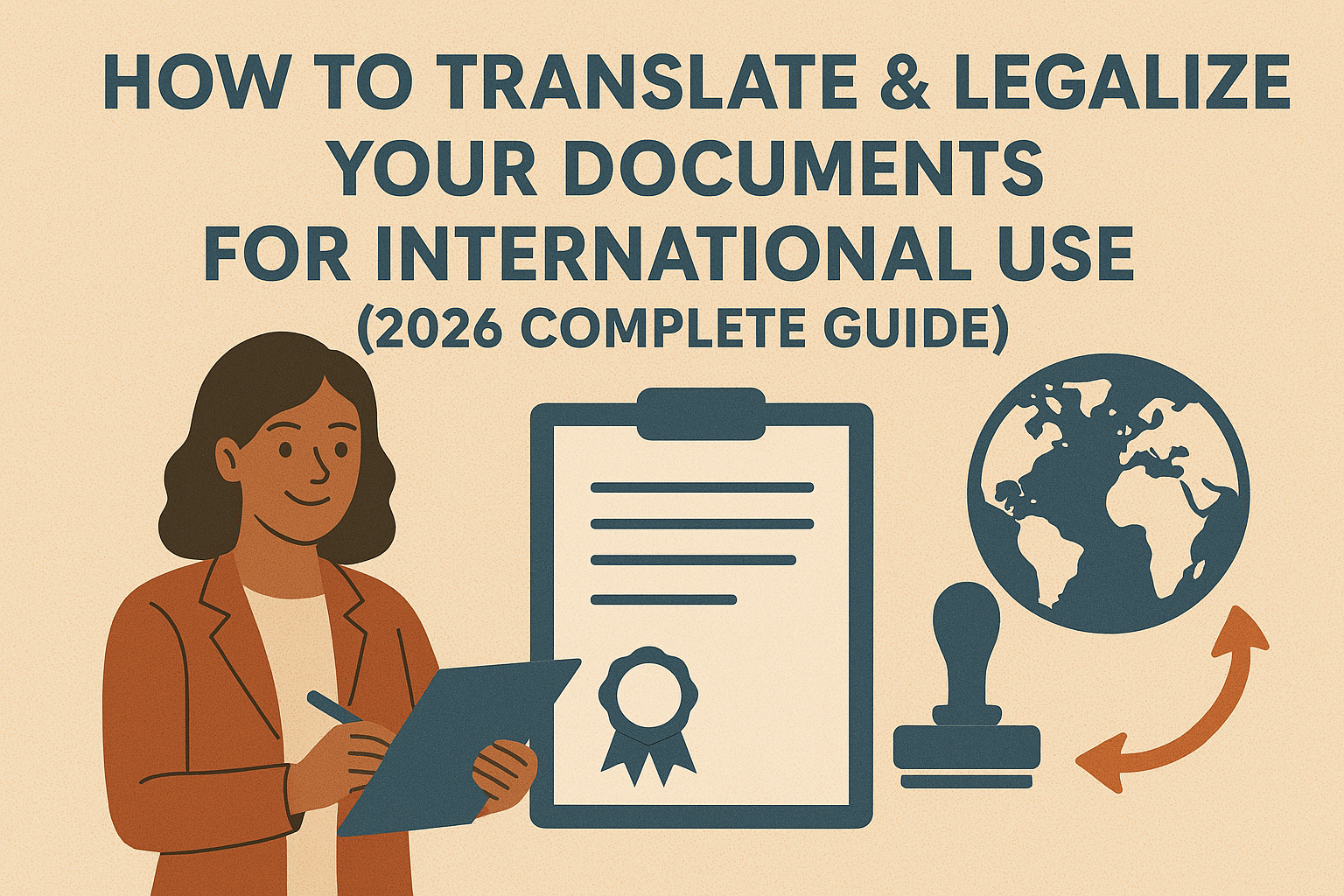
How to Translate & Legalize Your Documents for International Use (2026 Complete Guide)

For healthcare professionals moving internationally, proper document translation and legalization is crucial. Incorrectly processed documents are a leading cause of visa, licensing, and employment application delays. This comprehensive 2025 guide covers everything you need to know about translating, certifying, and legalizing your healthcare documents for international use.

📋 Understanding the Document Journey

Your documents must go through a multi-step process to be accepted internationally:

Your Original Documents
        ↓
    Translation
        ↓
    Certification/Notarization
        ↓
    Authentication/Legalization
        ↓
    Apostille (if applicable)
        ↓
Internationally Accepted Documents

Part 1: Translation of Documents

Which Documents Need Translation?

ALL documents not in the official language(s) of your destination country:

  • Diplomas and degrees
  • Academic transcripts
  • Professional licenses
  • Birth/marriage certificates
  • Police clearance certificates
  • Employment reference letters
  • Medical records
  • Any supporting documentation

Who Can Translate Your Documents?

Option A: Certified Professional Translators (Recommended)

Characteristics:

  • Certified by professional translation associations
  • Provide stamped/signed certification
  • Understand legal/medical terminology
  • Accepted by most immigration authorities

How to Find Certified Translators:

  1. Country-Specific Associations:
  2. Government-Approved Lists:
    • Many embassies maintain lists
    • Immigration departments often have approved translators
  3. University Translation Services:
    • Often offers certified translation
    • Understand academic documents well

Option B: Translation Agencies

Advantages:

  • Handle multiple languages
  • Project management included
  • Often faster for large volumes
  • Quality assurance processes

What to Look For:

  • Specialization in immigration/legal documents
  • Certified translators on staff
  • Member of professional associations
  • Positive reviews from immigrants
  • Clear pricing structure

Option C: Notary Public (in some countries)

When Acceptable:

  • Some countries accept notarized translations
  • Usually requires a translator’s affidavit
  • Check destination country requirements

The Translation Process Step-by-Step

Step 1: Document Preparation

  • Make high-quality color scans (300 DPI minimum)
  • Ensure all text is legible
  • Include all pages (even blank ones)
  • Note any seals/stamps/signatures

Step 2: Choose Your Translator

  • Get quotes from 2-3 certified translators
  • Verify their certification is current
  • Check turnaround times
  • Confirm they handle your document type

Step 3: Provide Clear Instructions

  • Specify destination country
  • Indicate purpose (immigration, licensing, employment)
  • Note any special terminology
  • Provide context if helpful

Step 4: Review the Translation

  • Check for accuracy
  • Verify all dates, names, and numbers
  • Ensure formatting matches original
  • Confirm the certification statement is included

What a Proper Translation Certificate Includes

A proper translation certification should contain:

  1. Statement of Accuracy: “I certify this is a true and accurate translation.”
  2. Translator’s Credentials: Certification number, association membership
  3. Language Pair: “From [Language] to [Language]”
  4. Date of Translation
  5. Translator’s Signature
  6. Translator’s Stamp/Seal (if applicable)
  7. Contact Information of translator/agency

Translation Costs for 2025

Document TypeAverage CostTimeframe
Simple Certificate (Birth, Marriage)$30-$601-3 days
Academic Diploma$40-$802-5 days
Academic Transcript (per page)$20-$403-7 days
Professional License$50-$1002-5 days
Employment Reference (per page)$25-$502-4 days

Factors Affecting Cost:

  • Language pair (rare languages cost more)
  • Urgency (rush fees typically 50-100% extra)
  • Complexity (medical/legal terms may cost more)
  • Certification requirements

Part 2: Certification & Notarization

What is Document Certification?

Certification confirms that a copy of a document is identical to the original.

Who Can Certify Documents?

1. Notary Public

Most widely accepted:

  • Verifies the identity of the person signing
  • Witnesses signatures
  • Places official seal/stamp
  • Maintains a record of notarization

How to Find a Notary:

  • Banks (often free for customers)
  • Law offices
  • Shipping stores (UPS, FedEx)
  • Mobile notary services
  • Online notary services (increasingly accepted)

2. Commissioner of Oaths

Similar to a notary in some countries:

  • Authorized to administer oaths
  • Can certify true copies
  • Often available at government offices

3. Legal Professionals

  • Lawyers/attorneys
  • Paralegals (in some jurisdictions)
  • Judges/magistrates

4. Government Officials

  • Embassy/consulate staff
  • Municipal/city officials
  • Certain government department staff

Click Here To Learn More: How to Get Police Clearance, Medicals & Biometrics for Health Worker Visas (2026 Complete Guide)

The Certification Process

For Copies of Original Documents:

  1. Present the original document to the certifier
  2. They make copies and compare
  3. They stamp/sign the certification statement
  4. They include their credentials and date

Certification Statement: Typically Includes:

  • “I certify this is a true copy of the original.”
  • Name and title of certifier
  • Date of certification
  • Official stamp/seal
  • Registration number (if applicable)

Special Requirements by Country

Canada:

  • Lawyer, notary, or commissioner of oaths
  • Some provinces have specific requirements
  • ICES/WES may accept uncertified translations from members

USA:

  • Notary public most common
  • Some states require a notary to witness a translator’s oath
  • USCIS has specific requirements

UK:

  • Solicitor or notary public
  • Some documents require legalization instead

Australia:

  • Justice of the Peace (JP)
  • Lawyer or notary
  • NAATI translator can certify their own translations

Cost of Certification 2025

ServiceAverage CostNotes
Notary Public (per document)$10-$25Often free at banks
Commissioner of Oaths$0-$20Sometimes free at government offices
Lawyer Certification$50-$100For complex documents
Embassy Certification$20-$50 per documentPlus service fees

Part 3: Authentication & Legalization

Understanding the Chain of Legalization

This process verifies that the signatures/stamps on your documents are genuine.

The Two Systems:

1. Apostille Countries (Hague Convention)
Simpler process for 120+ member countries:

Your Document
    ↓
Notarization/Certification
    ↓
Apostille from Competent Authority
    ↓
Accepted in all Hague Convention Countries

2. Non-Apostille Countries
More complex “chain authentication”:

Your Document
    ↓
Notarization
    ↓
Authentication by Home Country Authorities
    ↓
Legalization by Destination Country Embassy
    ↓
Accepted in Destination Country

Step-by-Step: Apostille Process

Step 1: Identify Competent Authority

  • Varies by country/state/province
  • Usually, the Secretary of State or the Foreign Ministry
  • Some countries have regional authorities

Common Authorities:

  • USA: Secretary of State (state level), then U.S. Department of State
  • Canada: Global Affairs Canada or provincial authorities
  • UK: Foreign, Commonwealth & Development Office (FCDO)
  • Australia: Department of Foreign Affairs and Trade (DFAT)

Step 2: Prepare Documents

  • Must be certified/notarized first
  • Some authorities require a specific format
  • Check if original or copy needed

Step 3: Submit Application

  • Complete required forms
  • Pay fees
  • Include prepaid return envelope
  • Consider a courier service for tracking

Step 4: Receive Apostille

  • Certificate attached to the document
  • Contains standardized information
  • Valid in all Hague Convention countries

Step-by-Step: Non-Apostille Process

For documents going to non-Hague countries:

Step 1: Notarization

  • Get documents notarized locally

Step 2: Home Country Authentication

  • Authentication by the appropriate ministry
  • Often, the Foreign Ministry or equivalent
  • May require intermediate authentication first

Step 3: Destination Country Legalization

  • Submit to the destination country’s embassy/consulate
  • They verify the home country’s authentication
  • Place their own stamp/seal

Country-Specific Requirements 2026

Canada-Bound Documents:

Your Country's Process →
Global Affairs Canada Authentication →
Canadian Embassy Legalization (if needed)

USA-Bound Documents:

State Certification →
U.S. Department of State Authentication →
Embassy Legalization (if needed)

UK-Bound Documents:

Local Certification →
FCDO Apostille/Authentication →
UK Embassy Legalization (if from non-Hague country)

Processing Times & Costs 2025

StepAverage TimeAverage Cost
Notarization1-2 days$10-$25/doc
Authentication (Home Country)1-4 weeks$20-$50/doc
Apostille1-3 weeks$20-$80/doc
Embassy Legalization1-2 weeks$30-$100/doc
Total3-8 weeks$80-$255/doc

Expedited Services: Typically double the cost for 50% faster service

Part 4: Special Considerations for Healthcare Professionals

Educational Documents

Medical/Nursing Degrees:

  • Often require detailed course descriptions
  • May need syllabus/curriculum information
  • Clinical hours must be clearly documented
  • Consider credential evaluation services (WES, ECFMG, etc.)

Academic Transcripts:

  • Must show all courses and grades
  • Should include a grading scale explanation
  • Sealed envelopes are often required
  • May need separate translation of course descriptions

Professional Licenses

Important Details to Include:

  • License number
  • Issue and expiration dates
  • Any restrictions/conditions
  • Registration with the regulatory body
  • Certificate of Good Standing (often needed)

Employment Documents

Reference Letters Must Include:

  • Dates of employment (specific to day)
  • Hours per week
  • Detailed duties and responsibilities
  • Supervisor’s contact information
  • Salary information (sometimes required)

Medical Records

For Immigration Medicals:

  • Vaccination records
  • Previous test results
  • Specialist reports
  • Must be translated by medical translation specialists

Part 5: Digital Document Preparation

Scanning Best Practices

  1. Resolution: 300 DPI minimum
  2. Format: PDF/A for archiving
  3. Color: Color scans for seals/stamps
  4. File Naming: LastName_DocumentType_Date.pdf
  5. File Size: Optimize to under 4MB per document

Digital Certification & E-Apostille

Growing acceptance in 2025:

  • Some countries accept digital signatures
  • E-apostille available in certain jurisdictions
  • Digital notarization is becoming more common
  • Always verify acceptance with the destination authority

Cloud Storage Organization

Healthcare_Immigration_2025
├── 01_Original_Documents
├── 02_Translations
├── 03_Certified_Copies
├── 04_Authenticated
├── 05_Final_Submission
└── 06_Backups

Part 6: Common Mistakes & How to Avoid Them

Mistake 1: Using Non-Certified Translators

Solution: Always use translators certified by recognized associations

Mistake 2: Incomplete Certification Chain

Solution: Follow the exact chain required by the destination country

Mistake 3: Expired Documents

Solution: Check validity requirements and time your applications

Mistake 4: Poor Quality Scans

Solution: Use professional scanning services or a high-quality scanner

Mistake 5: Missing Pages

Solution: Number pages and create a checklist for each document

Mistake 6: Incorrect Information

Solution: Double-check all names, dates, and numbers match across documents

Part 7: Timeline Planning for 2026

Recommended Timeline

Month 1-2: Planning

  • Research destination country requirements
  • Identify required documents
  • Find certified translators
  • Understand the authentication chain

Month 2-3: Translation

  • Get documents translated
  • Review translations carefully
  • Obtain certification statements

Month 3-4: Certification

  • Get copies certified/notarized
  • Verify certification meets requirements

Month 4-5: Authentication/Legalization

  • Submit for apostille/authentication
  • Process through the embassy if needed
  • Track all submissions

Month 5-6: Final Preparation

  • Make copies of everything
  • Create submission packets
  • Prepare digital versions
  • Verify all requirements met

Part 8: Cost-Saving Tips

  1. Bundle Documents: Some services offer volume discounts
  2. Government Services: Often cheaper than private services
  3. Avoid Rush Fees: Plan to avoid expedited charges
  4. Digital Submissions: Some countries accept digital, saving courier costs
  5. Group Authentication: Process multiple documents together

Part 9: Resources & Contacts 2026

Translation Associations

  • International Federation of Translators (FIT)
  • American Translators Association (ATA)
  • National Accreditation Authority for Translators and Interpreters (NAATI)

Authentication Authorities

  • USA: U.S. Department of State Office of Authentications
  • Canada: Global Affairs Canada Authentication Services
  • UK: Foreign, Commonwealth & Development Office
  • Australia: Department of Foreign Affairs and Trade

Professional Services

  • Document Preparation Services: Specialize in immigration documents
  • Courier Services: DHL, FedEx for international document shipping
  • Scanning Services: For high-volume document digitization

Part 10: Quality Checklist Before Submission

For Each Document:

  • The original language document is clear and complete
  • Translation is accurate and certified
  • Certification/notarization present and valid
  • Authentication/apostille attached if required
  • All dates are consistent across documents
  • Names spelled consistently
  • Seals/stamps legible
  • Pages numbered and in order
  • Digital copy matches physical
  • Meets destination country specifications

Emergency Situations: What If…

…documents are lost in transit?

  • Always use tracked courier services
  • Keep digital copies
  • Some authorities can re-issue for a fee

…requirements change during the process?

  • Check official websites regularly
  • Contact authorities for clarification
  • Consider professional immigration help

…documents are rejected?

  • Request specific reasons
  • Correct deficiencies
  • Consider the appeal process if available

Final Pro Tips for 2026

  1. Start Early: This process always takes longer than expected
  2. Verify Twice: Requirements change frequently
  3. Professional Help: Consider hiring specialists for complex cases
  4. Keep Records: Document every step, payment, and communication
  5. Plan for Validity: Some documents expire (police certificates, medicals)
  6. Digital Backup: Scan everything at each stage
  7. Communicate Clearly: Be specific with translators and authorities
  8. Budget Appropriately: These costs add up quickly

Remember: For healthcare professionals, document accuracy is particularly critical. Licensing bodies and immigration authorities scrutinize healthcare credentials. Investing in proper translation and legalization protects your application and professional reputation.

Next Steps: Begin by identifying EXACT requirements for your destination country and profession. Contact their immigration department and professional regulatory body for current specifications. Then start gathering your documents and finding certified translators familiar with healthcare terminology.
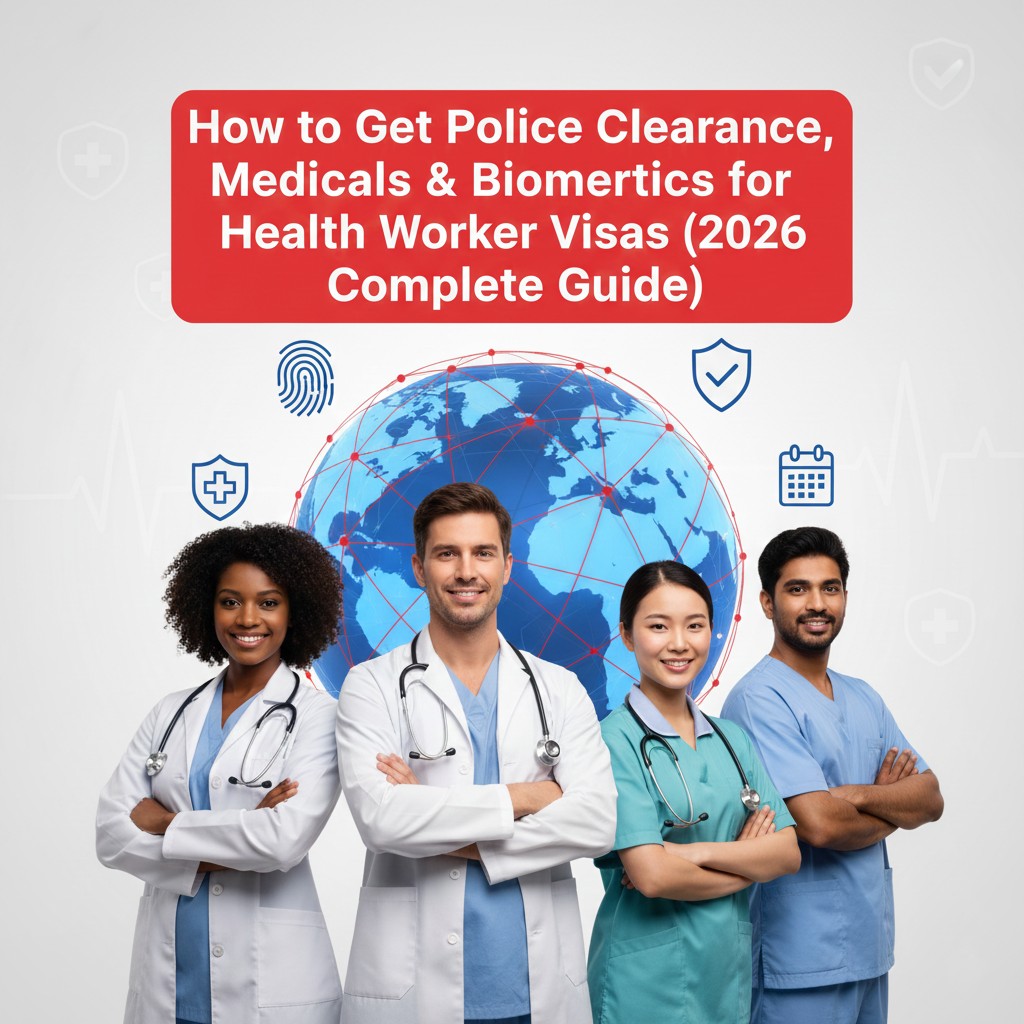

How to Get Police Clearance, Medicals & Biometrics for Health Worker Visas (2026 Complete Guide)

For healthcare professionals applying for international work visas, police clearance certificates, medical examinations, and biometrics collection are three critical requirements that often cause confusion and delays. This comprehensive guide covers exactly how to complete these steps efficiently in 2025 for major destination countries.

📋 Part 1: Police Clearance Certificates (PCC)

Why Police Clearance is Required

Countries require police certificates to ensure you don’t have a criminal history that would make you inadmissible. Requirements vary by country but generally include:

  • No serious criminal convictions
  • No involvement in organized crime
  • No human rights violations
  • No security threats

Which Countries Require PCC?

For ALL countries you’ve lived in for 6+ consecutive months since age 18

Step-by-Step Process for 2025

A. For Your Home Country

1. Identify the Issuing Authority:

  • India: Regional Passport Office or Police Commissioner’s Office
  • Philippines: National Bureau of Investigation (NBI)
  • Nigeria: Nigerian Police Force Criminal Records Office
  • UK: ACRO Criminal Records Office
  • USA: FBI Identity History Summary
  • Canada: RCMP Certified Criminal Record Check
  • Australia: National Police Check via AFP

2. Document Requirements (Common to All):

  • Completed application form
  • Passport copy (all pages)
  • Passport-sized photos
  • Proof of address
  • Previous PCC copy (if renewing)
  • Applicable fees

3. Processing Times & Costs 2025:

CountryStandard ProcessingExpeditedCost (Approx.)
India15-30 days3-7 days₹500-₹2,000
Philippines10-15 days2-3 days₱200-₱500
Nigeria21-28 days7-10 days₦10,000-₦20,000
USA12-14 weeks2-3 days*$18-$50
UK10 working days2 days£55-£75
Canada2-4 weeks2-3 days$50-$100

*FBI expedited via channelers

B. For Countries Where You’ve Previously Lived

Important: You must obtain PCCs from EVERY country where you lived 6+ months since age 18.

Common Challenges & Solutions:

  • Country no longer exists: Get certificate from successor state
  • Cannot return: Many countries allow application from abroad
  • Name changes: Include all names used with supporting documents
  • Language: May require certified translation

PCC Application Tips for 2025

  1. Apply Early: Start 3-4 months before visa application
  2. Get Multiple Copies: Request 2-3 original copies
  3. Verify Validity: Most are valid 6-12 months
  4. Track Applications: Use tracking numbers for mail applications
  5. Digital Options: Many countries now offer online applications

Special Considerations for Healthcare Workers

  • Enhanced Checks: Some countries require enhanced disclosure for healthcare roles
  • Working with Vulnerable Populations: Additional checks may be needed
  • Pediatric Roles: May require specific child protection clearance

🏥 Part 2: Medical Examinations

Why Medical Exams Are Required

Countries screen for:

  • Public health risks (communicable diseases)
  • Conditions requiring expensive treatment
  • Conditions affecting the ability to work
  • Drug/alcohol dependency

Country-Specific Medical Requirements 2025

A. Canada Immigration Medical Exam (IME)

Who Conducts It: Panel Physicians approved by IRCC
Find a Physician: IRCC Panel Physician Finder

Exam Includes:

  • Physical examination
  • Chest X-ray (ages 11+)
  • Blood tests (ages 15+)
  • Urine tests (ages 5+)
  • Syphilis test (ages 15+)

Cost: $200-$400 CAD
Processing: 5-10 business days to upload to IRCC
Validity: 12 months

B. UK Immigration Medical

TB Testing Required for: Applicants from the listed countries
Where: Approved clinics only
Cost: £70-£150 for TB test
Additional Tests: May include HIV, hepatitis, etc., for healthcare workers

C. USA Immigration Medical (Form I-693)

Who Conducts It: Civil Surgeons designated by USCIS
Includes:

  • Physical examination
  • Vaccination review
  • TB test (all ages)
  • Syphilis test (ages 15+)
  • Gonorrhea test (ages 18+)
    Cost: $200-$500 USD
    Validity: 2 years from the civil surgeon’s signature

D. Australia Immigration Medical

Who: Bupa Medical Visa Services or approved physicians
Includes:

  • Medical examination
  • Chest X-ray (ages 11+)
  • HIV test (ages 15+)
  • Hepatitis B & C tests (ages 15+)
  • Creatinine test (ages 15+)
    Cost: AUD $300-$600

Medical Exam Preparation Checklist

Before Appointment:

  • Passport (original)
  • Eyeglasses/contacts if worn
  • Medical history records
  • Vaccination records
  • List of current medications
  • Previous X-rays/medical reports
  • Payment method

During Exam:

  • Be honest about medical history
  • Disclose all medications
  • Mention past surgeries/hospitalisations
  • Ask questions if unsure

Common Reasons for Medical Inadmissibility

  • Active tuberculosis
  • Untreated syphilis
  • Drug-resistant infections
  • Conditions requiring expensive treatment
  • Conditions affecting public safety

What If You Have a Medical Condition?

  1. Controlled Conditions: Usually acceptable with medical documentation
  2. Treatment Plans: Show evidence of management
  3. Cost Thresholds: Some countries have treatment cost limits
  4. Waivers: May be available in certain cases

Click Here To Learn More: Complete Document Checklist for Healthcare Immigration (2025 Edition)

📸 Part 3: Biometrics Collection

What Are Biometrics?

Digital photographs and fingerprints are used for identity verification.

Country-Specific Biometrics Requirements 2025

A. Canada Biometrics

Who Needs It: Most temporary and permanent residence applicants
Cost: $85 CAD per person, $170 per family
Where: Visa Application Centres (VACs) worldwide
What’s Collected:

  • Digital fingerprints (all 10 fingers)
  • Digital photo
    Validity: 10 years
    Booking: VFS Global for most countries

B. UK Biometrics

Who Needs It: All visa applicants
Cost: Included in visa fee
Where: Visa Application Centres
What’s Collected:

  • Digital fingerprints
  • Digital photo
    Additional: May include signature scan

C. USA Biometrics

Who Needs It: Most visa applicants
Cost: Included in visa fee
Where: USCIS Application Support Centres or Embassy
What’s Collected:

  • Digital fingerprints
  • Digital photo
  • Digital signature

D. Australia Biometrics

Who Needs It: Applicants from certain countries
Cost: Included in visa fee
Where: Australian Visa Application Centres
What’s Collected:

  • Digital fingerprints
  • Digital photo

Biometrics Appointment Preparation

What to Bring:

  • Biometrics Instruction Letter (BIL)
  • Passport (original)
  • Appointment confirmation
  • Payment receipt (if not prepaid)
  • Any previous biometrics documents

What NOT to Bring:

  • Electronic devices (often prohibited)
  • Large bags
  • Accompaniment (unless required for minors/disabled)

Biometrics Collection Process

  1. Security Check: Similar to airport security
  2. Document Verification: Check of all documents
  3. Fingerprint Scanning: All 10 fingers, multiple attempts if needed
  4. Photo Capture: Neutral expression, no glasses/headwear (unless religious)
  5. Quality Check: Verification of biometrics quality
  6. Receipt: Confirmation of completion

Special Circumstances

Injured Fingers:

  • Inform the officer before scanning
  • May use alternative fingers
  • May require a medical certificate

Physical Conditions Affecting Biometrics:

  • Amputations: Note on form
  • Skin conditions: May need to reschedule
  • Temporary injuries: Wait until healed if possible

Age Considerations:

  • Children under 14: May not need fingerprints (varies by country)
  • Elderly applicants: May have difficulty with fingerprint quality

⏰ Timing & Sequencing for 2025 Application

Optimal Order of Operations

Phase 1: Initial Preparation (Month 1-2)

  1. Research all PCC requirements
  2. Start PCC applications for the hardest-to-get countries
  3. Book a medical exam (but don’t take it until instructed)

Phase 2: Main Application (Month 3)

  1. Submit a visa application
  2. Receive the biometrics instruction letter
  3. Book a biometrics appointment

Phase 3: Post-Application (Month 4)

  1. Complete biometrics
  2. Complete medical when requested
  3. Submit all PCCs

Critical Timing Considerations

  1. PCC Validity: Most valid 6-12 months
    • Apply 3-4 months before visa submission
    • Consider expiration dates for the entire process
  2. Medical Exam Validity:
    • Canada: 12 months
    • USA: 2 years from the civil surgeon’s signature
    • UK: 6 months for TB test
    • Australia: 12 months
  3. Biometrics Validity:
    • Canada: 10 years
    • Others: Usually tied to the application

2025 Processing Timeline Estimates

StepProcessing TimeWhen to Start
PCC Home Country2-4 weeks4 months before visa app
PCC Other Countries4-12 weeks5 months before
Medical Exam1-2 weeksAfter visa application
BiometricsAppointment + processingAfter BIL received
Total3-5 monthsStart early!

💰 Cost Breakdown for 2025

RequirementCanadaUSAUKAustralia
Police Clearance$50-100/country$18-50/country£55-75/countryAUD $42/country
Medical Exam$200-400$200-500£70-150*AUD $300-600
Biometrics$85IncludedIncludedIncluded
Total Per Person$335-585+$218-550+£125-225+$342-642+

*UK cost mainly for TB test if required

Additional Costs:

  • Translation of documents: $20-50/page
  • Courier services: $30-100
  • Travel to appointments: Variable

🚨 Common Problems & Solutions

Police Clearance Issues

Problem: The Country won’t issue a PCC without residence.
Solution:

  • Check if they offer “non-resident” service
  • Use embassy/consulate assistance
  • Provide an explanation letter with the visa application

Problem: PCC shows minor offence.
Solution:

  • Obtain court documents showing the disposition
  • Get character references
  • Consult an immigration lawyer

Medical Exam Issues

Problem: Abnormal test results.
Solution:

  • Get specialist evaluation
  • Provide treatment plans
  • Show the stability of the condition

Problem: Missing vaccinations.
Solution:

  • Get missing vaccines
  • Provide a medical exemption if valid
  • Some countries allow the undertaking to vaccinate

Biometrics Issues

Problem: Poor fingerprint quality.
Solution:

  • Moisturise your hands before the appointment
  • Inform the officer of any conditions
  • May require multiple visits

Problem: Cannot attend the appointment.
Solution:

  • Reschedule immediately
  • Provide a medical certificate if ill
  • Contact the embassy for alternatives

📁 Document Organisation System

Digital Folder Structure

text

Visa_Requirements_2025/
├── 01_Police_Clearance/
│   ├── Home_Country/
│   ├── Country_2/
│   └── Translations/
├── 02_Medical/
│   ├── Appointment_Letter/
│   ├── Test_Results/
│   └── Vaccination_Records/
├── 03_Biometrics/
│   ├── Instruction_Letter/
│   ├── Appointment_Confirmation/
│   └── Receipt/
└── 04_Tracking/
    ├── Application_Timeline.xlsx
    └── Contact_Log.docx

Physical File Organisation

  • Use colour-coded folders
  • Include checklists in each section
  • Keep originals in protective sleeves
  • Make multiple copies of everything

✅ Final Checklist Before Submission

Police Clearance

  • All countries since the age of 18 are covered
  • Certificates within the validity period
  • Original copies obtained
  • Translations certified if needed
  • Names are consistent across all documents

Medical Examination

  • Completed by an approved physician
  • All required tests done
  • Vaccinations up to date or plan provided
  • Results uploaded/submitted correctly
  • Copy of results for your records

Biometrics

  • Instruction letter received
  • Appointment booked
  • All documents prepared
  • Know location and requirements
  • Confirmation of completion obtained

📞 Important Contacts & Resources 2025

Official Government Websites

Police Clearance Portals

Biometrics Service Providers

  • VFS Global: Most common for UK/Canada
  • USCIS: For USA applications
  • TT Services: For some countries
  • Local embassies: For specific instructions

Pro Tips for Healthcare Workers 2025

  1. Start Early: These steps take much longer than anticipated
  2. Be Thorough: Missing one PCC can delay everything
  3. Keep Records: Document every step, payment, and communication
  4. Verify Requirements: Check official websites monthly for updates
  5. Consider Professional Help: For complex cases or multiple countries
  6. Digital Copies: Scan everything before submission
  7. Follow Instructions Exactly: Deviations cause delays
  8. Plan for Validity: Time your applications carefully

Remember: As a healthcare professional, your application may receive additional scrutiny. Ensure all documents are complete, accurate, and submitted professionally. These requirements aren’t just bureaucracy—they’re part of ensuring healthcare systems remain safe and trustworthy.

Next Steps: Begin by identifying all countries where you need police certificates, as this is typically the most time-consuming requirement. Contact their embassies or check their websites for current procedures, as processes change frequently.

Complete Document Checklist for Healthcare Immigration (2025 Edition)

Navigating healthcare immigration requires meticulous documentation. Missing or incorrect documents are the leading cause of application delays and refusals. This comprehensive 2025 checklist covers all major healthcare immigration pathways for Canada, the USA, UK, and Australia.

📋 Master Checklist: Essential for All Healthcare Professionals

A. Personal Identification Documents

  • Passport: Valid for at least 6-12 months beyond planned entry date
  • Birth Certificate: Original or certified copy with official translation if not in English/French
  • Marriage Certificate/Divorce Decree: If applicable, with certified translations
  • Passport-Sized Photos: Recent (within 6 months), meet specific country dimensions:
    • Canada: 50mm x 70mm (2 requirements)
    • USA: 2″ x 2″ (5 requirements)
    • UK: 45mm x 35mm
    • Australia: 35mm x 45mm
  • National ID Cards: If applicable

B. Educational Documents

  • Original Diplomas/Degrees: From nursing/medical school
  • Official Transcripts: Sealed, sent directly from institution or in sealed envelope
  • Educational Credential Assessment (ECA) Report:
    • Canada: WES, ICAS, or IQAS report (within last 5 years)
    • USA: CGFNS or ECFMG report for nurses/doctors
    • UK: NARIC Statement of Comparability
    • Australia: Vetassess or relevant skills assessment body
  • Course Syllabi/Curriculum Details: Especially for Canadian licensing bodies
  • Professional Training Certificates: Additional certifications (ACLS, BLS, specialty training)

C. Professional Licensing & Registration

  • Current Professional License: From home country, showing good standing
  • Registration Certificates: All jurisdictions where you’ve practiced
  • Certificate of Good Standing: From every regulatory body you’ve been registered with (usually valid 3-6 months)
  • License Verification Letters: Often required to be sent directly by licensing body
  • Exam Results:
    • NCLEX (USA/Canada)
    • OET/IELTS for UK NMC
    • PLAB/UKMLA for UK doctors
    • AMC exam results for Australia

D. Work Experience Documents

  • Detailed Reference Letters:Most important document after license
    • On official letterhead
    • Signed by supervisor/HR with contact information
    • Include: exact employment dates, hours per week, position title
    • Detailed duties matching your NOC/SOC code
    • Salary information
  • Employment Contracts: Copies of all relevant contracts
  • Pay Stubs/Tax Returns: Last 2-3 years as proof of employment
  • CV/Resume: Chronological, detailed, matching reference letters

E. Language Proficiency Proof

  • Valid Language Test Results:
    • Canada: IELTS/CELPIP (English) or TEF/TCF (French) – valid 2 years
    • USA: TOEFL/IELTS for certain states
    • UK: IELTS/OET – valid 2 years
    • Australia: IELTS/PTE/OET – valid 3 years
  • Test Report Form Numbers: For verification
  • Multiple Test Results: If combining scores (UK NMC allows this)

F. Medical & Health Documents

  • Immigration Medical Exam: Completed by panel physician
  • Vaccination Records: Especially for COVID-19, TB, hepatitis
  • HIV Test Results: If required by the destination country
  • Chest X-Rays: For TB screening
  • Any Specialist Reports: If you have ongoing medical conditions

G. Police & Security Clearance

  • Police Clearance Certificates: From every country lived in for 6+ months since age 18
  • FBI Clearance: Required for USA applicants
  • RCMP Certificate: May be required for Canada
  • Military Records: If applicable

H. Financial Documents

  • Proof of Funds: Bank statements (3-6 months)
  • Employment Contract: Showing salary and benefits
  • Tax Returns: Last 2-3 years
  • Sponsorship Letters: If applicable

Click Here To Learn More: How to Get a Canadian Work Permit as a Healthcare Assistant (HCA) in 2026

🇨🇦 CANADA-SPECIFIC DOCUMENTS

For Express Entry Applicants

  • Express Entry Profile Number
  • Job Seeker Validation Code
  • Provincial Nomination Certificate (if applicable)
  • LMIA Copy (if applicable)
  • Arranged Employment Offer Letter

For Provincial Nominee Program (PNP)

  • Provincial Application Forms
  • Employer Declaration Forms
  • Job Approval Letter (some provinces)
  • Settlement Plan (required for some streams)

For Licensing Bodies

  • NNAS Advisory Report (nurses)
  • MCC Credentials Verification (doctors)
  • CSMLS Assessment (lab techs)
  • CAPR Documents (physiotherapists)
  • Jurisprudence Exam Results (if completed)

🇺🇸 USA-SPECIFIC DOCUMENTS

For Nurses (EB-3/H-1B)

  • CGFNS VisaScreen Certificate
  • NCLEX-RN Results
  • State Nursing License Application
  • SSN Application (if already have)
  • Form I-140 Approval (for EB-3)

For Physicians

  • ECFMG Certificate
  • USMLE Scores
  • State Medical License Application
  • Residency Match Documents (if applicable)
  • J-1/H-1B Visa Documents (if currently in USA)

For All USA Applicants

  • Form I-129 (H-1B)
  • Form I-140 (EB-3)
  • Labor Certification (PERM) Documents
  • Form DS-260 (Immigrant Visa)
  • Affidavit of Support (Form I-864)

🇬🇧 UK-SPECIFIC DOCUMENTS

For NMC Registration (Nurses)

  • NMC Online Account Details
  • CBT Pass Certificate
  • OSCE Booking Confirmation
  • NMC Decision Letter
  • PIN Number (once received)

For Health and Care Worker Visa

  • Certificate of Sponsorship (CoS) Reference Number
  • Proof of Maintenance Funds (£1,270 for 28 days)
  • TB Test Certificate (if from a listed country)
  • ATAS Certificate (if applicable)

For GMC Registration (Doctors)

  • PLAB/UKMLA Results
  • Certificate of Good Standing from all medical councils
  • Evidence of English Proficiency
  • Primary Medical Qualification (PMQ)
  • FP/IMT Acceptance Letter (if applicable)

🇦🇺 AUSTRALIA-SPECIFIC DOCUMENTS

For Ahpra Registration

  • Ahpra Application Form
  • Criminal History Check
  • International English Language Test
  • Proof of Identity Documents (Group A and B)
  • Registration Certificate from the home country

For Skilled Migration

  • Skills Assessment Result
  • Expression of Interest (EOI) Number
  • Invitation to Apply
  • Form 80 – Personal Particulars
  • Form 1221 – Additional Personal Particulars

🌍 INTERNATIONAL CERTIFICATIONS (Value-Add Documents)

Clinical Certifications

  • Advanced Cardiac Life Support (ACLS)
  • Basic Life Support (BLS)
  • Pediatric Advanced Life Support (PALS)
  • Neonatal Resuscitation Program (NRP)
  • Trauma Nursing Core Course (TNCC)

Specialty Certifications

  • Critical Care Registered Nurse (CCRN)
  • Oncology Certified Nurse (OCN)
  • Certified Emergency Nurse (CEN)
  • Medical-Surgical Nursing Certification (CMSRN)

Additional Training

  • Infection Prevention & Control Certificates
  • Wound Care Management Training
  • Palliative Care Certifications
  • Mental Health First Aid

📁 ORGANIZATION SYSTEM FOR 2026 APPLICATIONS

Digital Organization

text

Healthcare_Immigration_2025/
├── 01_Personal_Documents/
├── 02_Education/
├── 03_Professional_Licenses/
├── 04_Work_Experience/
├── 05_Language_Tests/
├── 06_Medical/
├── 07_Police_Clearance/
├── 08_Financial/
├── 09_Country_Specific/
└── 10_Applications/

Physical Organization

  • Color-coded folders for each category
  • Sheet protectors for original documents
  • Index tabs for quick access
  • Checklist copies in each section
  • Digital backups on an encrypted drive and cloud

⏰ VALIDITY TIMELINES FOR KEY DOCUMENTS

DocumentTypical Validity2025 Considerations
Language Tests2-3 yearsBook early due to high demand
Police Clearance6-12 monthsGet after leaving country
Medical Exams12 monthsSchedule close to application
Reference LettersNo expiryShould be recent (within 1 year)
Bank Statements3-6 monthsShow consistent balance
IELTS/OET2 yearsUK NMC may accept combined scores

🚨 COMMON MISTAKES TO AVOID IN 2026

Document Errors

  • Mismatched names across documents
  • Incomplete reference letters are missing key details
  • Expired documents (especially language tests)
  • Poor quality scans or photographs
  • Missing certified translations

Process Errors

  • Applying with incomplete documentation
  • Not following country-specific requirements
  • Missing document authentication steps
  • Underestimating processing times
  • Not keeping copies of everything

Timing Errors

  • Getting police clearance too early
  • Medical exam before invitation
  • Language tests expiring mid-process
  • Not accounting for holiday closures

✅ PRE-SUBMISSION QUALITY CHECK

Final Verification (48 Hours Before Submission)

  • All documents meet specific country requirements
  • All pages of each document are included
  • Photos/scan quality is excellent (300 DPI minimum)
  • File sizes within limits (usually under 4MB each)
  • Documents named consistently (e.g., “Smith_Passport.pdf”)
  • All forms signed and dated correctly
  • Payment methods confirmed
  • Courier/tracking arranged for physical documents
  • Digital copies match physical documents exactly

Submission Day Checklist

  • Printed cover letter/checklist included
  • Payment confirmation printed
  • Application form barcodes visible
  • Self-addressed return envelope (if required)
  • Document inventory list included
  • ] Courier pickup scheduled
  • Digital submission confirmation saved

🔄 POST-SUBMISSION ACTIONS

Immediate Actions

  • Save submission confirmation/tracking number
  • Note expected processing time
  • Mark the calendar for follow-up if no acknowledgment
  • Backup all submitted documents

Ongoing Management

  • Monitor application status regularly
  • Respond to requests within deadlines
  • Update documents if they expire during processing
  • Inform authorities of any changes (address, marital status)

📞 CONTACT INFORMATION LOG

Keep this with your documents:

OrganizationContact PersonPhoneEmailCase/Reference #
Immigration Office
Licensing Body
Employer/Sponsor
Recruitment Agency
Legal Representative
Courier Service

💰 COST TRACKER FOR 2025 APPLICATIONS

ExpenseEstimated CostPaidDateReceipt #
Language Test
Credential Assessment
Licensing Fees
Medical Exam
Police Clearance
Application Fees
Courier/Postage
Translation Services
Legal/Consultant Fees
Total

Final Pro Tips for 2026:

  1. Start Early: Begin collecting documents 6-12 months before planned application
  2. Digital First: Create high-quality scans as you receive each document
  3. Certify Wisely: Use authorized translators and notaries only
  4. Follow Instructions: Each country/program has specific requirements
  5. Stay Organized: Your organization system will save you countless hours
  6. Plan for Validity: Time-sensitive documents should be obtained in optimal sequence
  7. Professional Help: Consider consultants for complex cases
  8. Backup Everything: Keep physical and digital copies in separate secure locations

This comprehensive checklist covers approximately 95% of document requirements for healthcare immigration in 2025. However, always verify specific requirements with your target country’s official immigration website and your chosen immigration pathway.

Remember: In healthcare immigration, thorough documentation isn’t just bureaucratic—it’s proof of your qualifications, experience, and readiness to provide safe, competent care in your new country.

All You Need To Know About The USA EB-3 Visa for Nurses 2026

The EB-3 visa represents one of the most reliable pathways for internationally educated nurses to secure U.S. permanent residency (Green Card). As America’s nursing shortage intensifies, with the Bureau of Labor Statistics projecting over 275,000 new nursing positions needed by 2032, the EB-3 category offers qualified nurses a structured route to live and work permanently in the United States.

This comprehensive 2026 guide provides everything you need to navigate the EB-3 process, from eligibility requirements to current processing timelines and strategic sponsorship approaches.

Understanding the EB-3 Visa Category for Nurses

The EB-3 visa is the third employment-based preference category for U.S. immigration, designed for “skilled workers, professionals, and other workers.” Registered Nurses typically qualify under the “Skilled Workers” subcategory.

Key Distinction: Unlike the H-1B visa (which is temporary and subject to annual caps), the EB-3 leads directly to a Green Card (permanent residence), offering long-term stability for you and your family.

2026 Eligibility Requirements for Nurses

Mandatory Professional Requirements

  1. Valid Nursing License
    • Current, unrestricted RN license in your home country
    • Eligibility for U.S. state licensure (requirements vary by state)
  2. Educational Credentials
    • Nursing diploma or degree from an accredited institution
    • Educational equivalency to U.S. nursing education (typically evaluated by CGFNS or equivalent)
  3. Professional Certification
    • NCLEX-RN Exam: Must pass the U.S. National Council Licensure Examination
    • VisaScreen Certificate: Required from CGFNS International (verifies education, license, and English proficiency)
  4. English Language Proficiency
    • Acceptable tests: IELTS Academic, TOEFL iBT, or OET
    • Minimum scores vary but typically require:
      • IELTS: 6.5 overall with 6.0 in speaking
      • TOEFL iBT: 83+ with 26 in speaking
      • OET: Grade B in all sections
  5. Work Experience
    • Minimum 2 years of post-licensure nursing experience preferred
    • Experience must be in a relevant clinical setting

Employer Requirements

  • Full-time, permanent job offer from a U.S. employer
  • Employer must demonstrate inability to find qualified U.S. workers
  • Position must meet prevailing wage requirements for the geographic area

Click Here To Learn More: Atlantic Immigration Program 2026: Best Healthcare Jobs & PR Pathways

The 3-Stage EB-3 Process: Timeline and Steps

Stage 1: Labor Certification (PERM) – 6-12 Months

Purpose: Prove that no qualified U.S. workers are available for the position

Process:

  1. Prevailing Wage Determination (PWD): 3-4 months
    • Department of Labor determines the minimum salary for the position
  2. Recruitment Phase: 2-3 months
    • Employers must advertise the position through multiple channels
    • Must consider all U.S. applicants in good faith
  3. PERM Application Filing: 4-6 months processing
    • Form ETA-9089 submitted to the Department of Labor
    • 2026 Note: DOL is implementing electronic PERM processing, which may reduce timelines

Stage 2: I-140 Immigrant Petition – 4-6 Months

Purpose: Employer petitions USCIS to classify you as an immigrant worker

Process:

  1. Premium Processing Available: $2,805 for 15-day adjudication
  2. Standard Processing: 4-6 months currently
  3. 2026 Projection: Possible expansion of premium processing to regular EB-3 cases

Stage 3: Adjustment of Status or Consular Processing – 12-24 Months

Purpose: Final step to obtain a Green Card

Two Pathways:

  1. Adjustment of Status (if in U.S.): File I-485
  2. Consular Processing (if outside U.S.): National Visa Center → U.S. Embassy interview

Critical Factor: Visa Bulletin Dates

  • EB-3 category is subject to annual numerical limits
  • Nurses from most countries face priority date backlogs
  • 2026 Priority Date Estimates:
    • Worldwide: Current to 1-2 year wait
    • India: 3-5+ year backlog expected
    • Philippines: 2-4 year backlog expected

Total Timeline Projections for 2026

Component2024 Timeline2026 Projected Timeline
PERM Process8-12 months6-10 months (with e-processing)
I-140 Processing4-6 months3-5 months
Visa Bulletin Wait12-36 months*12-30 months*
Final Adjudication12-18 months10-15 months
Total2.5-5 years2-4 years

*Varies dramatically by country of birth

EB-3 vs. Alternative Pathways for Nurses

EB-3 Advantages

  • Direct path to Green Card (permanent residency)
  • Can include spouse and children under 21
  • No annual cap limitations (though country quotas apply)
  • Greater job mobility after Green Card receipt

Alternative Options

  1. H-1B Visa: Temporary (3+3 years), annual lottery, requires bachelor’s degree equivalency
  2. TN Visa (Canada/Mexico only): Temporary, annual renewal, NAFTA professionals
  3. EB-2 for Advanced Practice: For Nurse Practitioners with master’s degrees
  4. Schedule A Designation: Can expedite the PERM process for certain nursing specialties

2026 Sponsorship Strategies: Finding Employers

High-Demand Specialties for 2026

  1. Critical Care/ICU Nurses: Highest sponsorship rates
  2. Operating Room Nurses: Surgical expansion creates demand
  3. Psychiatric/Mental Health Nurses: Growing awareness increases need
  4. Emergency Department Nurses: Constant high turnover
  5. Long-Term Care/Rehab Nurses: Aging population driver

Top Employer Categories

  1. Major Hospital Systems:
    • HCA Healthcare
    • Mayo Clinic Health System
    • Kaiser Permanente
    • Cleveland Clinic
  2. Specialized Healthcare Networks:
    • DaVita (Dialysis)
    • Fresenius Medical Care
    • Encompass Health (Rehab)
  3. Government Facilities:
    • Veterans Affairs (VA) Hospitals
    • Military treatment facilities
    • Public health departments
  4. Staffing Agencies with Sponsorship Programs:
    • AMN Healthcare
    • Cross Country Healthcare
    • Maxim Healthcare Services

Strategic Job Search Approach

  1. Target “Health Professional Shortage Areas” (HPSAs):
    • Higher chance of PERM approval
    • Often includes signing bonuses and loan repayment
  2. Network Through Professional Associations:
    • American Nurses Association
    • Specialty nursing organizations
    • International nurse recruitment conferences
  3. Leverage Social Media:
    • LinkedIn with “EB-3 sponsorship” in profile
    • Nursing-specific job boards and forums

Cost Breakdown for 2026

ExpenseEstimated CostTypically Paid By
NCLEX-RN Exam$200-350Nurse
VisaScreen Certificate$540Nurse
English Language Test$200-500Nurse
PERM Labor Certification$0*Employer
I-140 Filing Fee$700Employer
Premium Processing (optional)$2,805Either
I-485 Adjustment of Status$1,440Either
Medical Examination$200-500Nurse
Total Estimated$3,280 – $6,295+

*Employer pays legal/recruitment costs, which can be $5,000-$15,000

Common Challenges & Solutions for 2026

Challenge 1: Priority Date Backlogs

Solution:

  • File PERM/I-140 as early as possible to secure priority date
  • Consider employment in less backlogged geographical areas
  • Explore Schedule A designation if eligible

Challenge 2: State Licensure Delays

Solution:

  • Research and target “compact states” (Nurse Licensure Compact)
  • Begin licensure process immediately upon job offer
  • Consider temporary licensure options

Challenge 3: Changing Immigration Policies

Solution:

  • Work with experienced immigration attorneys
  • Maintain flexibility in location and specialty
  • Build a strong employer relationship for ongoing support

Success Timeline: A 2026 Case Study

Nurse Maria’s Journey (Philippines-born, 5 years ICU experience):

Year 1 (2026):

  • Q1: Passes NCLEX, obtains VisaScreen
  • Q2: Secures job offer from Texas hospital
  • Q3: Employer files PWD, begins recruitment

Year 2 (2027):

  • Q1: PERM application filed
  • Q3: PERM approved, I-140 filed with premium processing
  • Q4: I-140 approved, priority date secured

Year 3 (2028):

  • Maintains employment, obtains state license
  • Monitors the Visa Bulletin for priority date movement

Year 4 (2029):

  • Q2: Priority date becomes current
  • Q3: Files I-485 Adjustment of Status
  • Q4: Receives Green Card approval

Total Time: ~4 years

Preparing for Your EB-3 Journey in 2026

Immediate Steps (Next 3 Months)

  1. Assess Eligibility: Verify you meet all nursing requirements
  2. Begin Testing: Schedule NCLEX and English language exams
  3. Research Employers: Identify hospitals with sponsorship history
  4. Financial Planning: Budget for application costs

Medium-Term Preparation (3-12 Months)

  1. Secure U.S. Nursing License: Target compact states if possible
  2. Build Documentation: Collect employment verification, educational records
  3. Network Actively: Connect with recruiters and immigration attorneys
  4. Consider Specialization: Obtain certifications in high-demand areas

Long-Term Strategy (1-2 Years)

  1. Patient Persistence: Understand this is a multi-year process
  2. Professional Development: Continue enhancing your nursing skills
  3. Family Preparation: Plan for eventual relocation
  4. Financial Stability: Maintain resources for the transition period

2026 Policy Changes & Predictions

Based on current trends, expect these developments:

  1. Digital Processing Acceleration: USCIS and DOL moving to fully electronic systems
  2. Nursing Compact Expansion: More states joining NLC, easing licensure
  3. Targeted Backlog Reduction: Possible legislative action for healthcare workers
  4. Premium Processing Expansion: Likely to include more EB-3 cases
  5. Telehealth Considerations: New regulations affecting nursing roles and locations

Key Resources for 2026 Applicants

  1. Official Government Sites:
    • USCIS EB-3 Information
    • Department of Labor PERM Processing
    • Visa Bulletin Updates
  2. Professional Organizations:
    • Commission on Graduates of Foreign Nursing Schools (CGFNS)
    • National Council of State Boards of Nursing (NCSBN)
    • American Association of International Healthcare Recruitment
  3. Support Communities:
    • Online forums for internationally educated nurses
    • Social media groups for EB-3 applicants
    • Local immigrant assistance organizations

Final Recommendation: Is EB-3 Right for You in 2026?

The EB-3 visa remains the most stable, long-term solution for nurses seeking U.S. permanent residency. While the process is lengthy, the reward—a Green Card for you and your family—provides unparalleled security and opportunity.

Best Candidates for EB-3 in 2026:

  • Nurses with 3+ years of clinical experience
  • Those specializing in high-demand areas (ICU, OR, Psych)
  • Individuals willing to commit to a multi-year process
  • Nurses from countries with shorter priority date backlogs

Consider Alternatives If:

  • You need to arrive in the U.S. within 1-2 years
  • Your country faces extreme backlogs (India, Philippines)
  • You cannot meet the English language requirements
  • You prefer temporary work arrangements

The U.S. healthcare system’s dependence on internationally educated nurses continues to grow. By starting your EB-3 journey in 2026, you position yourself at the forefront of this ongoing demand, with the potential to build a rewarding career and life in the United States.

Next Steps: Begin with a thorough self-assessment against the eligibility requirements, then consult with an experienced immigration attorney specializing in nurse immigration to develop your personalized strategy.

Top Certifications That Boost Your Chances of Migration As a Healthcare Professional in 2026

For internationally educated healthcare professionals, standing out in a competitive global job market requires more than just a degree and experience. The right certifications can be the decisive factor that fast-tracks your visa application, satisfies stringent licensing bodies, and lands you a job offer in your dream destination.

This guide covers the top certifications that boost healthcare migration prospects, detailing which ones are valued by immigration authorities and employers in countries like Canada, the USA, the UK, and Australia.

Why Certifications Matter for Healthcare Migration

In the context of immigration, certifications serve three crucial purposes:

  1. Proof of Competency: They validate that your skills meet the specific standards of the destination country.
  2. Licensing Requirement: For regulated professions, they are non-negotiable for obtaining a work license.
  3. CRS/Points Boost: Certain certifications can directly increase your points in systems like Canada’s Express Entry or Australia’s SkillSelect.

The Ultimate List of High-Value Certifications by Profession

For All Healthcare Professionals: The Foundation Certifications

These are essential for almost every healthcare role in English-speaking countries.

1. High-Stakes English Language Tests

This is your most important first certification.

  • IELTS Academic/General Training or CELPIP (for Canada):
    • Why it Matters: A minimum score (usually CLB 7 or above) is mandatory for both licensing and visa applications in most countries.
    • Migration Benefit: Directly adds points to your Express Entry CRS score. Higher scores (CLB 9+) can give you a significant edge.
  • OET (Occupational English Test):
    • Why it Matters: Specifically designed for healthcare professionals. It is widely accepted by regulatory bodies like the NMC (UK), NMBI (Ireland), and Ahpra (Australia).
    • Migration Benefit: Often preferred by healthcare employers as it tests language in a medical context, demonstrating you can communicate effectively with patients and colleagues.

2. Advanced Cardiac Life Support (ACLS) & Basic Life Support (BLS)

  • Why it Matters: These are the global gold standard for emergency response. They demonstrate your proficiency in handling cardiac and respiratory emergencies.
  • Migration Benefit: Highly valued by hospitals in the US, Canada, Australia, and the Middle East. Having an ACLS/BLS certification from a recognized provider (like the American Heart Association – AHA) makes your application instantly more attractive to employers, as it reduces their training burden.

For Nurses: Specialized Credentials for Maximum Impact

3. NCLEX-RN or NCLEX-PN (for USA & Canada)

  • Why it Matters: This isn’t just a certification; it’s the licensing examination to become a Registered Nurse or Practical Nurse in the U.S. and Canada.
  • Migration Benefit: Passing the NCLEX is the single most important step for nurse migration to North America. A passed NCLEX, even before having a job offer, shows employers you are serious and have already cleared the biggest hurdle.

4. Certified Speciality Credentials (e.g., CCRN, CMSRN, ONC)

  • Why it Matters: Certifications like the Critical Care Registered Nurse (CCRN), Medical-Surgical Nursing Certification (CMSRN), or Orthopaedic Nurse Certified (ONC) demonstrate expertise in a high-demand niche.
  • Migration Benefit: Specialists are often prioritized for immigration. Employers in countries facing shortages (like the UK and Canada) are more likely to sponsor a nurse with a proven specialty, as they are harder to find locally.

Click Here To Learn More: How To Move to the UK as a Healthcare Assistant Without Experience (2025 Step-by-Step Guide)

For Doctors: Targeted Examinations for Licensing

5. USMLE (United States Medical Licensing Examination) Steps

  • Why it Matters: The USMLE is a three-step examination for medical licensure in the United States. Passing Steps 1 and 2 CK/CS is a prerequisite for entering the residency match program.
  • Migration Benefit: While a long pathway, completing the USMLE is the only route to practicing independently as a physician in the U.S. ECFMG Certification (which requires passing USMLE steps) is essential.

6. PLAB (Professional and Linguistic Assessments Board) or UKMLA (UK Medical Licensing Assessment)

  • Why it Matters: The PLAB test is the main route for International Medical Graduates (IMGs) to demonstrate the knowledge and skills to work in the UK. It is being replaced/incorporated into the UKMLA.
  • Migration Benefit: Passing PLAB/UKMLA Part 1 is often a requirement for securing a job offer within the UK’s NHS, which then leads to a Health and Care Worker Visa.

For Allied Health Professionals: Profession-Specific Licenses

7. CSMLS Certification (for Medical Laboratory Technologists in Canada)

  • Why it Matters: The Canadian Society for Medical Laboratory Science (CSMLS) certification is the national standard for MLTs in Canada. It is often required for provincial licensure.
  • Migration Benefit: Having this certification makes you immediately employable across Canada and is a highly respected credential that strengthens your Express Entry profile.

8. CAPR Credentials (for Physiotherapists in Canada)

  • Why it Matters: The Canadian Alliance of Physiotherapy Regulators (CAPR) administers the written and clinical exams required to practice in Canada.
  • Migration Benefit: Completing the CAPR process is a prerequisite for licensure in most Canadian provinces, making it a non-negotiable and powerful credential for migration.

For Senior Caregivers: Niche Certifications

9. First Aid & CPR/AED Certification

  • Why it Matters: A basic but mandatory requirement for almost all caregiver roles in Canada, Australia, and the UK.
  • Migration Benefit: While simple, not having it can get your application rejected immediately. Having a current, nationally recognized certificate is a basic filter for employers.

10. Certifications in Dementia Care, Palliative Care, or Disability Support

  • Why it Matters: These demonstrate specialized knowledge in caring for specific, high-needs populations.
  • Migration Benefit: With aging populations in developed countries, expertise in dementia and palliative care is in extremely high demand. Highlighting these certifications can make you a preferred candidate for sponsored roles.

How to Choose the Right Certifications for Your Goals

  1. Identify Your Target Country: Research the mandatory licensing requirements first. Your primary goal should be to obtain the certification that grants you a license to practice there (e.g., NCLEX for Canada/US, NMC registration for the UK).
  2. Analyze In-Demand Specialties: Look at the official shortage lists (e.g., Canada’s Express Entry category-based draws, Australia’s Skilled Occupation List). Certifications in these specialties (e.g., Critical Care, Perioperative Nursing) will give you the biggest advantage.
  3. Consider Portability: Certifications from internationally recognized bodies like the American Heart Association (AHA) are valued globally, whereas some local certifications may not be.

Strategic Tips for Certification Success

  • Start Early: Many of these exams require months of preparation.
  • Verify Recognition: Ensure the certifying body is recognized by the regulatory college in your target country/province.
  • Budget accordingly: Exam fees, preparation courses, and potential travel can be costly. Plan your finances.
  • Leverage Your Credentials: Once certified, update your CV, LinkedIn profile, and Express Entry profile immediately to reflect your new qualifications.

Your Action Plan for 2025

  • Step 1: Book and prepare for your language test (IELTS/CELPIP/OET).
  • Step 2: Research the mandatory licensing exam for your profession and country (e.g., NCLEX, PLAB, CSMLS).
  • Step 3: Invest in specialty certifications (ACLS, CCRN) relevant to your experience and market demand.
  • Step 4: Obtain and maintain core safety certifications like BLS/First Aid.

Investing in the right certifications is a powerful strategy to demonstrate your commitment, competence, and readiness to integrate into a new healthcare system. By strategically choosing and obtaining these credentials, you don’t just improve your resume—you dramatically increase your chances of a successful and speedy healthcare migration.

Your passport to global opportunity is not just your degree—it’s the certifications that validate it. Start your journey today!

How to Prepare Your Healthcare CV for International Employers: Ultimate 2025 Guide with SEO & ATS Tips

For doctors, nurses, and allied health professionals, a well-crafted CV (Curriculum Vitae) is your passport to international opportunities. However, a CV that worked in your home country might not pass the initial screening for roles abroad. The key to success lies in optimising your CV for both human recruiters and the Applicant Tracking Systems (ATS) they use.

This ultimate 2025 guide will show you how to structure and keyword-optimise your healthcare CV to get noticed, get interviewed, and get hired.

Why a Standard CV Isn’t Enough for International Jobs

International recruiters and ATS software are scanning for specific signals:

  • Right to Work: Visa status and sponsorship needs.
  • Professional Registration: Eligibility or status with the local licensing body.
  • Relevant Keywords: Specific skills, procedures, and technologies mentioned in the job description.
  • Clarity & Conformity: A format that is easy to scan and matches regional expectations.

Part 1: The Structure of a Winning International Healthcare CV

Follow this exact structure for maximum impact.

1. Header & Contact Information

  • Your Name: Large, bold font.
  • Professional Title: The title you’re targeting (e.g., “Registered Nurse (NMC Applicant)” or “Internationally Educated Medical Laboratory Technologist”).
  • Phone Number (with Country Code): +1 (555) 123-4567
  • Email Address: Professional (e.g., firstname.lastname@gmail.com).
  • Location: Your city and country.
  • LinkedIn Profile URL: Crucial. Ensure your LinkedIn profile is updated and mirrors your CV.
  • Visa Status: A brief line like “Requires Tier 2 / Health and Care Worker Visa Sponsorship” or “ECA Complete, Express Entry Profile Active.”

2. Professional Summary

This is your 3-4 line elevator pitch. It must be powerful and keyword-rich.

  • Who you are: Your profession and speciality.
  • Your experience: Years of experience and key areas of expertise.
  • Your goal: The type of role you’re seeking.
  • Your registration status: Mention your progress with the local licensing body.

Example for a Nurse:

“Compassionate and dedicated Registered Nurse with 8 years of experience in emergency and critical care settings. Proficient in advanced life support, trauma nursing, and electronic health records. Seeking to leverage my skills in a UK NHS Trust. Currently holding an NMC PIN and eligible for full registration.”

3. Core Competencies / Skills Section

This is a goldmine for ATS optimisation. Use a bulleted list of keywords.

  • Clinical Skills: Patient Assessment, Venepuncture, IV Therapy, Wound Care, Medication Administration, ACLS, PALS, ECG Monitoring.
  • Technical Skills: Epic, Cerner, Meditech (Electronic Health Records).
  • Professional Skills: Patient Education, Interdisciplinary Collaboration, Clinical Documentation, and Infection Control.
  • Language Skills: English (IELTS: 8.0), French (Fluent).

4. Professional Experience

Use reverse chronological order (most recent job first).

  • Job Title, Employer, City, Country | Dates of Employment
  • Key Responsibilities: Use bullet points and action verbs.
    • Instead of: “Was responsible for patient care.”
    • Write: “Provided comprehensive nursing care to 5-7 patients per shift in a high-acuity medical-surgical unit.”
  • Quantify Your Achievements: Numbers stand out.
    • “Reduced medication administration errors by 15% through double-check protocols.”
    • “Mentored 3 new graduate nurses, improving their onboarding experience.”

5. Education & Credentials

  • Degree, University, City, Country | Year of Graduation
  • Licensing & Certifications: This section is critical.
    • NMC PIN Number (or application reference number)
    • IELTS/OET Score (with date)
    • BLS, ACLS, PALS (with expiration dates)
    • Specialty Certifications

6. Additional Sections

  • Professional Memberships: e.g., Royal College of Nursing (RCN)
  • Conference & Workshops
  • Awards & Honors

Click Here To Learn More: Most Common Interview Questions for Healthcare Workers Moving Abroad: How to Answer & Prepare for 2026

Part 2: SEO & ATS Optimisation: Getting Past the Robots

Applicant Tracking Systems are software that scan and rank CVs before a human sees them. To beat the bots, you need to speak their language.

1. Keyword Optimisation: The Heart of ATS

  • Mine the Job Description: This is your keyword cheat sheet. Identify the skills, qualifications, and verbs used.
    • If the ad says “experienced in pediatric phlebotomy,” ensure “pediatric phlebotomy” is in your CV.
    • If it requires “trauma nursing care,” use that exact phrase.
  • Use Standard Job Titles: The ATS is often programmed to recognise common titles. Use “Registered Nurse” instead of “Staff Nurse II” if that’s what the job ad uses.
  • Incorporate Core Healthcare Keywords:
    • For Nurses: patient care, care planning, clinical documentation, medication safety, interdisciplinary team, patient advocacy, [Your Speciality] (e.g., ICU, Paediatrics, Oncology).
    • For Doctors: clinical diagnosis, patient management, treatment planning, surgical procedures, [Your Speciality] (e.g., Internal Medicine, General Surgery).
    • For Allied Health: diagnostic testing, patient assessment, therapeutic interventions, and report generation.

2. Formatting for ATS Success

  • Use a Clean, Simple Layout: Avoid columns, tables, images, and graphics. These can confuse the ATS.
  • Use Standard Fonts: Stick to Arial, Calibri, Georgia, or Times New Roman.
  • Use Headers: Label sections clearly with “Work Experience,” “Education,” etc.
  • Save as a .docx or PDF: Unless specified otherwise, a PDF is usually safe. If in doubt, use .docx.
  • No Headers or Footers: The ATS may not read text placed in headers or footers.

Part 3: Country-Specific CV Adjustments

For the United Kingdom (UK)

  • Length: 2 pages maximum.
  • Include: Your NMC PIN status is the most important detail. Place it prominently.
  • Personal Statement: The UK CV uses a “Personal Statement” at the top (similar to our Professional Summary).
  • No Photo, Age, or Marital Status: To comply with UK equality laws.

For Canada

  • Length: 2 pages is standard.
  • Include: Your IELTS/CELPIP scores and information about your Educational Credential Assessment (ECA).
  • Mention Express Entry: If you have a profile, you can note your CRS score.

For the United Arab Emirates (UAE) & the Middle East

  • Include a Professional Photo: A headshot in professional attire is standard and expected.
  • Be Detailed: CVs can be 3-4 pages long.
  • Include Personal Details: Date of birth, nationality, and marital status are commonly included.

For Australia & New Zealand

  • Include Key Selection Criteria: Some applications require a separate document addressing specific points from the job description. Your CV should still be keyword-optimised.
  • Be Concise: 3-4 pages is acceptable for experienced professionals.

Before You Hit “Send”: The Final Checklist

  • Spelling & Grammar: Zero tolerance for errors. Use Grammarly and have a friend proofread.
  • File Name: Save it as YourName_CV_Profession.pdf (e.g., MariaGonzalez_CV_RegisteredNurse.pdf).
  • ATS Check: Copy and paste your CV content into a plain text editor. If it’s jumbled, your formatting needs fixing.
  • Keyword Match: Compare your CV to the job description. Have you included the main keywords?
  • LinkedIn Consistency: Does your LinkedIn profile match your CV exactly?

By following this guide, you transform your CV from a simple career history into a powerful, targeted marketing document. It will clearly communicate your value, seamlessly pass through digital filters, and confidently land in the “yes” pile of your future international employer.

Your global career starts with a single document. Make it count.

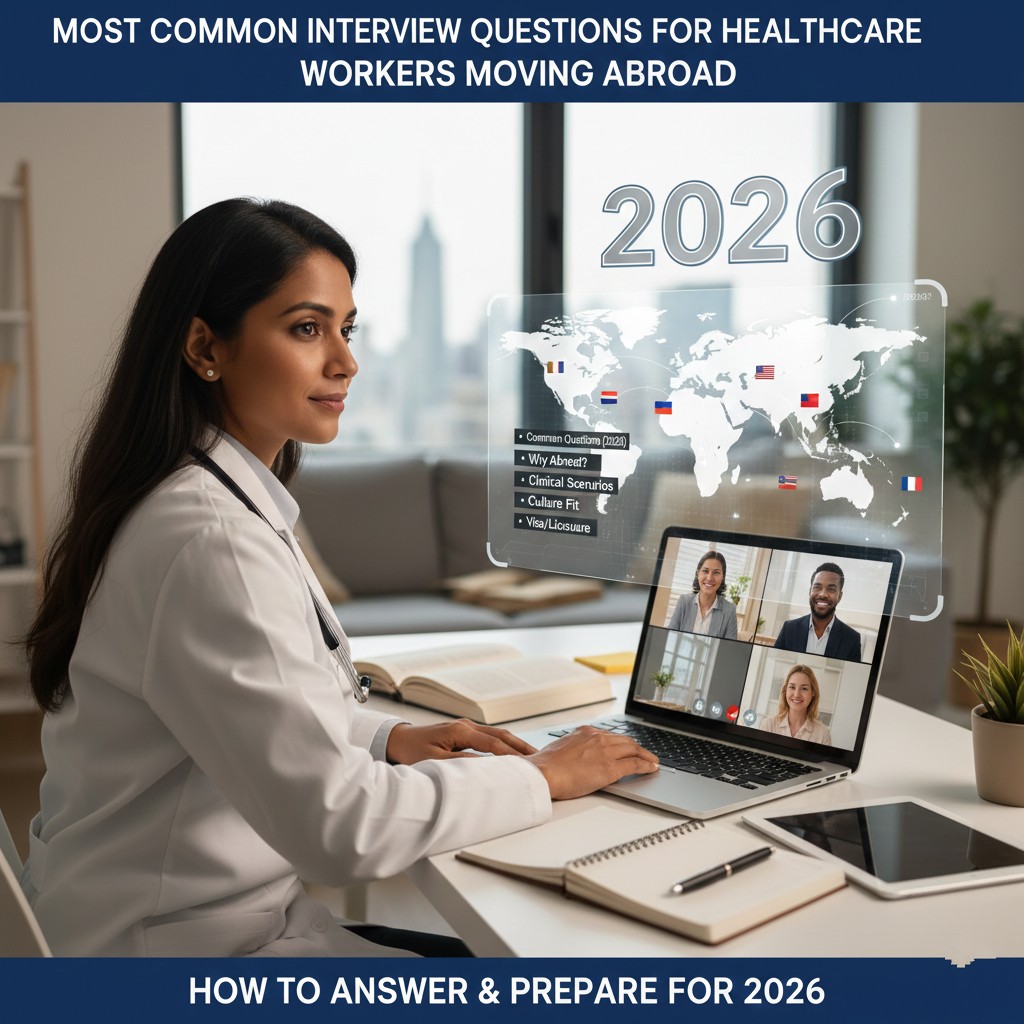
Most Common Interview Questions for Healthcare Workers Moving Abroad: How to Answer & Prepare for 2026

Securing a job interview for a healthcare position abroad is a huge achievement. But the interview itself can feel daunting. International healthcare interviews are unique; they assess not only your clinical skills but also your cultural adaptability, communication, and motivation for moving.

This guide breaks down the most common interview questions for healthcare workers moving abroad, providing strategic insights and sample answers to help you confidently prepare and land your dream job.

Why International Healthcare Interviews Are Different

Employers abroad are investing significantly in your relocation and visa sponsorship. They need to be sure you are:

  • Clinically Competent: Your skills meet their national standards.
  • Culturally Adaptable: You can integrate into a new healthcare system and society.
  • Committed for the Long-Term: You’re less likely to leave quickly, ensuring a return on their investment.
  • A Safe Practitioner: You understand and will adhere to their legal and ethical frameworks.

The 5 Key Question Categories & How to Answer Them

Prepare for questions in these five critical areas.

Category 1: Motivation & Commitment

These questions probe your reasons for moving and your long-term plans.

1. “Why do you want to work in [Country] specifically, and not somewhere else?”

  • What They’re Really Asking: Are you genuinely interested in our country, or are you just applying everywhere?
  • How to Answer: Show you’ve done your research. Combine professional and personal reasons.
  • Sample Answer Framework: “I’m particularly drawn to [Country] for two main reasons. Professionally, I deeply respect the [mention something specific, e.g., the NHS’s ethos of free healthcare at the point of delivery / Canada’s patient-centred model]. Personally, I’m excited about [mention a cultural or lifestyle aspect, e.g., the work-life balance, the natural landscape, the vibrant cities] and see it as a place where my family and I can build a long-term future.”

2. “Where do you see yourself in 5 years?”

  • What They’re Really Asking: Will you stay with us, or is this a temporary stop?
  • How to Answer: Express a desire for growth and stability within their system.
  • Sample Answer Framework: “In five years, my goal is to be a fully integrated and valuable member of your team. I hope to have progressed to a [mention a realistic senior role, e.g., Senior Staff Nurse, Team Lead], and to be mentoring new international staff, just as I hope to be mentored when I first arrive. I am committed to putting down roots in [Country] and building my career here long-term.”

Category 2: Clinical Knowledge & Competence

These questions verify your technical skills and clinical judgment.

3. “Describe a complex clinical situation you managed. What was your role, and what was the outcome?”

  • What They’re Really Asking: Can you apply your knowledge under pressure? Do you practice safely and effectively?
  • How to Answer: Use the STAR method (Situation, Task, Action, Result).
    • Situation: Briefly set the scene. “I was caring for a post-operative patient who suddenly became short of breath and hypotensive.”
    • Task: What was your goal? “My immediate task was to stabilise the patient and identify the cause.”
    • Action: What did you actually do? This is the most important part. “I immediately elevated the head of the bed, administered oxygen, and alerted the senior doctor. I performed a focused assessment, suspecting a pulmonary embolism, and ensured all necessary preparations were made for a potential transfer to the ICU.”
    • Result: What was the outcome? “The patient was diagnosed with a PE and received timely treatment. My swift assessment and escalation were credited with preventing a worse outcome.”

4. “How do you stay current with evidence-based practice?”

  • What They’re Really Asking: Are you a lifelong learner who will adapt to our protocols?
  • How to Answer: Mention specific, credible sources.
  • Sample Answer Framework: *”I make it a priority to stay updated. I am subscribed to several professional journals like [mention 1-2, e.g., The Lancet, The American Journal of Nursing], and I regularly use online resources like UpToDate for point-of-care decisions. I also attend annual conferences and webinars relevant to my speciality to ensure my practice is always aligned with the latest evidence.”*

Click Here To Learn More: Best Destination To Immigrate To As a Healthcare Worker

Category 3: Cultural Adaptability & Communication

These are critical for international hires.

5. “This unit is very diverse. How will you adapt to working with colleagues and patients from different cultural backgrounds?”

  • What They’re Really Asking: Will you be a respectful and effective team member?
  • How to Answer: Show empathy, curiosity, and respect.
  • Sample Answer Framework: “I see diversity as a strength. I believe in approaching every patient and colleague with respect and an open mind. I am a keen observer and a good listener, and I’m not afraid to ask questions to better understand different cultural norms or communication styles to ensure I provide the most culturally sensitive care possible.”

6. “Describe a time you had a conflict with a colleague. How did you resolve it?”

  • What They’re Really Asking: Are you professional, emotionally intelligent, and a team player?
  • How to Answer: Focus on your communication and problem-solving skills, not on blaming the other person.
  • Sample Answer Framework: “I once disagreed with a senior colleague about a patient’s care plan. I requested a private moment to speak with you. I calmly explained my assessment and reasoning, and I actively listened to their perspective. We realised we both had the patient’s best interest at heart but had different approaches. We agreed to present both options to the attending physician and jointly decide on the best course of action forward. It taught me the importance of direct, respectful communication.”

Category 4: Understanding of the Local Healthcare System

This shows you’ve done your homework.

7. “What do you know about our healthcare system [e.g., the NHS, Medicare in Australia] and its current challenges?”

  • What They’re Really Asking: Have you made an effort to understand your new workplace?
  • How to Answer: Demonstrate specific, well-researched knowledge.
  • Sample Answer Framework: “I understand that the NHS is a publicly funded system providing free care at the point of delivery. I’m aware that, like many health systems, it faces challenges such as high patient demand, waiting lists, and workforce pressures. I’m impressed by its commitment to clinical governance and patient safety, and I’m motivated to contribute my skills to help meet these challenges.”

Category 5: Scenario & Ethical Questions

These test your judgment and knowledge of local protocols.

8. “A patient’s family member is demanding information, but the patient has not given consent. What do you do?”

  • What They’re Really Asking: Do you understand patient confidentiality and consent laws?
  • How to Answer: Prioritise patient confidentiality and follow protocol.
  • Sample Answer Framework: “My first duty is to protect patient confidentiality. I would politely explain to the family member that I cannot disclose any information without the patient’s explicit consent. I would then inform the patient of the request and, if they are willing, facilitate a conversation where they can share what they are comfortable with. I would also document the interaction according to hospital policy.”

9. “What will be the biggest challenge for you in moving here, and how do you plan to overcome it?”

  • What They’re Really Asking: Are you self-aware and resilient?
  • How to Answer: Be honest but positive, showing a proactive plan.
  • Sample Answer Framework: “I anticipate the biggest initial challenge will be learning the nuances of the new electronic health record system and some of the local medication brand names. However, I’m a quick learner and I plan to overcome this by actively seeking training, asking my colleagues for support, and creating my own personal reference guides until I become proficient. I see it as a short-term hurdle on the path to long-term success.”

Your Pre-Interview Checklist

  • Research: The hospital/trust, the country’s healthcare system, and the local area.
  • Practice: Rehearse your answers to these common questions aloud.
  • Prepare Your Own Questions: Ask insightful questions like:
    • “What does your orientation and mentorship program for international hires look like?”
    • “What are the biggest opportunities for professional development here?”
    • “Can you describe the culture of the team I’d be working with?”
  • Tech Check: For virtual interviews, test your camera, microphone, and internet connection. Choose a quiet, professional-looking background.
  • Mind the Time Zone! Double-check the interview time and time zone difference.

Final Tips for Success

  • Be Authentic: Let your passion for care and your genuine interest in the role shine through.
  • Be Positive: Frame challenges as learning opportunities.
  • Show Gratitude: Send a personalised thank-you email within 24 hours.

Preparation is the key to confidence. By mastering these questions, you’ll demonstrate that you are not just a skilled clinician, but a resilient, adaptable, and committed professional—exactly what international employers are looking for.

Good luck! You’ve got this.

Best Destination To Immigrate to as a Healthcare Worker

For doctors, nurses, and allied health professionals, the world is full of opportunity. But with so many countries actively recruiting, how do you choose the best destination for your career, lifestyle, and future? The right country balances a high salary with a straightforward path to permanent residence and a manageable licensing process.

This definitive 2025 guide ranks the top countries for healthcare worker immigration based on three critical factors: Salary Potential, Ease of Permanent Residence (PR), and Licensing Process Simplicity.

How We Ranked the Countries

We evaluated each destination on a 5-star scale across three key pillars:

  • 💰 Salary & Benefits: Average compensation, overtime potential, and benefits like paid leave.
  • 🛂 PR Pathway: How clear, fast, and reliable the immigration pathway is for skilled healthcare workers.
  • 📜 Ease of Licensing: The complexity, cost, and duration of converting your credentials to work in that country.

1. Canada: The All-Round Champion

Overall Rating: ★★★★★ (5/5)

Canada remains a top contender due to its aggressive immigration strategy aimed directly at filling healthcare shortages nationwide.

  • 💰 Salary & Benefits: ★★★★☆ (4/5)
    • Registered Nurses: CA$70,000 – CA$100,000+
    • General Practitioners: CA$200,000 – CA$300,000+
    • Why it’s great: Strong public healthcare system, unionised positions, and good benefits. Slightly lower base salaries than in the US, but balanced by a lower cost of living in many regions.
  • 🛂 PR Pathway: ★★★★★ (5/5)
    • Why it’s #1: Canada has the most straightforward and welcoming immigration system.
    • Express Entry Healthcare Draws: Targeted invitations for healthcare workers with lower score requirements.
    • Provincial Nominee Programs (PNPs): Dedicated streams for doctors and nurses in almost every province (e.g., Ontario, British Columbia).
    • Permanent residence is often granted upfront, providing immediate stability.
  • 📜 Ease of Licensing: ★★★★☆ (4/5)
    • The process is well-structured but can be lengthy and expensive.
    • For Nurses: Requires passing the NCLEX-RN and applying through the National Nursing Assessment Service (NNAS) and a provincial college.
    • For Doctors: Involves exams through the Medical Council of Canada (MCC) and a residency match, which is highly competitive for specialists.
    • Pro Tip: Start the licensing process 1-2 years before you plan to move.

2. Australia: The High-Earning Paradise

Overall Rating: ★★★★☆ (4.5/5)

Australia offers fantastic salaries and an incredible quality of life, though its licensing can be a significant hurdle.

  • 💰 Salary & Benefits: ★★★★★ (5/5)
    • Registered Nurses: AU$75,000 – AU$110,000+
    • General Practitioners: AU$250,000 – AU$350,000+
    • Why it’s great: Some of the highest healthcare salaries in the world, strong worker protections, and generous paid time off.
  • 🛂 PR Pathway: ★★★★☆ (4/5)
    • The General Skilled Migration program and state-nominated visas provide clear pathways.
    • Healthcare occupations are consistently on the priority skills lists.
    • The process is points-based and competitive, but invitations are frequent for health professionals.
  • 📜 Ease of Licensing: ★★★☆☆ (3/5)
    • This is Australia’s main challenge. The Australian Health Practitioner Regulation Agency (AHPRA) has rigorous standards.
    • Requires a thorough assessment of qualifications and often a period of supervised practice.
    • Can be a time-consuming and costly process, but it’s very well-organised.

3. United Arab Emirates (UAE): The Tax-Free Haven

Overall Rating: ★★★★☆ (4/5)

The UAE (especially Dubai and Abu Dhabi) offers a unique blend of tax-free income, luxury, and a high-paced, international environment.

  • 💰 Salary & Benefits: ★★★★★ (5/5)
    • Registered Nurses: AED 120,000 – AED 180,000+ (US$32,000 – US$49,000+) Note: Often tax-free and includes accommodation allowances.
    • Specialist Doctors: AED 360,000 – AED 600,000+ (US$98,000 – US$163,000+) tax-free.
    • Why it’s great: No income tax, lucrative benefits packages that often include free housing, flight allowances, and private health insurance.
  • 🛂 PR Pathway: ★★★☆☆ (3/5)
    • The UAE has recently introduced long-term residency visas (Golden Visas) for professionals, including healthcare specialists.
    • However, it is not a pathway to citizenship, and residency is typically tied to employment.
    • It’s best for those seeking to work abroad for a defined period to maximise savings.
  • 📜 Ease of Licensing: ★★★★☆ (4/5)
    • Requires passing a licensing exam like the HAAD (Health Authority Abu Dhabi) or DHA (Dubai Health Authority) exam.
    • The process is generally faster and more straightforward than in Western countries, but requires thorough document attestation.

4. United Kingdom: The Structured & Historic System

Overall Rating: ★★★★☆ (4/5)

The UK’s National Health Service (NHS) is a world-renowned institution that provides a structured career path and excellent training.

  • 💰 Salary & Benefits: ★★★☆☆ (3/5)
    • Registered Nurses (NHS Band 5): £28,000 – £35,000
    • General Practitioners: £65,000 – £98,000+
    • Why it’s great: Strong professional development, defined career bands, and a powerful pension scheme. Salaries are lower than in North America/Australia, but are balanced by strong worker rights.
  • 🛂 PR Pathway: ★★★★★ (5/5)
    • The Health and Care Worker visa is one of the best in the world for the profession.
    • It offers reduced application fees, fast processing, and most importantly, exemption from the Immigration Health Surcharge (IHS), saving thousands of pounds.
    • Leads to settlement (Indefinite Leave to Remain) after 5 years.
  • 📜 Ease of Licensing: ★★★★☆ (4/5)
    • For Nurses: The Nursing & Midwifery Council (NMC) process involves a computer-based test (CBT) and an objective structured clinical examination (OSCE). It’s rigorous but very structured.
    • For Doctors: The General Medical Council (GMC) pathway involves passing the PLAB exams or demonstrating equivalent competence.

Click Here To Learn More: Ultimate Guide to Credential Assessment for Healthcare Professionals

5. New Zealand: The Lifestyle Choice

Overall Rating: ★★★★☆ (4/5)

New Zealand is perfect for those who prioritise work-life balance, stunning nature, and a friendly culture.

  • 💰 Salary & Benefits: ★★★☆☆ (3/5)
    • Registered Nurses: NZ$60,000 – NZ$90,000
    • General Practitioners: NZ$120,000 – NZ$200,000+
    • Why it’s great: Unbeatable work-life balance, a focus on well-being, and a safe, beautiful environment. Salaries are lower, but the lifestyle is a key benefit.
  • 🛂 PR Pathway: ★★★★★ (5/5)
    • Healthcare is consistently on the Green List, providing a direct and prioritised pathway to residency.
    • This means you can apply for residence directly from overseas or after working in New Zealand for a short period.
  • 📜 Ease of Licensing: ★★★★☆ (4/5)
    • Similar to Australia, the process is managed by a central body for most professions (e.g., Nursing Council of New Zealand).
    • It requires a qualification assessment and often a competency assessment program or bridging course. The process is transparent and well-supported.

Comparison Table at a Glance (2025)

CountryAvg. Nurse Salary (USD)PR Pathway ClarityLicensing DifficultyBest For
Canada$52,000 – $75,000ExcellentMediumOverall stability & community
Australia$50,000 – $73,000Very GoodHighMaximizing earnings & adventure
UAE$32,000 – $49,000+ (Tax-Free)GoodMediumTax-free savings & luxury lifestyle
UK$35,000 – $44,000ExcellentMediumStructured career & history
New Zealand$37,000 – $55,000ExcellentMediumUnbeatable work-life balance

Note: Salaries are approximate and can vary widely by experience, speciality, and region.

How to Choose the Best Country for YOU

Ask yourself these questions:

  1. What is your primary goal? Maximum savings (UAE), fastest PR (Canada/NZ), or career prestige (USA/Australia)?
  2. What kind of lifestyle do you want? Fast-paced city (UAE, UK), outdoor adventure (NZ, Canada), or sunny beaches (Australia)?
  3. How quickly do you need to be licensed? If speed is critical, the UAE or the UK may have faster processes than Canada or Australia.

Your 2025 Action Plan

  • Self-Reflect: Decide on your top priorities (Salary, PR, or Lifestyle).
  • Shortlist 2-3 Countries from this list that match your goals.
  • Research Licensing Bodies: Visit the official websites for your profession in those countries.
  • Check Immigration Portals: Look at the official immigration websites (e.g., IRCC for Canada, Home Office for UK) to understand visa requirements.
  • Start the Process: Begin credential evaluation and language testing for your top-choice country.

The global demand for your skills guarantees that you have excellent options. By focusing on the factors that matter most to you, you can make an informed decision and embark on a successful international healthcare career in 2025.

The world needs your skills. Where will you take them?

Australia Skilled Migration 2025: Everything You Need to Know About Visa Pathways & Requirements

Dreaming of a life Down Under? You’re not alone. Australia’s robust economy, stunning landscapes, and high quality of life continue to make it a top destination for skilled professionals worldwide. However, the Australian skilled migration landscape is constantly evolving.

Staying updated on the latest changes is crucial for a successful application. This definitive Australia PR guide for 2025 breaks down the latest updates, points requirements, and pathways to help you navigate your journey to becoming a skilled migrant in Australia.

Why Choose Australia for Skilled Migration in 2025?

Australia is actively seeking talented individuals to fill skill shortages and drive its economy forward. The 2024-25 Migration Program planning level is set at 185,000 places, with a significant portion allocated to skilled streams. For those with the right qualifications, this represents a golden opportunity.

The Core of the System: The Points Test

Most permanent skilled visas use a points-based system. Your score determines your competitiveness for an invitation. For 2025, maximizing your points is more critical than ever. Here’s a breakdown of the key factors:

Points CriteriaMaximum Points
Age (25-32 years)30 points
Superior English (IELTS 8 or equivalent)20 points
Skilled Employment (8-10 years overseas)15 points
Skilled Employment (8-10 years in Australia)20 points
Qualifications (PhD)20 points
Study in a Regional Australia5 points
Professional Year in Australia5 points
Credentialed Community Language5 points
Partner Skills10 points
Total (Example)Can exceed 100

Key Changes & Focus Areas for 2025:

  • Emphasis on Onshore Applicants: Candidates with skilled work experience in Australia are awarded more points than comparable overseas experience.
  • Higher English Proficiency Rewarded: Achieving “Superior” or “Proficient” English scores is no longer just an advantage; it’s a necessity for a competitive points tally.
  • Specialized Skills are King: The system is increasingly designed to select candidates with specific, in-demand qualifications and experience.

Key Skilled Migration Visas for 2025

Here are the primary skilled worker visas you should be targeting.

1. Subclass 189 – Skilled Independent Visa

This is the “gold standard” for many applicants. It is a permanent residence visa that does not require nomination by a state or territory, or sponsorship by an employer.

  • Requirements:
    • Be invited to apply.
    • Have an occupation on a relevant skilled occupation list.
    • Have a positive skills assessment for your nominated occupation.
    • Score at least 65 points on the points test (though the actual invitation score is often higher).
  • 2025 Outlook: Invitation rounds are expected to be highly targeted towards specific sectors like Healthcare, Technology, and Engineering. A high points score (likely 85+) will be essential.

2. Subclass 190 – Skilled Nominated Visa

This is a permanent residence visa for skilled workers who are nominated by an Australian state or territory government.

  • Requirements:
    • Same core requirements as the Subclass 189.
    • Must be nominated by a state/territory.
    • Must commit to living in the nominating state for your first two years.
  • 2025 Outlook: This remains a highly viable pathway, especially if your occupation is on a state-specific shortage list. Each state (e.g., NSW, VIC, QLD) has its own unique criteria and “wish lists.”

3. Subclass 491 – Skilled Work Regional (Provisional) Visa

This is a 5-year provisional visa for skilled workers who want to live and work in regional Australia. It is a key pathway for those who may not have enough points for a 189 or 190 visa.

  • Requirements:
    • Nominated by a state/territory OR sponsored by an eligible family member living in a designated regional area.
    • Score at least 65 points (including the nomination bonus).
  • 2025 Outlook: The Subclass 491 visa is a strategic choice. It offers an additional 15 points upon nomination. After living and working in a regional area for 3 years, you can apply for the Permanent Residence (Subclass 191) visa.

Click Here To Learn More: Understanding The Common Causes Of UK Visa Refusal And How To Avoid Them

Step-by-Step Application Process for 2025

Navigating the Australia immigration 2025 process requires a meticulous approach.

  1. Skills Assessment: This is your first and most critical step. You must have your qualifications and work experience assessed by the designated authority for your occupation (e.g., Engineers Australia for engineers, ACS for IT professionals).
  2. Submit an Expression of Interest (EOI): Create and submit an EOI through the online SkillSelect system. This is where you detail your points and claim.
  3. Receive an Invitation to Apply (ITA): If you score high enough and meet the current migration needs, you will receive an ITA from the Department of Home Affairs.
  4. Lodge Your Visa Application: Once invited, you have 60 days to lodge a formal visa application, including all supporting documents like police checks and health examinations.
  5. Visa Grant: After processing, which can take several months, you will be granted your visa!

Top In-Demand Occupations for 2025

While the official skilled occupation lists (MLTSSL, STSOL, ROL) are updated regularly, the following sectors are consistently in high demand:

  • Healthcare: Registered Nurses, General Practitioners, Psychiatrists
  • Technology: Software Engineers, Data Scientists, Cybersecurity Specialists
  • Engineering: Civil Engineers, Mechanical Engineers, Electrical Engineers
  • Trades: Electricians, Plumbers, Carpenters
  • Education: Secondary School Teachers, Special Education Teachers

Common Pitfalls to Avoid in Your 2025 Application

  • Incorrect Points Calculation: Overclaiming points is a serious offence that can lead to a ban. Be conservative and evidence-based.
  • Poor Documentation: Ensure that all your documents, especially those related to skills assessment and work experience, are thorough and accurately match the requirements.
  • Underestimating Processing Times: Plan well ahead. The entire process from skills assessment to visa grant can take 12-24 months.
  • Ignoring State-Specific Opportunities: Regularly check the state nomination websites, as their criteria and open/close dates can change frequently.

Final Checklist for Your 2025 Australia Skilled Migration Journey

  • Researched and chosen an eligible skilled occupation.
  • Initiated the skills assessment process with the relevant authority.
  • Booked and achieved a competitive English language test score (IELTS, PTE, or TOEFL).
  • Calculated your points accurately (aim for 80 or higher to be competitive).
  • Prepared all required documents (passport, degree certificates, employment references, etc.).
  • Submitted a detailed and accurate EOI in SkillSelect.
  • Monitored state nomination opportunities for Subclass 190/491 visas.

The path to Australia’s skilled migration in 2025 is competitive but far from impossible. With careful planning, a focus on maximizing your points, and a clear understanding of the updated requirements, you can turn your Australian dream into a reality.

Need more personalized guidance? Consider consulting a registered migration agent (MARA) for advice tailored to your specific circumstances.

Understanding the Common Causes of UK Visa Refusal and How to Avoid Them

UK visas are among the most sought-after immigration permissions in the the world. Yet every year, thousands of applicants are refused—sometimes for reasons that are avoidable. A visa refusal can be emotionally and financially draining, and it may negatively affect future applications.

To attract readers (and ideally millions), your blog post should not only provide deep, insightful content but also be well structured, rich in relevant keywords, and truly helpful. In this post, we lay out the most common causes of UK visa refusals across visitor, student, work, and family/partner routes. Then we explain how to avoid them, what to do after refusal, and tips to build an iron-clad application the next time.

SEO Tip: Use “UK visa refusal,” “UK visa rejection reasons,” “why was my UK visa refused,” “UK visa refusal 2025,” etc., as your target keywords. Place them in headings, subheadings, introductory paragraphs, and alt texts of images.

Table of Contents

  1. Why UK Visa Refusals Happen
  2. General Grounds for Refusal (Across All Visa Types)
  3. Visitor / Tourist Visa Refusals: Key Pitfalls
  4. Student Visa Refusals: What Goes Wrong
  5. Work / Skilled / Temporary Visa Refusals
  6. Family / Partner / Spouse Visa Rejections
  7. Common Mistakes & Administrative Errors
  8. The Role of Credibility & Misrepresentation
  9. Past Immigration or Visa History
  10. Health, Criminal Record, and Suitability Issues
  11. What to Do After a Refusal
  12. How to Strengthen Your Next Application
  13. SEO & Blog Promotion Tips (so your post reaches millions)
  14. FAQs
  15. Conclusion

1. Why UK Visa Refusals Happen

Visa officers and caseworkers evaluate applications under immigration rules, Home Office guidance, and suitability criteria. If you fail to meet any one requirement, your visa can be refused. Sometimes the reasons are obvious (lack of funds); sometimes they are subtle (document discrepancy, credibility doubts).

Refusal letters generally explain the legal or factual basis for refusal, and whether you have a right to appeal or administrative review. (GOV.UK)

Understanding the roots of refusal can help you build stronger subsequent applications.

2. General Grounds for Refusal (Across All Visa Types)

Some refusal grounds are common to virtually all visa categories:

2.1 Failure to Provide Required Information / Documents

If you omit critical documents, fill forms incompletely, or fail to attend biometric appointments or interviews, the caseworker may refuse outright. (GOV.UK)

2.2 False Representations or Misrepresentations

Submitting forged, altered, or false documents—or giving inconsistent or misleading statements—can lead to visa refusal, and often carry serious consequences (e.g. ten-year ban). (GOV.UK)

2.3 Breach of Immigration Laws / Previous Violations

If you have previously overstayed, violated visa conditions, or broken immigration rules, this weighs heavily against you. (GOV.UK)

2.4 Purpose Not Covered by the Immigration Rules

If your intended purpose (e.g. type of work, type of activity) is not allowed under the visa route you applied to, the application can be refused. (GOV.UK)

2.5 Suitability & Additional Grounds

Even if you meet formal eligibility, a caseworker might refuse under “suitability” grounds: e.g. health, criminal record, public policy, national security, or the risk of needing public funds. (GOV.UK)

These general grounds form the backbone; now, let’s see how they play out in specific visa types.

3. Visitor / Tourist / Visit Visa Refusals: Key Pitfalls

Visitor visas (also called Standard Visitor) often get refused because of issues around genuineness, funds, ties to the home country, and clarity of travel plans. (Richmond Chambers)

3.1 Unclear Purpose of Visit

If your travel plan, itinerary, and reason for visiting (tourism, visiting relatives, short courses) are vague or unsupported by evidence, the caseworker may doubt your intention. (Richmond Chambers)

3.2 Doubts about “Genuine Visitor”

The Home Office requires you to satisfy them that:

  • You will leave the UK at the end of your visit
  • You are not making the UK your home by frequent successive visits
  • You are coming for a permitted purpose
  • You won’t work or access public funds illegally. (Richmond Chambers)

If your travel history or ties seem weak, it raises red flags. (House of Commons Library)

3.3 Insufficient Funds / Financial Evidence

You must show you can afford the trip, pay for accommodation, living costs, and return travel. If your bank statements are weak, incomplete, or unclear, refusal is likely. (Richmond Chambers)

3.4 Lack of Ties to Home Country

If you don’t show strong ties—job, business, property, family responsibilities, or other commitments—caseworkers may fear you’ll overstay. (Immigration Advice Service)

3.5 History of Previous Visa Refusals or Overstays

A prior refusal or immigration history could make the caseworker more skeptical. (Immigration Advice Service)

3.6 Submission of False or Altered Documents

This includes fake bank statements, forged letters, or altered travel documents. Even small discrepancies can cause refusal. (Immigration Advice Service)

3.7 Criminal or Health Concerns

If you have a criminal record (depending on severity) or a health condition that might pose a public health risk, refusal is possible. (Immigration Advice Service)

3.8 Inconsistent or Contradictory Information

If details in your application conflict (dates, names, prior visits) or are inconsistent with supporting documents, that undermines credibility. (DavidsonMorris | Solicitors)

4. Student Visa Refusals: What Goes Wrong

Student visas (Tier 4 / Student route) are heavily scrutinized in terms of finances, course legitimacy, visa history, and credibility.

4.1 Insufficient Maintenance Funds / Financial Evidence

One of the top reasons student visas are refused is not proving you have enough funding. The funds often must be present for 28 continuous days prior to application, and statements must be fresh (often within 31 days). (University of Huddersfield)
If statements are out of date, fluctuating, or show unexplained deposits, it could lead to rejection. (University of Huddersfield)

4.2 Course and Institution Concerns

If the course isn’t recognized or meets the UK’s approved institution standards, or if caseworkers doubt the progression (e.g. purpose, relevancy), refusal can happen.

4.3 Doubts about Study Intentions (Credibility)

If the caseworker suspects you’re not coming genuinely to study (i.e. come to stay or work), they may refuse. Weak statements, a contradictory background, or a poor justification for course choice can hurt.

4.4 Previous Immigration / Visa History

If you have previously overstayed, been removed, or refused, it will count against you.

4.5 Administrative / Documentary Mistakes

Missing transcripts, wrong format, outdated documents, lack of English test proof—these are common pitfalls.

5. Work / Skilled / Temporary Visa Refusals

Work or skilled visas (e.g. Skilled Worker, SPS, Intra-company Transfer) have their own strict requirements. Key refusal causes include:

5.1 Failing to Meet Eligibility Criteria

If your job role doesn’t match the required occupation codes, salary thresholds, or required experience, the application will be refused.

5.2 Incorrect or Inadequate Certificate of Sponsorship (CoS)

The sponsoring employer must supply a valid CoS. If it’s wrongly issued or misclassified, refusal can result.

5.3 Salary Too Low / Financial Threshold Not Met

Many work visas require the applicant or employer to pay a minimum salary. If you do not meet it, or the employer doesn’t show the ability to pay, refusal is likely.

5.4 Incomplete Documentation or Qualification Proof

If you cannot prove qualifications, translations, accreditation, or prior experience, the caseworker may refuse.

5.5 Credibility / Misrepresentation

Inconsistencies in a resume, job history, or employer statements can lead to doubts.

5.6 Labour Market & Compliance Issues

If the sponsoring employer is non-compliant with immigration or labour laws, or is under investigation, your application might be refused even if you are qualified.

6. Family / Partner / Spouse Visa Rejections

Partner, spouse, or family visas are especially scrutinized for relationship genuineness, financials, and immigration compliance. (Total Law)

6.1 Lack of Genuine and Subsisting Relationship

If the Home Office doesn’t believe your relationship is real (or ongoing), they may refuse. You need evidence: joint finances, cohabitation, communications, and photos. (Total Law)

6.2 Failure to Meet Financial Requirements

Spouse visa routes typically require a minimum combined (or sponsor) income threshold. If you don’t meet it or fail to document properly, it will be refused. (Total Law)

6.3 English Language Requirements

Many partner visas require proof of English ability (e.g. tests). If you fail to show this, refusal follows. (Total Law)

6.4 Sponsor’s Immigration Status

Your sponsor must be a British citizen, have settled status, or have refugee/humanitarian protection. If they don’t, you may be ineligible. (Total Law)

6.5 Previous Relationships, Divorce or Marital History

Failure to prove the end of prior relationships or reconcile marital history can lead to rejection.

6.6 Documentation Mistakes, Unsupported Claims

Even in partner cases, missing letters, mismatched names, or unsorted documents can doom an application.

7. Common Mistakes & Administrative Errors

Many visa refusals are not due to major legal issues but simple avoidable mistakes:

  • Incomplete or unsigned forms (A Y & J Solicitors)
  • Using the wrong type of visa (applying to a route you don’t qualify for) (Total Law)
  • Irregular or suspicious fund transfers (e.g. large sudden deposit just before application) (A Y & J Solicitors)
  • Documents not translated or certified properly
  • Documents not in chronological or logical order
  • Using old or outdated documents
  • Typographical or spelling errors, name mismatches and date errors
  • Not properly signing or dating statements

Such mistakes are often the difference between a grant and a rejection.

8. The Role of Credibility & Misrepresentation

One of the overarching themes in refusal decisions is credibility. Even if you technically satisfy requirements, if the caseworker doubts your honesty, your application can fail.

8.1 Contradictory Statements

If your application, supporting letters, previous visa applications, or interviews contradict each other, that raises red flags.

8.2 Sudden or Unexplained Financial Changes

Large, unexplained deposits or irregular account behaviour make officers question the legitimacy of your funds.

8.3 Weak or Vague Supporting Evidence

If your letters, emails, photos, or claims are generic or unconvincing, credibility suffers.

8.4 Over-embellishment or Exaggeration

If you overstate job roles, incomes, or achievements, and that is inconsistent with documents, you risk refusal.

8.5 Inexperience with Immigration Nuances

If you don’t understand the rules, you may inadvertently misstate or misapply. That can be perceived as dishonesty rather than ignorance.

9. Past Immigration or Visa History

Your previous immigration behaviour is heavily weighted in decisions:

  • Past visa refusals, especially with similar routes
  • Overstays in the UK or other countries
  • Deportation or removal history
  • Violations of visa terms (working when prohibited, changing status without permission)
  • Breach of conditions, or failure to report changes

Caseworkers often look at patterns in your immigration record to assess risk.

10. Health, Criminal Record, & Suitability

Beyond eligibility, visa decision makers check suitability:

10.1 Criminal Record

Certain convictions, especially serious ones, may render you ineligible or lead to refusal. Minor offences may require disclosure and explanation.

10.2 Health Issues / Public Health Risks

If you have certain communicable diseases or conditions that pose a burden on public services, refusal may follow.

10.3 Public Policy or Security Concerns

If you are seen to pose a threat (security, public order) or have a history of fraud, that can lead to refusal.

10.4 Likelihood of Dependence on Public Funds

If the Home Office believes you may need welfare, you could be refused under suitability grounds.

11. What to Do After a Refusal

11.1 Read the Refusal Letter Carefully

It will (or should) explain the grounds for refusal, which helps you understand where your application fell short. (GOV.UK)

11.2 Check if You Have Appeal or Administrative Review Rights

Some visa routes permit appeals or administrative review (i.e. asking the Home Office to re-check for errors). Others do not. (GOV.UK)

11.3 Assess Whether to Reapply or Appeal

If your grounds are technical (missing doc) it may be better to reapply. If you see a legal or factual mistake by the decision maker, a review or appeal may be viable.

11.4 Address Every Issue Point by Point

In your next submission or appeal, explicitly address each refusal reason with new or better evidence.

11.5 Seek Professional Advice

Immigration lawyers or expert advisors can help you interpret the refusal, strategize, and draft better applications.

11.6 Don’t Rush to Reapply

If you reapply too quickly without fixing problems, you risk compounding negative history.

12. How to Strengthen Your Next Application

Here are the best practices to build a stronger application:

12.1 Use a Comprehensive Checklist

List all required documents per visa rules and tick them off so nothing is omitted.

12.2 Organize Documents Logically

Group by type (identity, financials, immigration history, relationship) and keep them chronological.

12.3 Translate & Certify Where Required

All non-English documents must be translated by certified translators, and originals must be available.

12.4 Explain Unusual Aspects

If you have gaps in employment, sudden fund deposits, or unconventional background, include a clear statement/explanation with supporting evidence.

12.5 Provide Strong Ties to Home Country

Show job, business, family, property, educational commitments, or any binding responsibilities that compel your return.

12.6 Use Reliable Financial Evidence

Ensure funds remain stable for required periods, avoid large last-minute deposits, use audited statements, and show the origin of funds.

12.7 Consistent & Honest Statements

Ensure all statements, forms, questionnaire answers, supporting letters, and evidence are internally consistent.

12.8 Use Expert Help Where Needed

A seasoned immigration adviser or lawyer can help align the application with current policy, spot weak points, and guide corrections.

12.9 Keep Up to Date with Rule Changes

UK immigration rules change often. Always verify the latest criteria, thresholds, and formats.

12.10 Include a Cover Letter or Summary

A short but clear cover letter summarizing the purpose, structure, and contents can help the caseworker follow your logic.


14. Frequently Asked Questions (FAQs)

Q: Will a visa refusal permanently ruin my chances?
A: Not necessarily. Many people successfully reapply after refusal, provided they address the issues raised and rebuild credibility.

Q: Can I appeal every type of visa refusal?
A: No — appeal rights depend on the visa route. Some visas allow appeals or administrative reviews; others only permit a fresh application. (GOV.UK)

Q: If I reapply, should I change visa category?
A: Only if your purpose genuinely changes and you qualify for a different route. Applying under the wrong category can lead to refusal.

Q: How long should I wait before reapplying?
A: There’s no universal waiting period. But reapplying too soon without new evidence often repeats a refusal.

Q: Do I need a lawyer for an appeal or a reapplication?
A: While not strictly required, a specialist immigration adviser or lawyer can greatly improve your chances by spotting risk areas and drafting strong submissions.

Q: Will an old criminal conviction always be a refusal?
A: It depends on severity, how long ago, and whether you can show rehabilitation. Minor or spent convictions may be accepted with an explanation.


15. Conclusion

Visa refusals are painful, but often avoidable. The difference between rejection and acceptance frequently lies in attention to detail, strong supporting evidence, a credible narrative, and alignment with immigration rules. By understanding the common causes—document mistakes, weak finances, credibility doubts, history issues—you can craft stronger next applications.