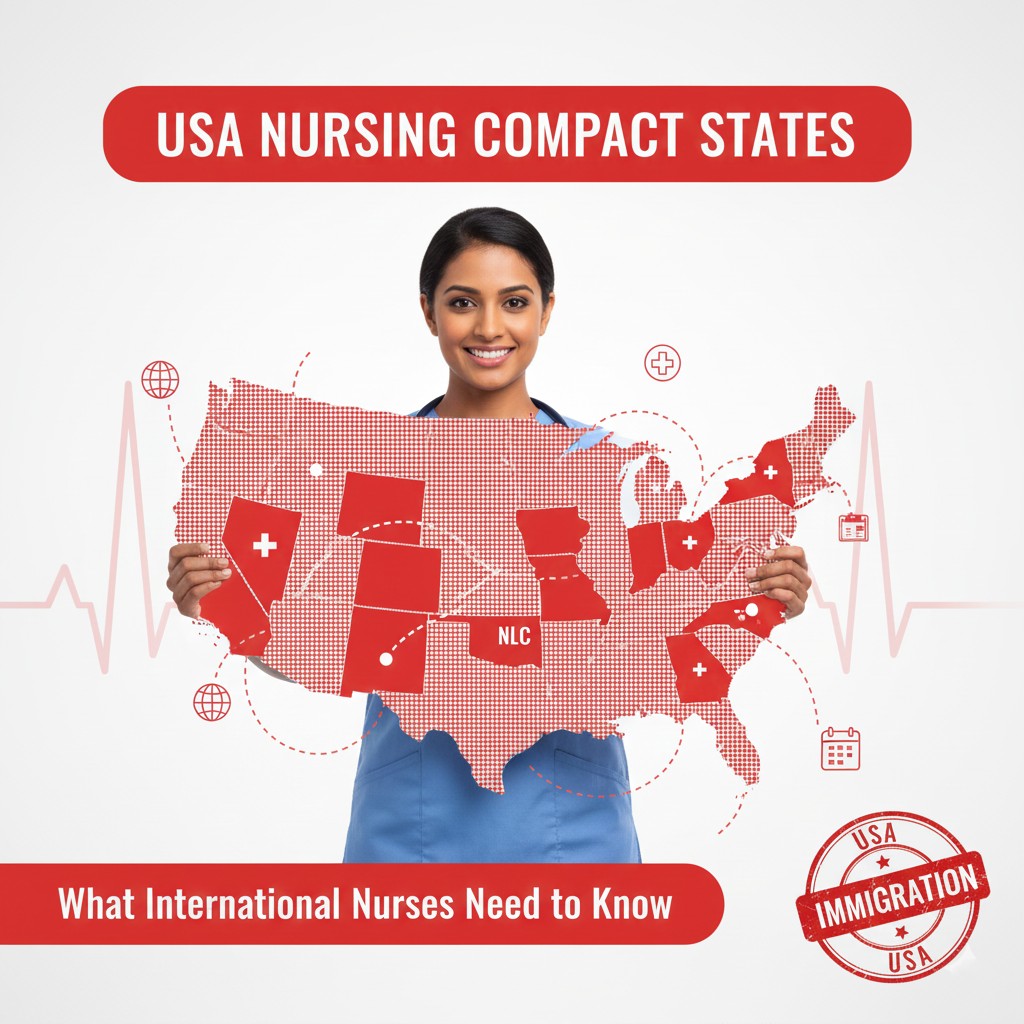
USA Nursing Compact States: What International Nurses Need to Know

If you’re an international nurse considering moving to the United States — or already working in US healthcare — understanding Nursing Compact States is essential. This guide breaks down what the Nurse Licensure Compact (NLC) is, which states are part of it, how it affects licensure mobility, and what you should know before you apply or relocate.
✅ What Is the Nurse Licensure Compact (NLC)?
- The NLC is an interstate agreement among many U.S. states that enables a nurse holding a license in one member state (their “home state”) to practice in any of the other member states — without the need for additional state-by-state licenses. Wikipedia+2Nurseslabs+2
- The license is often called a “compact license” or “multistate license.” It applies to both Registered Nurses (RNs) and Licensed Practical/Vocational Nurses (LPN/LVN). Nurseslabs+1
- This arrangement dramatically simplifies licensure requirements and increases mobility — a major advantage for travel nurses, permanent relocation, cross-state employment, and telehealth work. directshifts.com+1
Important limits:
- You must declare a primary state of residence (PSOR), which must be a compact state, to obtain a compact license. onlinenursing.baylor.edu+1
- If you move your primary residence to a different compact state, you must transfer (re-issue) your license under the new state within 60 days. NURSECOMPACT+1
- The NLC does not automatically cover advanced nursing roles like APRNs — those may require separate state-specific licensing (or other interstate agreements). NCSBN+1
🗺️ Which States Participate in the Compact (2025)?
As of 2025, there are 41 U.S. states and territories participating in the NLC — meaning they recognize compact licenses. Wikipedia+2Nursejournal.org+2
Here’s a non-exhaustive list of compact states (check official lists as statuses can change):
Examples of NLC States
Alabama, Arizona, Arkansas, Colorado, Delaware, Florida, Georgia, Idaho, Indiana, Iowa, Kansas, Kentucky, Louisiana, Maine, Maryland, Mississippi, Missouri, Montana, Nebraska, New Hampshire, New Jersey, New Mexico, North Carolina, North Dakota, Ohio, Oklahoma, South Carolina, South Dakota, Tennessee, Texas, Utah, Vermont, Virginia, Washington, West Virginia, Wisconsin, Wyoming … among others. Wikipedia+1
States/Territories with partial or pending implementation
Some jurisdictions have passed NLC legislation but are either awaiting full implementation or are in a transitional phase. Always check the official status before planning. Nursejournal.org+1
Non-NLC states (as of 2025):
A few states have not adopted the Compact license model — for example, states such as New York remain outside the NLC. Wikipedia+1
🎯 Why NLC Matters for International Nurses
🌟 Flexibility Across States
If you secure licensure in one compact state and designate it as your residence, you automatically get the right to practice in all other compact states — without recurring licensing procedures. This is ideal for travel nursing, cross-state job offers, contract work, or telehealth roles. Nurse.com+1
💲 Time & Cost Savings
You avoid repeated applications, background checks, fingerprinting, and licensing fees for each state you want to practice in. Instead, one multistate license suffices. directshifts.com+1
🏥 Better Job Opportunities & Mobility
Compact licensure gives you access to a much wider job market across multiple states — helpful for nurses seeking roles in underserved areas, seeking higher pay, or wanting geographic flexibility. online.utpb.edu+1
🚨 Emergency & Telehealth Readiness
In emergencies — pandemics, natural disasters, sudden staff shortages — compact licensed nurses can quickly relocate or deliver telehealth services across state lines, addressing urgent demand without licensure delays. directshifts.com+1
📝 What International Nurses Should Know When Trying to Obtain a Compact License
If you’re an internationally educated nurse and want to work in a U.S. compact state, here’s a rough roadmap — and important caveats:
✔️ Eligibility & Requirements
- Primary Residence in a Compact State: Your permanent address, driver’s license, taxes, and voter registration should match the compact state. onlinenursing.baylor.edu+1
- Graduate from an Approved Nursing Program: Your nursing education must meet the state’s standards. For foreign nursing credentials, your credentials might need evaluation.
- Pass Required Exams: Typically, passing the standard licensure exam (e.g., NCLEX-RN or NCLEX-PN) is required. directshifts.com+1
- Clean Record & Background Check: No active disciplinary issues, and often fingerprinting + background check clearance. directshifts.com+1
⚠️ Things to Watch Out For
- Residency vs. Practice State: Your compact license is tied to your state of legal residence. If you move your permanent residence to another state (even another compact state), you must transfer your license; otherwise, it becomes invalid for multistate practice privileges. NURSECOMPACT+1
- Non-Compact States Are a Different Game: If you want to practice in a state that’s not part of the compact (or a state pending implementation), you’ll likely need to apply for a separate state license (licensure by endorsement) for that state. Wikipedia+1
- Advanced/ Specialized Roles May Not Be Covered: The NLC covers standard RN and LPN licenses. Some advanced practice roles (e.g., nurse practitioners, APRNs) may require additional or separate licensure. NCSBN+1
- Regulations Vary by State: While the compact standardizes many requirements, scope-of-practice laws, licensing fees, and employment conditions may still differ by state.

🧭 Practical Advice for International Nurses Considering U.S. Work Under NLC
If you’re aiming to work in the U.S. under the compact system, here are actionable steps to maximize your chances:
- Select a compact state as your primary residence — research which compact states offer the best job market, licensing support, and living conditions.
- Ensure your credentials are evaluated — foreign nursing qualifications usually need an educational credential assessment before you are eligible for licensure.
- Prepare for and pass required licensure exams (e.g. NCLEX) or meet other state licensure requirements.
- Submit license application and background checks — make sure your license is clean and meets all requirements of the compact state.
- Verify compact status and license type — confirm you’ve been issued a “multistate license” (not a single-state license) under the NLC.
- Keep documentation updated, especially if you change residence — apply for license transfer immediately after move (within 60-day rule). NURSECOMPACT+1
- If interested in telehealth or travel nursing, pick compact states with wide employer networks, good demand, and favorable licensing laws.
📌 Key Takeaways (Why the NLC Matters Now)
- The NLC offers unprecedented flexibility and mobility for nurses across many U.S. states — a major advantage for internationally educated nurses.
- It reduces administrative burdens, licensing costs, and time delays, which often affect foreign-trained professionals entering the U.S. system.
- For travel nurses, telehealth, or cross-state employment — especially in 2025, with ongoing healthcare labor shortages — a compact license can open doors nationwide.
- Understanding residence-based rules is critical: compact licensure isn’t automatic just because you hold a U.S. nursing license — your residency, license type, and state participation all matter.
